

The federal government has begun marketing seven warehouses that Immigration and Customs Enforcement bought earlier this year for a planned nationwide expansion of immigration detention. The government spent more than $700 million to acquire the properties.
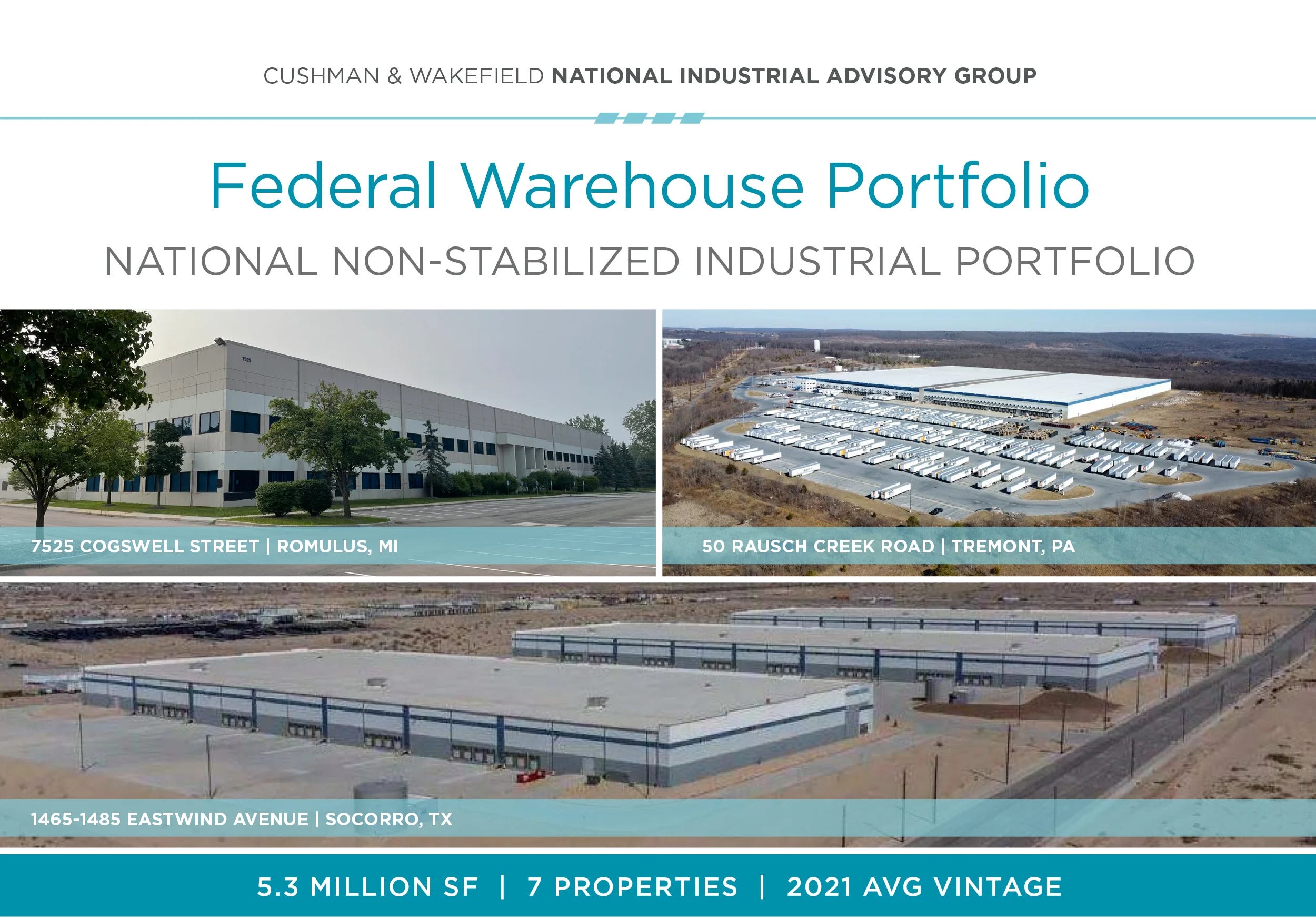
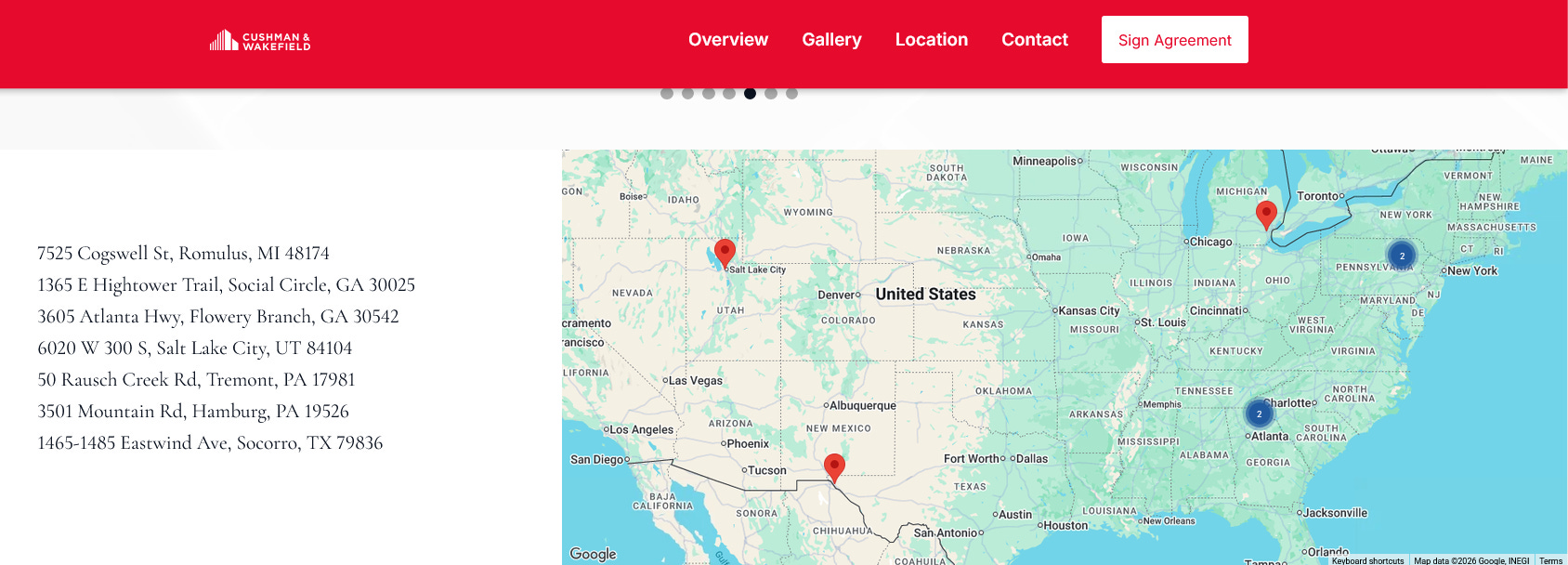
The seven properties are in Hamburg and Tremont, Pa.; Social Circle and Flowery Branch, Ga.; Socorro, Texas; Salt Lake City; and Romulus, Mich.
The listing describes the buildings as vacant and mostly new bulk distribution centers, with six of the seven built since 2018. It markets them to logistics and distribution companies and says they will be sold free of existing financing. The listing does not mention ICE or the government’s plans to use the buildings for detention.
Cushman & Wakefield is marketing the properties through a website called the Federal Warehouse Portfolio, offering the seven buildings individually or as a package.
A strategy built for speed and ‘cruelty’
The warehouse strategy was designed to let ICE expand detention capacity faster than traditional construction would allow.
Rather than build new facilities, the government bought large industrial buildings that could be converted into detention and processing centers. Internal documents described facilities ranging from short-term processing sites to so-called mega-centers capable of holding thousands of people.
Project Salt Box reported in March that the Hagerstown and Surprise, Arizona, warehouses were each being converted under contracts worth hundreds of millions of dollars. The Hagerstown facility was designed for an initial capacity of 540 detainees, and internal planning documents contemplated as many as 1,500.
Career officials inside ICE warned early that the plan would not work. In February, a federal procurement specialist with 25 years of experience in national security logistics told Project Salt Box that career staff believed the detention expansion was “doomed to failure.” The source, who spoke on condition of anonymity to avoid retaliation, said warnings from experienced civil servants were being overruled by political leadership that viewed “cruelty as the policy.”
According to the source, a senior ICE official had recommended buying federal property or former detention facilities that already had working utilities. Instead, the source said, the administration “went the wrong way and looked at warehouses,” largely because people with connections to the administration owned such sites and wanted to sell them. The Hagerstown warehouse had been allocated only enough water for a logistics operation, not for 1,500 people.
“ERO staff continues to state this is not a viable option, but they are consistently overruled,” the source said, referring to ICE’s Enforcement and Removal Operations division.
The speed of the purchases created its own problems.
In Hagerstown, federal officials completed an environmental review and approved the project on Jan. 15, one day before the government closed on the purchase. Project Salt Box later reported that ICE’s environmental analysis treated the proposed detention facility as functionally equivalent to the existing warehouse. ICE planned to turn the building into a secure, 24-hour residential facility with dormitories, medical care, kitchens and recreation areas.
A federal judge later halted the Hagerstown project after Maryland challenged the government’s environmental review. Similar legal challenges followed in Arizona, Michigan, New Jersey and elsewhere.
By spring, work on the Hagerstown and Surprise facilities had stopped. Project Salt Box reported that the Surprise construction contract, valued at up to $313 million, had been placed under a federal stop-work order before Arizona filed its lawsuit.
The government paid a premium
The purchases also raised questions about how much ICE paid for the properties.
Project Salt Box reported in March that ICE paid $145.4 million for the Salt Lake City warehouse, a property previously valued at about $97 million.
In Social Circle, Ga., ICE paid about $129 million for a property previously valued at about $29 million. In Socorro, Texas, a warehouse last valued at about $11 million sold to the federal government for about $123 million.
Across more than a dozen transactions examined by Project Salt Box, ICE repeatedly paid well above previous valuations and recent sales of comparable properties.
Some of the private owners who sold the properties made substantial gains.
The Hagerstown sale was one of the clearest examples. Project Salt Box reported that the property had been refinanced at $76.8 million in June 2025, seven months before the federal government bought it for $102.4 million. The refinancing and sale generated tens of millions of dollars for the property’s owners.
In a joint investigation published in April, Project Salt Box and More Perfect Union found that several of the warehouses had been owned by institutional real estate funds and financed with bank debt. When the government bought those properties, the loans were paid off and the liens were released.
The Tremont, Pa., warehouse, a former Big Lots distribution center that sat empty after the company went bankrupt in 2024, belonged to a subsidiary of a real estate fund managed by Blue Owl Capital, a New York private equity firm. ICE bought it for $119.5 million, about double its estimated market value. The Salt Lake City warehouse had belonged to Deutsche Bank through a series of subsidiaries. Both properties are among the seven now for sale.
Goldman Sachs refinanced the Hagerstown property as part of a $352 million loan months before the sale. The bank was also once the majority owner of the Roxbury, New Jersey, warehouse that ICE bought for $129.3 million.
A Goldman Sachs representative told More Perfect Union that the bank, as a lender, was not involved in the sale of individual properties and would not share in any profit from them. Blue Owl did not respond to a request for comment, and Deutsche Bank declined to comment.
The warehouses became liabilities
By May, ICE was weighing how to maintain warehouses that were no longer being converted.
Project Salt Box reported that the agency was preparing to hire a contractor for up to $20 million to perform caretaker and maintenance work at mothballed warehouses, including keeping security, electrical and fire-detection systems running. None of the warehouses was operating as a detention facility at the time.
In June, The New York Times reported that ICE planned to sell or transfer seven of the 11 properties.
In a report released Sept. 24, the Government Accountability Office found that ICE had already spent more than $20 million it could not recover on the seven warehouses it planned to sell. That included about $7.7 million for items such as zoning assessments and title insurance and another $12.8 million for utilities, security and other services through August.
Any sale below the original purchase price would add to those losses. The asking price for the seven properties is below what ICE paid for them.
A shift to prisons and new construction
The sale does not mean the administration has given up on expanding immigration detention. Project Salt Box’s procurement reporting shows that the strategy has changed.
As the warehouse projects stalled, the Department of Homeland Security, which oversees ICE, began buying existing detention facilities from private prison companies. It has also pursued new construction on federal land and sought turnkey detention facilities that can open more quickly.
In August, Project Salt Box reported that the warehouse strategy had become only one part of a broader detention expansion. ICE had bought existing facilities from CoreCivic and was pursuing other contracts to add detention space.
The seven warehouses now for sale account for about $707 million of the $1.07 billion ICE spent on warehouses. They include the Socorro property, which ICE once planned as an 8,500-bed detention center and later said would become a training and office campus.
The remaining four have followed different paths. The Hagerstown and Surprise projects remain tied up in court. In San Antonio, ICE has hired a contractor to convert its warehouse into a processing center. In Roxbury, the Department of Homeland Security reversed a decision to sell the warehouse and told a court it may convert the site to detention after all.
In January, the government was buying warehouses at a rapid pace to build a new detention network. Nine months later, it is relying on a commercial real estate broker to find buyers for seven of them.
Another excellent article. If we have a Democratic Congress next year, I sure hope one of the committees takes advantage of all the information SALT BOX has accumulated. The administration has moved at lightening speed to move money from the taxpayers to their inner circle of, what?, friends and family? donors, the cult of the colossally corrupt? SALT BOX has been doing the job normally done by the Inspector Generals, and then some because of having been able to force them to alter some of their plans. Hopefully you guys will be ready to hand it over to them so they get off to a fast start. Thank you guys - and gals... You are another example of America's citizen based democracy at it's best.
What a waste of our tax dollars, especially buying them way above the market price to help DJT’s rich donors.