

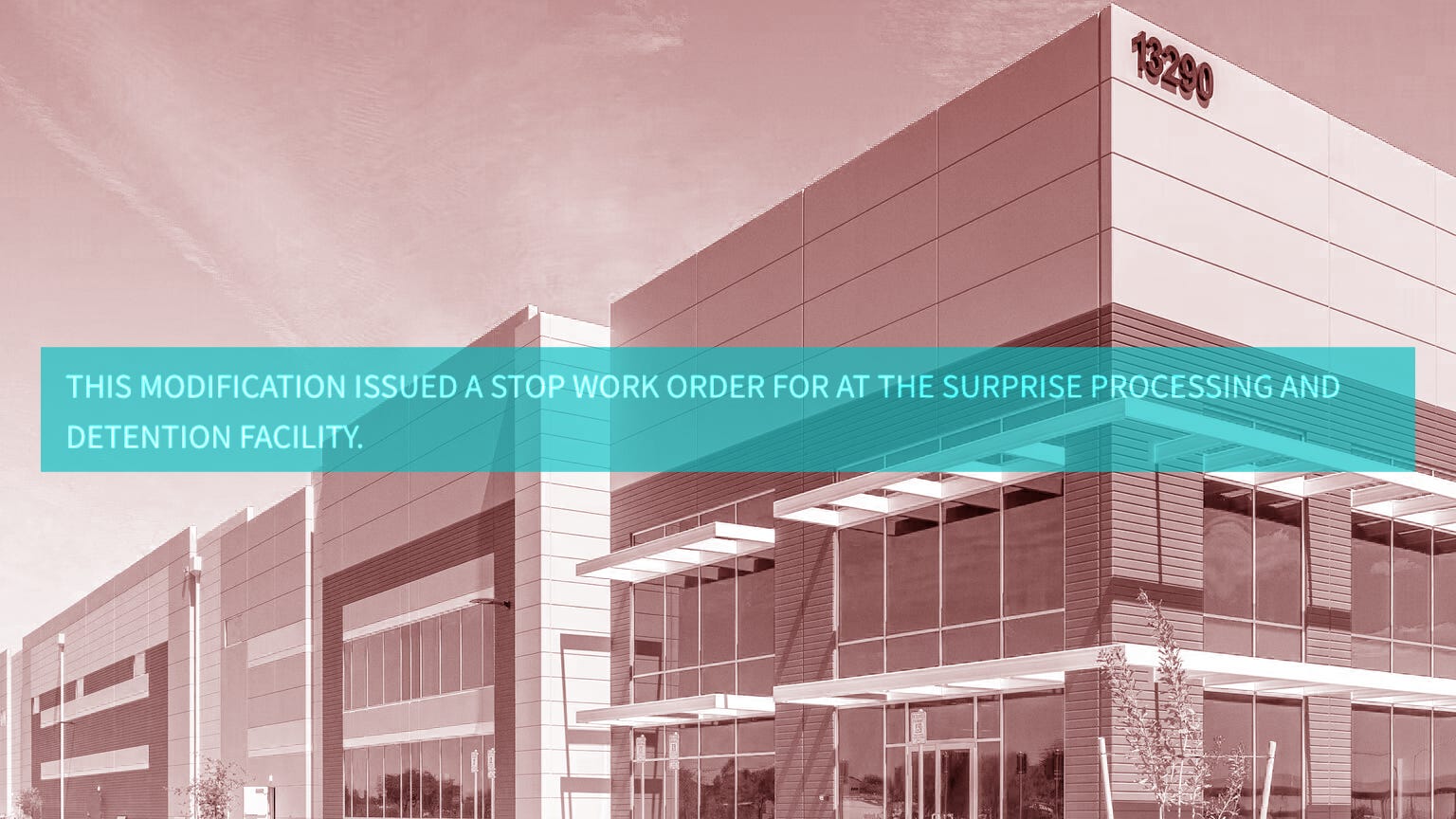
The federal government issued a stop work order on the $313 million contract to convert an industrial warehouse in Surprise into an immigration detention facility at least two days before Arizona’s attorney general filed suit to block the project, according to federal contracting records reviewed by Project Salt Box.
The records, posted to USASpending.gov, show two successive modifications to the contract held by GardaWorld Federal Services. The first, designated P00001 and signed April 22, initiated the halt. A second modification, P00002 — signed April 23 — bore the explicit description: “THIS MODIFICATION UPDATES THE STOP WORK ORDER IN EFFECT AT THE SURPRISE PROCESSING AND DETENTION FACILITY.” Both reflected a $0 obligation, consistent with administrative actions that carry no new funding.

Arizona Attorney General Kris Mayes announced on April 24 that she had filed suit in the U.S. District Court for the District of Arizona seeking to permanently block the facility. A stop work order was already in place.
DHS, ICE, and GardaWorld did not respond to requests for comment sent by Project Salt Box prior to publication.
A Parallel Contract, Also Halted
Three weeks before the Surprise modifications appeared, an identical sequence played out on a companion warehouse contract in Williamsport, Maryland.
KVG LLC was awarded $113 million on March 6 — the same day as the GardaWorld contract — to renovate an ICE-owned warehouse in Williamsport into a processing and detention facility. On April 2, a contract modification appeared in federal records. Its language was direct: “THIS MODIFICATION IMPLEMENTS A STOP WORK ORDER.”

The Maryland stop work arrived as courts were weighing the state’s legal challenge to that facility. On April 15, U.S. District Judge Brendan Hurson granted a preliminary injunction — the first court order halting one of the administration’s warehouse detention conversions. He found that DHS had defined the scope of its project so narrowly as to exclude the very purpose the project was meant to serve, and that the agency’s environmental review had recorded a conclusion rather than reached one. During oral argument, a government lawyer acknowledged that a proper environmental review could take years.
In Arizona, a stop work order was issued April 22, updated April 23, and a state lawsuit was filed April 24. Whether ICE issued the Surprise stop work in anticipation of court action, under instruction from the Department of Justice, following an internal policy review, or for reasons unrelated to the litigation is not established by the contract records. The government has offered no public explanation for either modification.
No Environmental Review on Record
The Arizona complaint, styled Arizona v. Mullin, names DHS Secretary Markwayne Mullin and Acting ICE Director Todd Lyons as defendants. It is the fourth lawsuit brought by a state against the federal warehouse detention program on environmental and procedural grounds.
It is also the most procedurally exposed for the government, because unlike the cases in Maryland, Michigan, and New Jersey, Arizona says there is no environmental review document to challenge at all.
In Michigan, records obtained by Project Salt Box showed that ICE’s Record of Environmental Consideration was completed in approximately 30 minutes, on the same day the state filed suit. In Maryland, the agency completed its review in a single day and purchased the property the next. In New Jersey, the review was signed off Feb. 6 and approved Feb. 24, one day after the property was purchased. Arizona has located no document at all.
That absence cuts against the government’s standard defense. In all three prior cases, DHS argued that modifying an existing building does not trigger the same environmental scrutiny as new construction, and that concerns about water, wastewater, and traffic belong to a later planning stage. Judge Hurson rejected that argument in Maryland.
When DHS has previously built or modified detention facilities, it complied with the National Environmental Policy Act. In 2021, the agency completed a full environmental assessment before advancing plans for a processing center in El Paso, Texas, sending draft documents to 23 stakeholders and soliciting public comment. No comparable process occurred in Surprise.
The procedural record in Surprise is thin in additional respects. In February, ICE issued a Floodplain Notice for the Surprise warehouse listing a public comment deadline of Jan. 19 — four days before the warehouse was purchased. On Feb. 20, before a separately listed deadline had passed, DHS removed the Floodplain Notice and replaced it with a notice for a facility in Romulus, Michigan. Judge Hurson cited an identical sequence in the Maryland case as evidence that the review process had been compromised.
ICE purchased the Surprise property for $70,035,000 on Jan. 23, 2026 — one day after DHS sent a consultation letter to the Arizona State Historic Preservation Office regarding the proposed acquisition, and before the preservation office had received the letter. DHS did not consult with or notify the City of Surprise before the purchase. At the first city council meeting after the acquisition was announced, residents spoke in opposition for nearly five hours, pushing a 7 p.m. meeting past midnight.
The Site
The warehouse sits at 13290 W. Sweetwater Avenue in Surprise, an industrial distribution facility of 418,400 square feet that was built to be leased to up to four commercial tenants. It was not designed to house people.
Directly across the street, Rinchem Co. LLC operates a 123,000-square-foot hazardous materials storage facility containing chemicals used in semiconductor production. Rinchem filed a Risk Management Plan on Jan. 1, 2026, three weeks before ICE purchased the warehouse next door. According to Arizona’s complaint, the plan does not account for the presence of a large captive population nearby, and Arizona is unaware of any risk assessment ICE conducted regarding the proximity of the two sites.
The warehouse is also approximately one mile from Dysart High School, which enrolls roughly 1,400 students, and Dysart Middle School, which enrolls around 600. ICE has made no public mention of either.
Arizona’s complaint alleges that the facility violates the Immigration and Nationality Act, which requires the federal government to arrange for “appropriate” places for immigration detention — a standard the state argues the Surprise site, given its location adjacent to a chemical hazard facility, can never meet.
The complaint brings four counts under the Administrative Procedure Act: a challenge to the NEPA bypass; a claim that the site fails the INA’s appropriateness standard because of its proximity to hazardous chemicals and inadequate water and sewer infrastructure; a claim that ICE failed to consider existing detention facilities as alternatives before acquiring new property, having considered only other industrial warehouses; and a claim that the decision was arbitrary and capricious, in that ICE provided no reasoned explanation for abandoning its prior practice of environmental review. The state is asking the court to vacate the acquisition decision and permanently enjoin ICE from converting or operating the site.
The Arizona filing was the 41st lawsuit Mayes has filed or joined against the Trump administration in its second term. She announced it standing outside the warehouse. “If there is a tank rupture or a chemical spill or a fire,” she said, “emergency responders will be responding to a potential mass casualty event involving hundreds if not thousands of people.”
The government has not yet responded to the complaint. The stop work modifications remain in the federal contracting database without explanation, alongside the modification at the Williamsport facility where a federal court has already ruled the government violated the law.
Project Salt Box tracks all warehouse updates and ongoing litigation at tracker.projectsaltbox.com.
Keep up the good work.
Big congrats and thank you to AG Kris Mayes and Northwest Valley Indivisible whose continued efforts put pressure on the council and stood up for the wellbeing of Surprise citizens and the surrounding towns. We’ve seen some real heroes in our high school students as well. Good job, Cali.