

U.S. Immigration and Customs Enforcement posted a solicitation on Thursday for a construction program worth up to $10 billion, a move to build and expand detention space on land the agency owns rather than lease it.
The solicitation begins with eight projects: new “Secure Housing Units” — entire wings of individual cells — at eight of the agency’s Service Processing Centers. Two of those centers closed years ago. A third, on St. Thomas in the U.S. Virgin Islands, has never existed.
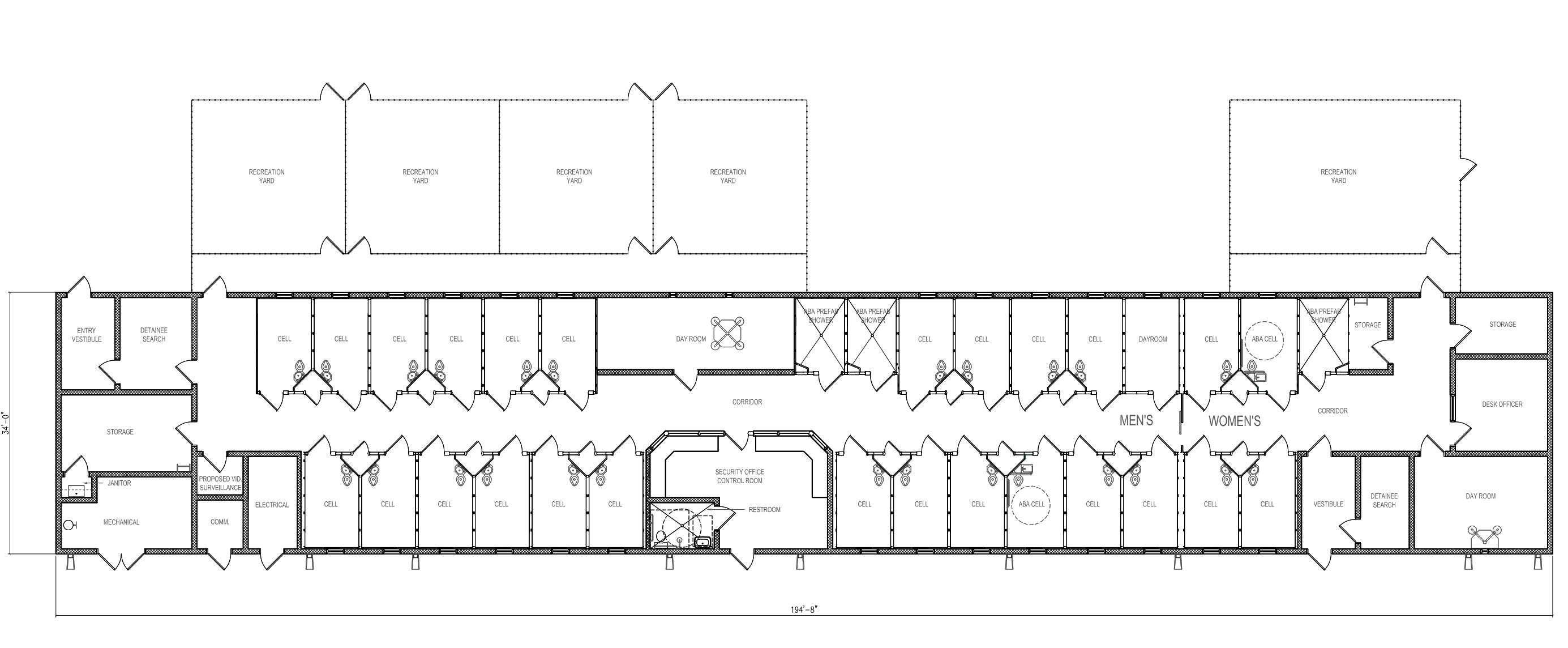
Each unit is described as a single-story building of 26 cells, two of them wheelchair-accessible, with day rooms, showers, search and storage rooms, a control room and separate exercise yards for men and women. The fencing must block men held in the units from seeing into the women’s yard. The eight units come to 208 cells, priced at $24 million to $42 million apiece, roughly $247 million combined. The $10 billion contract ceiling covers far more than that — the solicitation names 14 more locations where work could later be ordered, from Honolulu to Guantánamo Bay.
Only one of the eight, at the Port Isabel Service Processing Center near Los Fresnos, Tex., is a funded job. The other seven are what the solicitation calls “scenarios” — priced in full, with a caveat that the government is not committing to build them.
An eighth funded project, at an ICE training site on the Army’s Fort Benning in Georgia, appears in the schedule for bidders’ site visits but not on the list of jobs up for bid.
Over the past year, ICE tried several ways to add detention space quickly. It leaned on a Navy construction program, WEXMAC TITUS, and dropped it after senators pressed the Pentagon to end the arrangement. It bought eleven warehouses for just over $1 billion to convert, and most are now for sale. A federal contractor with direct knowledge of the matter told Project Salt Box in June that the agency was pivoting to new facilities on land it controls. The solicitation posted Thursday calls for construction at government-owned sites and directs the winning company to help ICE find the next parcels to buy.

Unanswered questions
For a program with a $10 billion ceiling, the solicitation answers few basic questions.
ICE has not chosen a builder. The posting is a request for bids, with proposals due Aug. 14; the agency expects to pick winners by Sept. 25.
The construction dates are blank. The contracts take effect Sept. 30, but that is a paperwork date, and the start and completion dates for each project are left to be filled in later, job by job. The only firm number is an outer limit: 730 calendar days, two years, from the start of design to a finished building.
How many people the units would hold is unstated. Each is drawn as 26 cells — 21 for men, three for women, one accessible cell on each side — but the documents never say whether a cell holds one detainee or two, so the bed count is unfixed. Who would guard or run the units is also absent; this is a contract to construct buildings, not to staff them.
Several of the sites go unexplained. The solicitation lists 14 places where work could be ordered but describes what would be built at only the eight housing units. Three of the 14 — Huntsville, Texas.; Honolulu; and Fort Benning, Ga., an Army post — have no ICE detention facility today, and the document says nothing about what it would put there.
While there are no ICE-owned detention centers in these areas, the agency does regularly hold immigration detainees at U.S. Marshall Service and local law enforcement jails located near the named regions. It is not clear if the construction contract would cover expansion at these sites. ICE did not respond to a request for comment.
Building at centers that closed
Some of the eight sites are centers ICE runs today — Batavia, N.Y.; El Paso; Florence, Ariz.; and Krome in Florida. Three are not.
Others closed years ago. The El Centro Service Processing Center, in California’s Imperial Valley, shut down in October 2014 and its detainees were moved to a newly built contract facility in Calexico.
The Aguadilla Service Processing Center in Puerto Rico — spelled “Aquadilla” throughout the solicitation — dates to the Immigration and Naturalization Service and last appears in the agency’s own records on a 2005 distribution list, at 505 Gun Road in Ramey. The solicitation prices a new lockup unit at each.
A third has never existed. No Service Processing Center has operated on St. Thomas, in the U.S. Virgin Islands, yet the contract schedule lists a “St. Thomas Service Processing Center” and assigns it the largest price tag of the eight, up to $42 million. Its statement of work drops the label, calling the job only construction “at the St. Thomas campus, U.S. Virgin Islands,” with no address or site identification of any kind.
Identical design at eight sites
The four scenario statements of work reviewed by Project Salt Box — Aguadilla, El Centro, El Paso, and St. Thomas — run about 54,000 words apiece and are identical but for the facility name, the state where the design firm must be licensed and a block of Texas environmental rules that appears only in the El Paso version. The Puerto Rico, California and Virgin Islands documents got no comparable local language.
Each tells bidders to price the work on a soil report for Los Fresnos, Tex.: “Assume the same soil conditions for this site.” The instruction applies equally to El Centro, in one of the country’s most seismically active regions, and to Puerto Rico and the Virgin Islands, both shaken by damaging earthquakes in 2020. The documents do require borings at each site before design begins, by a locally licensed engineer — including, in the Virgin Islands, a firm with at least five similar projects completed “in St. Thomas.”
The soil report was written for none of these projects. It is a July 2023 report by the Army Corps of Engineers’ Fort Worth District, prepared for an earlier design-build solicitation titled “ICE Secure Housing Unit, Port Isabel, Texas,” and built on borings drilled in January 2019 for two adjacent Port Isabel projects, a kitchen building and wastewater plant improvements. The statements of work credit the borings to a firm called Geotechnology Inc., in March 2019; the report itself credits ETTL Engineers & Consultants, in January. Corps concept drawings for the Port Isabel unit, attached to the current solicitation and dated to the previous administration, are marked "CONCEPT NOT FOR CONSTRUCTION," and the spaces for a solicitation number and an issue date are filled with rows of X's.
The Port Isabel details carry through to sites 1,700 miles away. The St. Thomas and Aguadilla documents, like the others, tell the contractor to bring construction traffic in from Memorial Drive — a road on the Port Isabel location in Texas — and to coordinate grass-seed selection with “local SPC personnel” at centers that have no personnel because they are closed or were never built.
Fourteen possible sites
The contract also covers new construction of buildings and real property, demolition, and renovations “inclusive of change of occupancy use” — the building-code term for converting a structure to a new purpose. And it names the places where work can be ordered. One group, labeled “Mega Hub DC, One IDIQ Award,” consists of Aguadilla; Broadview, Ill.; Guantánamo Bay; Huntsville, Tex.; Oakdale, La.; St. Thomas; and Honolulu. A second group of individual awards covers the existing centers plus Fort Benning, the Army post in western Georgia.
The phrase “Mega Hub DC” appears once in the 102-page solicitation and is never defined. Five of the seven locations grouped under it have no ICE-owned detention facility today. Guantánamo Bay, where a presidential memorandum in January 2025 directed the expansion of migrant operations that President Trump said would hold 30,000 people, is a Navy base.
The competition is written for a handful of very large firms. Small businesses are barred from bidding, and every company must prove it can line up $10 billion in bonding — the insurance that guarantees a job gets finished if the builder fails — a bar few American construction firms can clear. As recently as April, ICE had asked bidders to show a fraction of that, $300 million. The workers on the job would need security clearances to handle classified national security information, unusual for a construction contract, and ICE reserves the right to order individual projects verbally.
The document also contradicts itself in ways ICE has not explained. In one place it puts the ceiling at $10 billion; two paragraphs later it caps the total work at $300 million, a difference of more than thirtyfold. One section says a company can win only one contract; another says two. The cover letter counts an initial batch of twelve projects; the schedule prices eight. And one heading still carries the label for a different kind of contract entirely — the multiple-company arrangement that appeared, unexplained, in the notice ICE posted last week.
Scouting the next sites
The contract also puts the builder to work finding the government’s next detention sites. The work statement includes tasks that have nothing to do with pouring concrete: the winning firm is to draw up “site options,” scout properties, and hand ICE a package on each one — price, zoning, who holds the easements, whether the land suits the intended use — “for Government to make decision on sites to be acquired.”
The firm must keep on staff an environmental specialist whose job is winning the federal sign-offs that let a project skip a full environmental study, and whose résumé, the document says, should ideally include work for “federal law enforcement agencies.”
That sign-off — a categorical exclusion, a finding that a project is too minor to warrant deeper environmental review — recurs across ICE’s expansion. Project Salt Box has documented the agency’s use of it at the planned Gilroy, Calif., facility, and a federal judge in Maryland found in April that ICE likely broke the law by cutting environmental corners at a warehouse in Williamsport.
Under this contract, the company preparing the exemption documents would be the company building the project — and, for sites the government has yet to buy, the company that picked and priced the land.
Proposals are due Aug. 14, 30 days after posting. Site visits at Port Isabel and Fort Benning are set for July 29 and 31. ICE anticipates awards by Sept. 25 and an effective date of Sept. 30, the last day of the fiscal year, with no phase-in period.
Looks like the work statement assigns NEPA reviews and the preparation of categorical exclusions to the construction contractor itself — "Frankenstein’s Exclusion" industrialized (term coined by MI AG in response the "absurd" (from MD federal court ruling) justifications for being exempt from NEPA. The builder writing its own exemption from environmental review. Coalition to Shut the Camps has been banging this bell hoping an AG with some spine would respond -- this is industrial scale corruption that DHS performed across dozens of states from the start of this process and will continue unless they are injoined from repeating the fraud over and over. This is what "wack a mole" strategies have gotten us. We won on many warehouses and DHS reroutes using the same fradulent playbook to achieve the same outcomes in States less likely to fight.
The contradictions and errors are what you see when unqualified employees are pushed and threatened to complete a project in too little time. Slapdash planning leads to slapdash construction.