

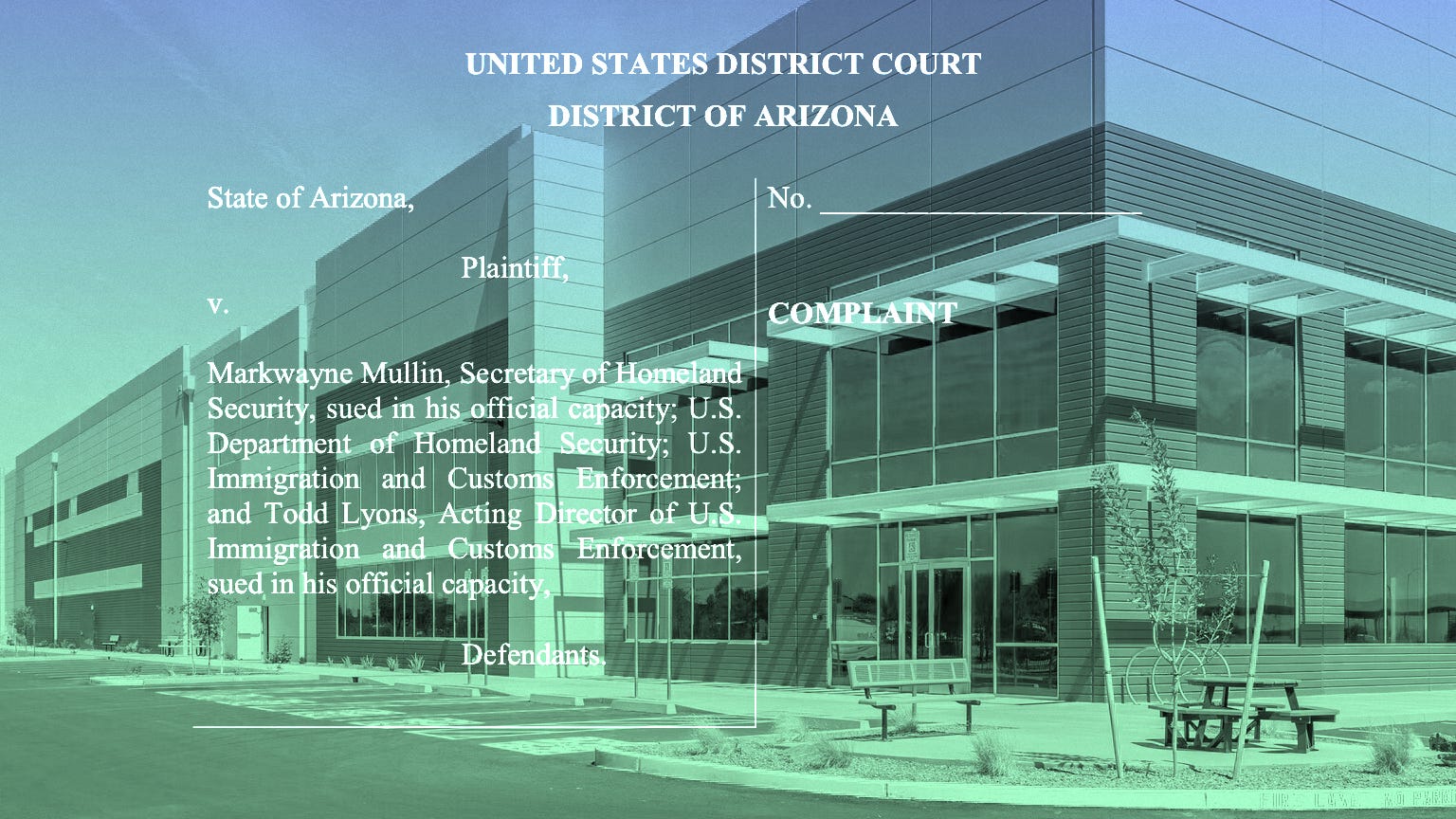
Arizona Attorney General Kris Mayes filed suit in federal court Thursday to block the conversion of a warehouse in Surprise, Arizona into an immigration detention facility, the fourth such challenge brought by a state against the federal government’s warehouse detention program on environmental and procedural grounds.

The complaint, filed in the U.S. District Court for the District of Arizona, names Secretary of Homeland Security Markwayne Mullin, the Department of Homeland Security, Immigration and Customs Enforcement, and Acting ICE Director Todd Lyons as defendants. It asks the court to declare the warehouse acquisition unlawful and to permanently enjoin ICE from converting or operating the site.
The filing arrives nine days after a federal judge in Maryland halted a similar conversion in Williamsport, finding that DHS had attempted to shoehorn a large-scale detention project into environmental exclusions designed for minor renovations. Courts in Michigan and New Jersey are weighing comparable claims.
The Surprise purchase
On Jan. 22, 2026, DHS sent a consultation letter to the Arizona State Historic Preservation Office regarding a proposed acquisition in Surprise. One day later, before the preservation office had received the letter, ICE purchased the property for $70,035,000. DHS did not consult with or notify the City of Surprise before the purchase. At the first city council meeting after the acquisition was announced, residents spoke in opposition for nearly five hours, pushing a 7 p.m. meeting past midnight, according to the complaint.
The facility, a 418,400-square-foot industrial distribution facility at 13290 W. Sweetwater Avenue, was built to be leased to up to four commercial tenants — and, as the term “warehouse” suggests, was not designed to house people.
Directly across the street, at 13255 W. Sweetwater Avenue, Rinchem Co. LLC operates a 123,000-square-foot hazardous materials storage facility containing chemicals used in semiconductor production. Rinchem filed a Risk Management Plan for the facility on Jan. 1, 2026, three weeks before ICE purchased the warehouse next door. According to the complaint, the RMP does not account for the presence of a large captive population nearby, and Arizona is unaware of any risk assessment ICE has conducted regarding the two sites’ proximity.
The warehouse is also located approximately one mile from Dysart High School, which enrolls around 1,400 students, and Dysart Middle School, which enrolls around 600. ICE has made no public mention of either. At a press conference outside the facility Thursday, Mayes said students at Dysart High, where roughly 60 percent of students are Hispanic according to state enrollment data, were frightened to walk to school because of the increased ICE presence in the area.
The fourth case
Unlike the cases in Maryland, Michigan, and New Jersey — where the government produced environmental review documents, however hastily — Arizona states it is unaware of any such document existing at all for the Surprise warehouse. No environmental impact statement, no environmental assessment, no categorical exclusion.
That distinguishes the Arizona case in a meaningful way. In Michigan, records obtained by Project Salt Box show that ICE’s Record of Environmental Consideration was completed in approximately 30 minutes, on the same day the state filed suit. In Maryland, the agency completed its review in a single day and purchased the property the next. In New Jersey, the review was signed off on Feb. 6 and approved Feb. 24, one day after the property was purchased.
Arizona can point to no document at all.
The complaint notes that when DHS has previously built or modified detention facilities, it complied with NEPA. In 2021, DHS completed an environmental assessment before advancing plans for a processing center in El Paso, Texas, sending draft documents to 23 stakeholders and soliciting public comment. No comparable process occurred here.
In February, ICE issued a Floodplain Notice for the Surprise warehouse that listed a public comment deadline of Jan. 19 — four days before the warehouse was purchased. A separate section of DHS’s website listed the deadline as Feb. 20.
On Feb. 20, before that deadline had passed, DHS removed the Floodplain Notice for the Surprise warehouse and replaced it with a notice for a facility in Romulus, Michigan. It was a nearly identical sequence of events to the one Judge Hurson cited in granting Maryland’s preliminary injunction nine days ago.
A contract with GardaWorld
On March 6, ICE contracted with GardaWorld Federal Services to retrofit and operate the Surprise warehouse at a cost of approximately $313 million, with a potential ceiling of $704 million. An economic analysis produced by DHS projected the construction phase would require nearly 1,400 workers.
GardaWorld, which provides security staffing at immigration detention facilities including one in Florida that Amnesty International has separately documented for human rights violations, has not previously undertaken facility conversion work of this scale, according to the complaint.
What’s ahead
The government has not yet responded to the Arizona complaint, but its filings in the other three cases offer a preview of its likely defense. In each, DHS has argued that modifying an existing building does not trigger the same environmental scrutiny as constructing a new one, and that questions about water use, wastewater capacity, and traffic belong to a later stage of the project. In New Jersey, Maryland, and Michigan, the government argued those projected harms were speculative — contingent on future decisions not yet made.
Judge Adam Hurson of the U.S. District Court in Maryland found that argument unpersuasive. He ruled that DHS had defined its project so narrowly as to exclude the very purpose the project was meant to serve, and that the agency’s review had recorded a conclusion rather than reached one. He granted a preliminary injunction on April 15. During the hearing, a lawyer for the federal government acknowledged that completing a proper environmental review could take years.
Arizona’s complaint brings four counts, all under the Administrative Procedure Act. The first challenges the NEPA bypass. The second and third argue the site is inappropriate under the Immigration and Nationality Act — both because the facility lacks adequate water and sewer infrastructure, and because the INA required ICE to consider existing detention facilities as alternatives before acquiring new property. ICE, the complaint notes, considered only other industrial warehouses. The fourth count argues the decision was arbitrary and capricious, in that ICE has provided no reasoned explanation for abandoning its prior practice of environmental review, nor any explanation for selecting a site adjacent to a hazardous chemical storage facility, according to the filing.
The state is asking the court to vacate the acquisition decision and permanently block construction and operation.
Follow this and the other warehouse cases at tracker.projectsaltbox.com.
So much teamwork has gone into investigating these proposed warehouses that are so inhumane. Great work by all organizations that have contributed to making the towns aware of what is being done by ICE.
46 to go ~