

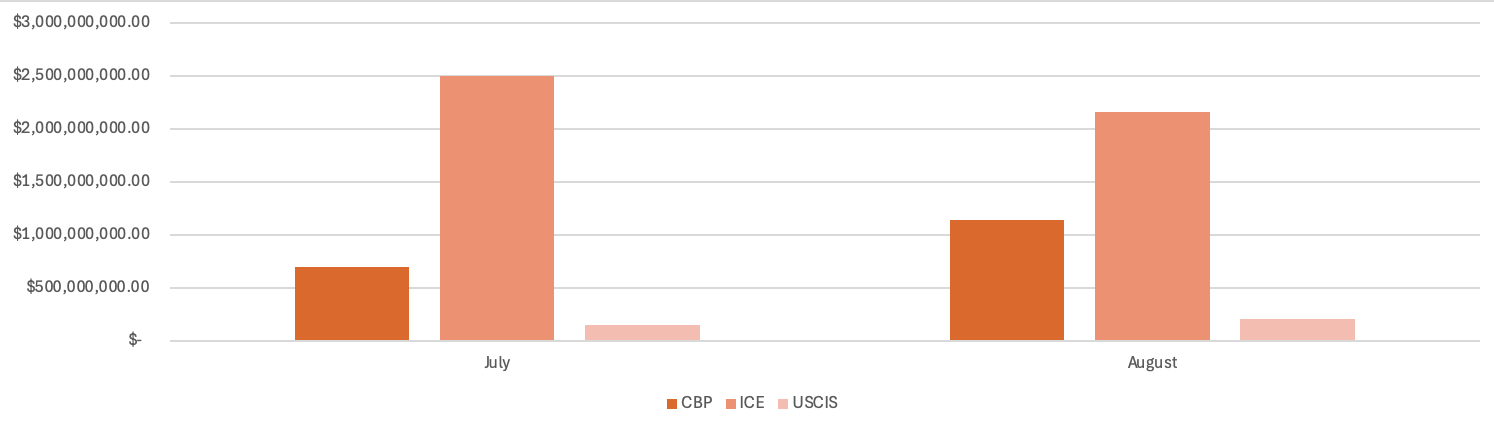
Bottom Line Up Front
ICE Shifts its Detention Expansion Strategy, but Warehouses Remain in Play: While the warehouse conversion component of the Detention Reengineering Initiative has been significantly stalled in five court cases, it has not been completely halted. This month saw the third warehouse conversion contract awarded to GardaWorld Federal, who has been given a year and $1 billion to renovate the warehouse in San Antonio, Tx. On top of that, ICE has now purchased four CoreCivic facilities, is establishing its own construction contracts to expand existing processing centers, and is seeking turnkey sites to rapidly add detention capacity.
ICE is Bulking Up its Transportation Infrastructure: Over half a billion dollars in transportation contracts last month demonstrate ICE’s investment in both ground and air transportation, as the agency continues its surge in enforcement and removals across the country.
A Broader Push to Identify and Locate People: ICE’s $57 million in August skip-tracing actions, alongside its new 287(g) coordination center, UAC-tracking work, and rapid-DNA testing contract, point to a broader investment in finding, identifying, and targeting people for enforcement.
Construction Continues at CBP Facilities: In addition to the billions of dollars CBP is spending on the border wall, the agency is also constructing and renovating border patrol stations and checkpoints, primarily along the southern border.
August’s Biggest Contracts
GardaWorld Federal landed two huge contracts last month, including a $382 million contract to provide “24/7/365 armed ground transportation for individuals placed into ICE custody under the 287(g) program across all 254 Texas counties.” The award is another example of the agency’s increased investment and reliance on partnerships with state and local law enforcement to support enforcement operations.
Earlier in the month, ICE awarded a contract to Koniag Services to run a 287(g) National Coordination Center in Tennessee. According to reporting by Tennessee Lookout, Koniag will operate the round-the-clock ICE call center that will handle an estimated 6,000–7,000 daily requests from cooperating law-enforcement agencies, including database checks and confirmation of field enforcement actions. The contractor will also track unaccompanied immigrant children, identify technology to strengthen local ICE partnerships, and provide officers with targeting materials aimed at reducing the non-detained docket in immigration courts. GardaWorld’s transportation contract is currently under protest by one of their competitors: Asset Protection & Security Services. Work will not start until that protest is resolved; a decision is due by December 21, 2026.
The second - and even larger - contract awarded to GardaWorld Federal in August was the contract to renovate a warehouse in San Antonio, Texas. This is the third warehouse conversion contract awarded by ICE, following the awards to KVG, LLC and GardaWorld Federal to renovate the warehouses in Hagerstown, Md. and Surprise, Az., respectively. With a period of performance of only a year on this new contract, and a ceiling of $1 billion, it’s likely the company will be moving very quickly to renovate the warehouse into an operating detention center.
A $328 million award to Eastern Air Express to operate the DHS-owned fleet of planes was another large transportation contract award in August. The department purchased 10 airplanes earlier this year to use as its own deportation fleet, and this contract will be used to operate and maintain those aircraft. Eastern Air Express is a subsidiary of Eastern Airlines and is the only current ICE Charter operator who operates 737s, the same jets in DHS's fleet, according to Gillian Brockell, who has been doggedly tracking and reporting on ICE flights and third country removals. The contract was awarded as yet another sole source by the agency and runs through February of 2028.
Analysis and Trends
ICE Continues Moving Beyond Warehouse Detention Plans: Despite the fact that the agency awarded its third warehouse renovation contract last month, the bulk of ICE’s detention expansion has shifted to different methods. CoreCivic sold two more detention centers to DHS—in Appleton, Mn. and Leavenworth, Ks.—to the tune of a combined $734 million. Additionally, ICE published a solicitation for Turn-Key Detention Centers that outlines a contractor-operated system encompassing mobile detention sites, transportation, detention beds in privately owned facilities, and on-site immigration courtrooms. In the solicitation, ICE also asked offerors to price a government-ownership option, indicating the agency may be considering additional facility purchases.
Increased Investment in Locating and Targeting Individuals: Through fourteen new contract actions, ICE spent $57 million to fund more skip tracing in August.
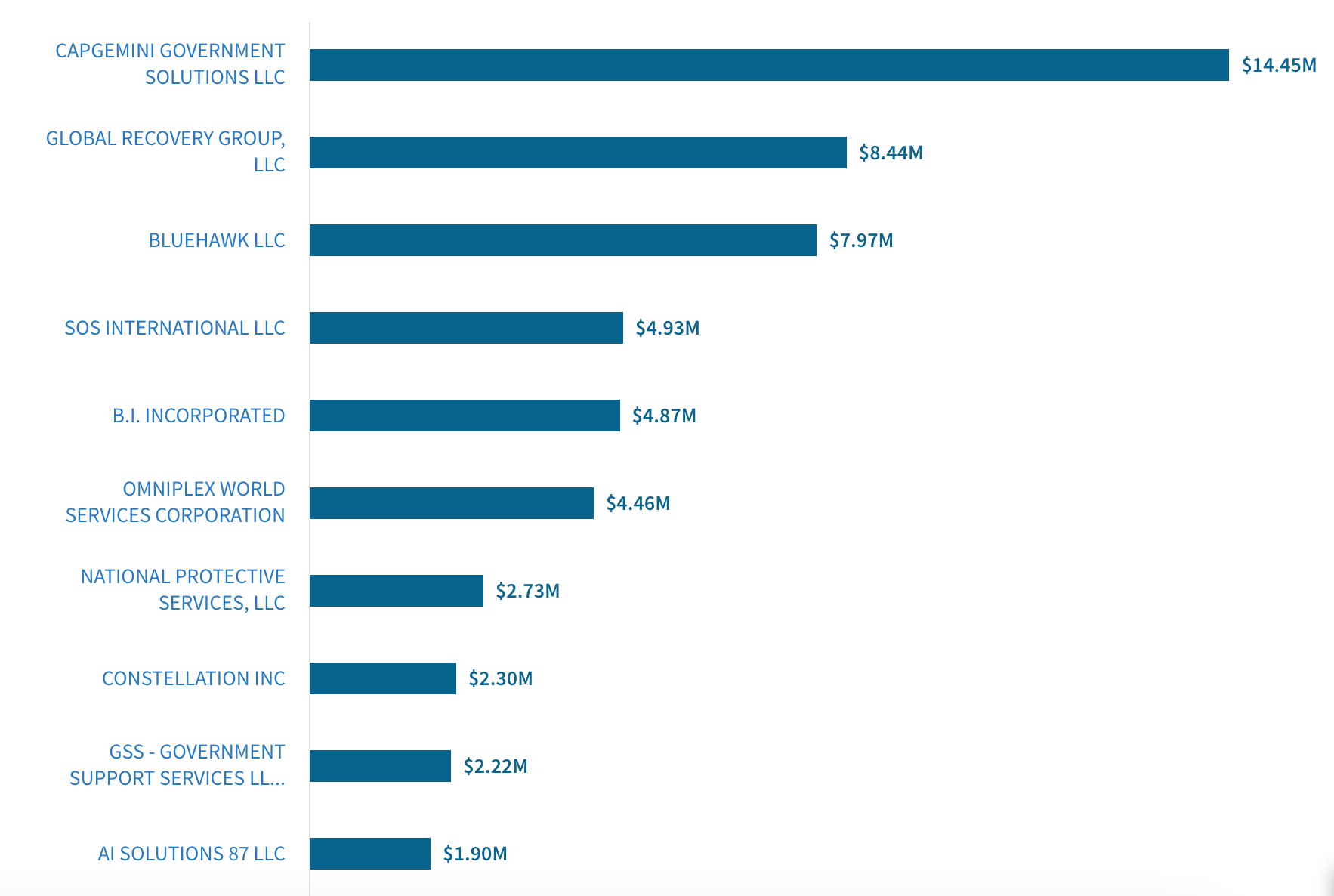
Project Salt Box has been following these contracts since December 2025, and we have recently seen an uptick in spending. The awardees were originally tasked with locating a total of 1.2 million people over the next two years. These skip-tracing contracts reflect a trend we have observed over the last several months — an increased push to use targeting methods to track down individuals. Whether through the UAC program, in which companies search for unaccompanied children and their caretakers, or rapid DNA testing to “verify biological relatives,” ICE is expanding the infrastructure it can use to identify, locate, and target people for enforcement actions.
Warehouse Recap
Since Project Salt Box first reported on ICE’s purchase of a warehouse in Hagerstown, Md., a lot has changed. In total, the agency bought eleven warehouses over the course of three months, spending a total of over $1 billion. Shortly after, lawsuits were filed against DHS in five states: Maryland, New Jersey, Michigan, Arizona, and Georgia. The litigation, public opposition, and questions over environmental review requirements helped stall the initiative, and reporting later indicated that DHS planned to offload seven of the eleven warehouses—through sales or transfers to other federal agencies—while redirecting its detention expansion toward existing jails, prisons, private facilities, and other faster-to-operate models.
The five challenged warehouse projects remain in various states of limbo. DHS told a court it no longer intended to retrofit the Romulus, Michigan, warehouse and planned to sell it. Officials in Social Circle, Georgia, likewise said the agency had confirmed it would not move forward with the project there. In Maryland, New Jersey, and Arizona, the projects remain stalled or unresolved amid litigation and environmental review issues. Recent events in Roxbury, New Jersey illustrate the initiative’s uncertainty. Although DHS previously indicated it would not move forward with the conversion there, state and local officials are investigating reports that ICE may have held detainees at the warehouse anyway, despite a court order barring detention in the facility.
About this Report
All procurement data used in this report is from usaspending.gov and SAM.gov. If there are specific procurements, companies, regions, or topics you would like us to cover in future monthly reports, please reach out to us and let us know.
Tennessee is a "right to work" (anti-union) state, so call center employees have fewer rights like bathroom breaks and lower pay.
Call centers measure the number of calls in 15, 30, and 60 minute periods; how long calls last; and how quickly calls are picked up (service level). They aim to minimize the service level.
They vary the staffing levels during the day and across longer time periods to meet their service level goals while minimizing staffing.
Unexpected high call volumes drive up service level, which in turn forces the call centers to increase staffing. Lower call volume periods are more expensive to staff per call because of the statistics of small numbers. So unexpected calls in low volume periods are more expensive per call to handle.
Also, when unexpected calls arrive in spikes, it drives up staffing costs more because you have to staff for the spike, not the average. Call centers staff in 4 and 8 hour shifts. They prefer for 4 hour shifts because it allows them to avoid paying benefits.
I am interested in what the terms of the call center contracts are. The contractors will have to meet the metrics with minimal staffing.
It seems like they will be quite vulnerable to fake call campaigns that throw off their statistics and costs. The government won't be able to keep the call center numbers private.
We saw how Internet tricksters messed with the Trump campaign events by requesting tickets and not showing up, creating embarrassment for the campaign. I suspect they will do the same with the call centers.
Thank you for your in-depth reporting.