

Federal officials approved an environmental review for a planned immigration detention center in western Maryland on Jan. 15, signed off on the project that same afternoon and completed the $102.4 million purchase of the property the next day, according to court records — a timeline that is now at the center of a legal fight over whether the government fully analyzed the project’s environmental impact before committing to it.
The project involves the 825,000-square-foot warehouse on a 54-acre site between Hagerstown and Williamsport that Immigration and Customs Enforcement plans to convert into a detention and processing center.

The Maryland site is one of at least 11 warehouses the federal government has purchased across the country as part of a multibillion-dollar plan to expand immigration detention capacity. The program, launched under the previous Homeland Security secretary, called for rapidly acquiring and converting large industrial buildings into detention centers. The new secretary, Markwayne Mullin, has since paused additional warehouse purchases and ordered a review of the contracts and proposals associated with the program.
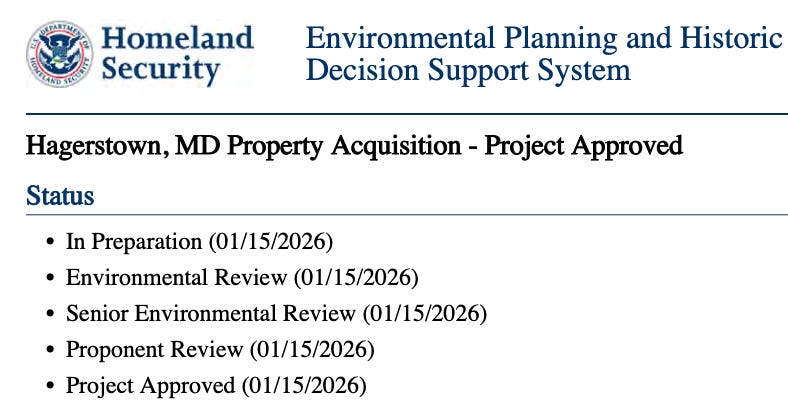
Agency records filed in federal court show the project listed as “In Preparation,” “Environmental Review,” “Senior Environmental Review,” “Proponent Review,” and “Project Approved” all on Jan. 15, 2026. Digital signatures show the final approval was completed at 4:49 p.m. The property was purchased the next day for $102.4 million, according to the deed filed in Washington County.
ICE later awarded a contract to retrofit the building on March 6. A federal judge temporarily blocked construction five days later after the state of Maryland sued, arguing that the project required a more extensive environmental review.
In court filings this week, the government said it complied with the National Environmental Policy Act by conducting an environmental review before buying the property. The agency said the project qualified for a streamlined review known as a categorical exclusion and argued that converting the warehouse into a detention facility “will not change the functional use of the property” and would have environmental impacts that are “minor and consistent with what would reasonably be expected in the area.”
That argument depends on a technical definition of “functional use” that focuses on environmental footprint rather than how the building is used. Because the site already supports vehicle traffic, lighting and wastewater, the government argued that housing detainees there would not significantly change its environmental impact. In practical terms, however, the project would convert a warehouse designed for storing and shipping goods into a secure, 24-hour residential facility with dormitories, medical care, kitchens, laundry and recreation yards — a level of continuous occupancy and infrastructure demand more similar to an institution than a distribution center. Facilities the agency classifies as processing centers can include dormitories, medical units and secure housing inside converted warehouses.
But local infrastructure data reviewed by Project Salt Box suggests the change in use could be substantial. The warehouse currently has four toilets, two water fountains and an 800-gallon-per-day water allocation. A facility housing 1,500 people would require roughly 200,000 gallons of water per day, according to local utility estimates. The city’s utilities director said her department had received “no application, no inquiry, no phone call” from the federal government about increasing water capacity for the site.
The state of Maryland has argued in court that operating a secure, 24-hour residential detention facility would place significantly different demands on water, sewer and local infrastructure than a distribution warehouse and should require a more extensive environmental review.
The government has asked the court to evaluate the project based on a facility designed to hold about 540 detainees and said Maryland’s concerns rely on “speculation about future actions that are not part of the Project.”
But in the same filings, the agency said the facility “could ultimately house 1,500 detainees” — a number consistent with internal ICE documents leaked earlier this year — and that it is now “reconsidering the precise scope” of the project and will conduct additional environmental analysis before making a final decision.
Environmental review documents also show the U.S. Fish and Wildlife Service identified several endangered or threatened species known or expected to live in the broader area and told the agency it was still required to determine whether the project “may have effects” on those species. In its review, ICE concluded the project would have “no effect,” writing that it would survey the area before exterior work began and halt construction if any protected species were found.
The dispute is nominally about environmental law, but the case has increasingly focused on timing and scope — when the government committed to the project, what size facility was analyzed, and whether the environmental review reflected a final plan or one that is still changing. The underlying question is whether the environmental review was used to inform a decision, as the law intends, or to justify a decision that had already been made.
A hearing in the case, brought by the Maryland attorney general, is scheduled for Wednesday, April 15, at 10 a.m. at the federal courthouse on Lombard Street in Baltimore, where a judge will consider whether to extend the halt on construction.
They said the same thing with Roxbury New Jersey. When our Town council called and asked them about the environmental, water/sewer evaluations they told our mayor that they had already done them. Mayor called our sewer department and they said nothing was ever done.
New Jersey is suing them. And that information is all in it.
Lies. Lies. Lies.
I believe that the more the factual statistics of water usage, sewer, strain on nearby medical facilities, electricity usage, etc. are presented, along with environmental concerns may very well sway the judge. Because anyone who even has a portion of a brain understands that a warehouse is no place to store humans. Also, keep honing in on the possible financial corruption associated with the warehouse high sales amounts.