

From Vacant Warehouse to ICE Detention Center: A $102 Million Sale Comes at a 33% Mark Up
A struggling Hagerstown warehouse, refinanced at $76.8 million in June, sold to the federal government for $102.4 million in January, highlighting rapid ICE expansion and a troubled investment


This article was updated Feb. 3, 2026, to include a statement from a DHS spokesperson.
The federal government paid $102.4 million for a Western Maryland warehouse — $25.6 million more than what the building was appraised for when the owners refinanced it seven months earlier.
That purchase is a centerpiece of the Trump administration’s $45 billion push to expand the nation’s immigration detention capacity through a network of deportation “processing centers.”
By repurposing existing industrial shells like the 1,500-bed facility planned for Hagerstown, the administration aims to bypass the years-long timelines required for new construction.
The App-Based Landlord
Behind the transaction is a modern real estate vehicle that blurs the line between Wall Street and ordinary investors. The seller, FRIND-Hopewell LLC, is a holding company created by Fundrise, a Washington-based investment platform that markets itself as giving everyday people access to private real estate deals.
Through a smartphone app, Fundrise allows non-traditional investors to buy into real estate portfolios with as little as $10. In the case of the Hagerstown property, the money came from two Fundrise investment funds: the Flagship Fund and the East Coast eREIT, both managed by the company's subsidiary, RSE Capital Partners.
To protect the parent company from liability, Fundrise used a common industry tactic: it placed the Hagerstown warehouse inside a separate LLC called FRIND-Hopewell. This structure meant that any legal or financial problems with the Department of Homeland Security sale would be contained. If the deal had fallen apart or triggered lawsuits, the LLC would have acted as a firewall, shielding Fundrise's billions in other assets.
Fundrise did not respond to requests for comment on the sale.
The corporate structure and the lack of direct investor disclosure mean that hundreds of Fundrise investors indirectly owned parts of the Hagerstown property, though many were unaware of the impending sale to ICE. One anonymous investor described the situation as a breach of trust, noting that passive investment structures often shield investors from awareness or responsibility, even when their funds enable government operations.
A Bad Investment
According to an initial SEC filing, Fundrise bought the Hagerstown warehouse in 2022 for $104.8 million. They budgeted another $9 million for leasing commissions and tenant improvements to lease the warehouse to one or two tenants and planned to have the building leased by the end of the year.
Things did not go as planned. The building remained empty for the next three years.
The Hagerstown warehouse had been a drain on the funds. In its 2024 SEC filing, the East Coast eREIT disclosed that it “experienced a decrease” in net asset value “driven primarily by carrying costs associated with vacant properties in the portfolio, including the Hagerstown Crossroads Property.”
Cash-Out Before the Sale
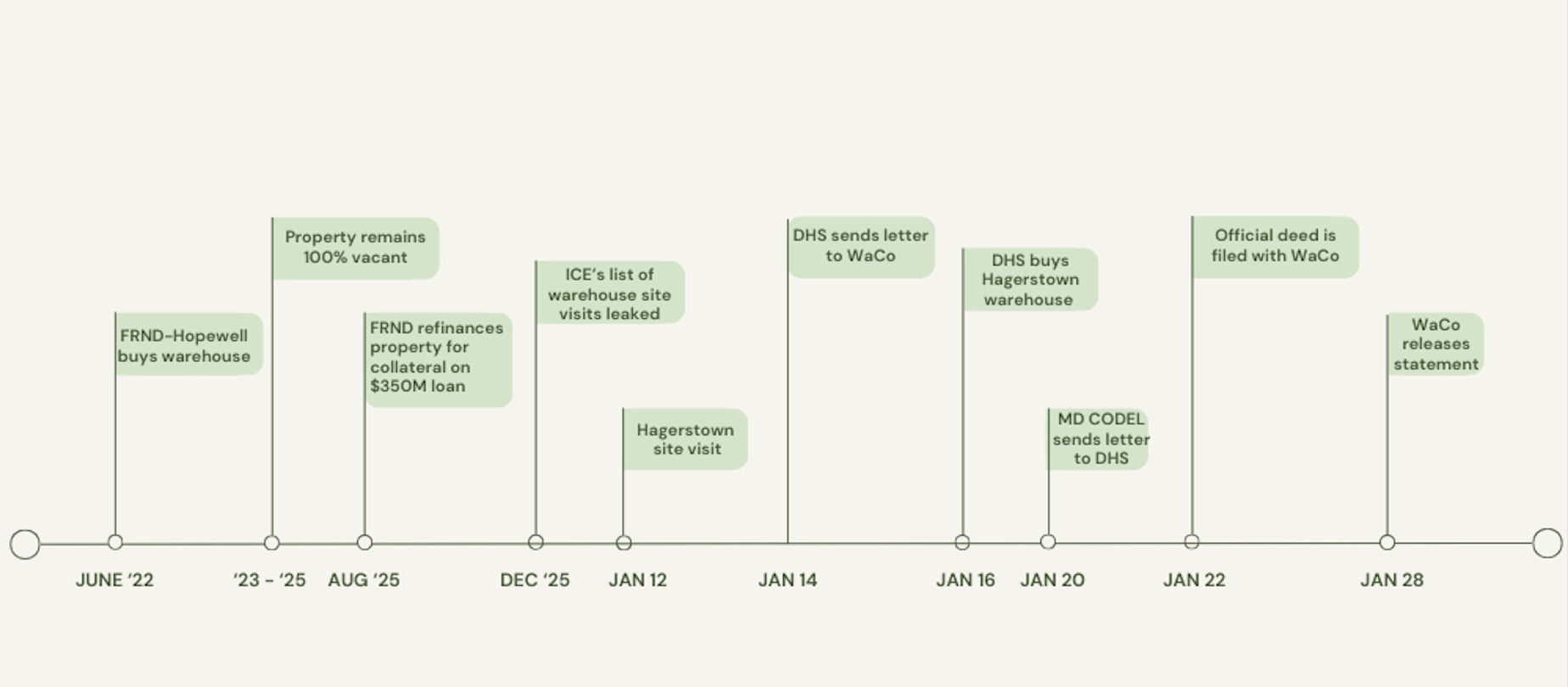
On June 16, 2025, FRIND-Hopewell LLC began the process to refinance the warehouse at 10900 Hopewell Road, also recorded as 16220 Wright Road, as part of a multi-state loan package, according to Washington County Circuit Court filings. The refinancing placed the Hagerstown property’s value at $76.8 million.
Cash-out refinancing, a common practice in commercial real estate, increases a property’s debt so that owners can extract cash while retaining ownership.

In August 2025, shortly before leaked documents revealed planned federal site visits, Fundrise secured a $352.7 million loan from Goldman Sachs and TPG. This institutional refinancing allowed the company to pay off existing debt on the vacant Hagerstown warehouse, a standard move when preparing an asset for sale. After three years of failed leasing efforts, the loan provided the financial stability needed to offload the under-performing property.
The transaction increased the property’s outstanding debt from $67.3 million to $83.1 million — a rise of roughly $15.9 million through what is known as cash-out refinancing, a common practice in commercial real estate that increases a property’s debt so that owners can extract cash while retaining ownership.
Commercial lenders typically limit loans to 75 to 80 percent of a property’s appraised value. The unusually high ratio in the Hagerstown deal, combined with the property’s eventual sale to the federal government at a significantly higher price, raises questions about how the refinancing was structured and underwritten ahead of a subsequent federal purchase.
By early January, the federal government purchased the property for $102.4 million. After paying off the $83.1 million loan, the owners received approximately $19.3 million from the sale — in addition to the $15.9 million already extracted through the June refinancing.
Total proceeds: approximately $35 million in less than seven months, from a property the private market valued at $76.8 million.
Questions of Value and Process
ICE is racing to significantly increase its detention capacity, from 65,000 beds to over 100,000 as the administration pursues a goal of deporting up to one million people annually.
The transaction highlights the aggressive, and often expensive, fiscal reality of the Trump administration’s push to expand the nation’s immigration infrastructure. To meet its mandate, the administration has moved to acquire “processing centers” — massive, existing industrial shells that can be converted into detainee processing hubs on a timeline that new construction cannot match.
Turning to existing warehouse structures offers the promise of faster deployment. But the Hagerstown transaction highlights questions about how fair market value is determined under compressed timelines. The $25.6 million difference between the appraisal and the purchase price represents a markup of about 33 percent, even though the appraisal had been completed just months earlier.
Property records do not indicate when negotiations between FRIND-Hopewell and the federal government began, or whether the company knew of government interest when it refinanced in June.
‘No New Detention Centers to Announce’
When asked directly about the Hagerstown purchase, a DHS spokesperson declined to confirm the facility, stating: “We have no new detention centers to announce at this time.”
The response neither confirms nor denies the documented $102.4 million property acquisition. The spokesperson emphasized that ICE “is actively working to expand detention space” and cited new congressional funding to “keep these criminals off American streets before they are removed for good from our communities.”
The statement claimed that “70% of ICE arrests are of illegal aliens charged or convicted of a crime in the U.S.”
However, according to a PolitiFact analysis of ICE detention statistics, approximately 64% of immigrants detained from January through October 2025 had either criminal convictions or pending charges.
More recent snapshots show the figure has declined to around 47-52% of those currently in detention. Independent analyses by both the Cato Institute and the New York Times have found that only about 5% of detained immigrants had been convicted of violent crimes, with most criminal convictions involving traffic violations.
Local Impact
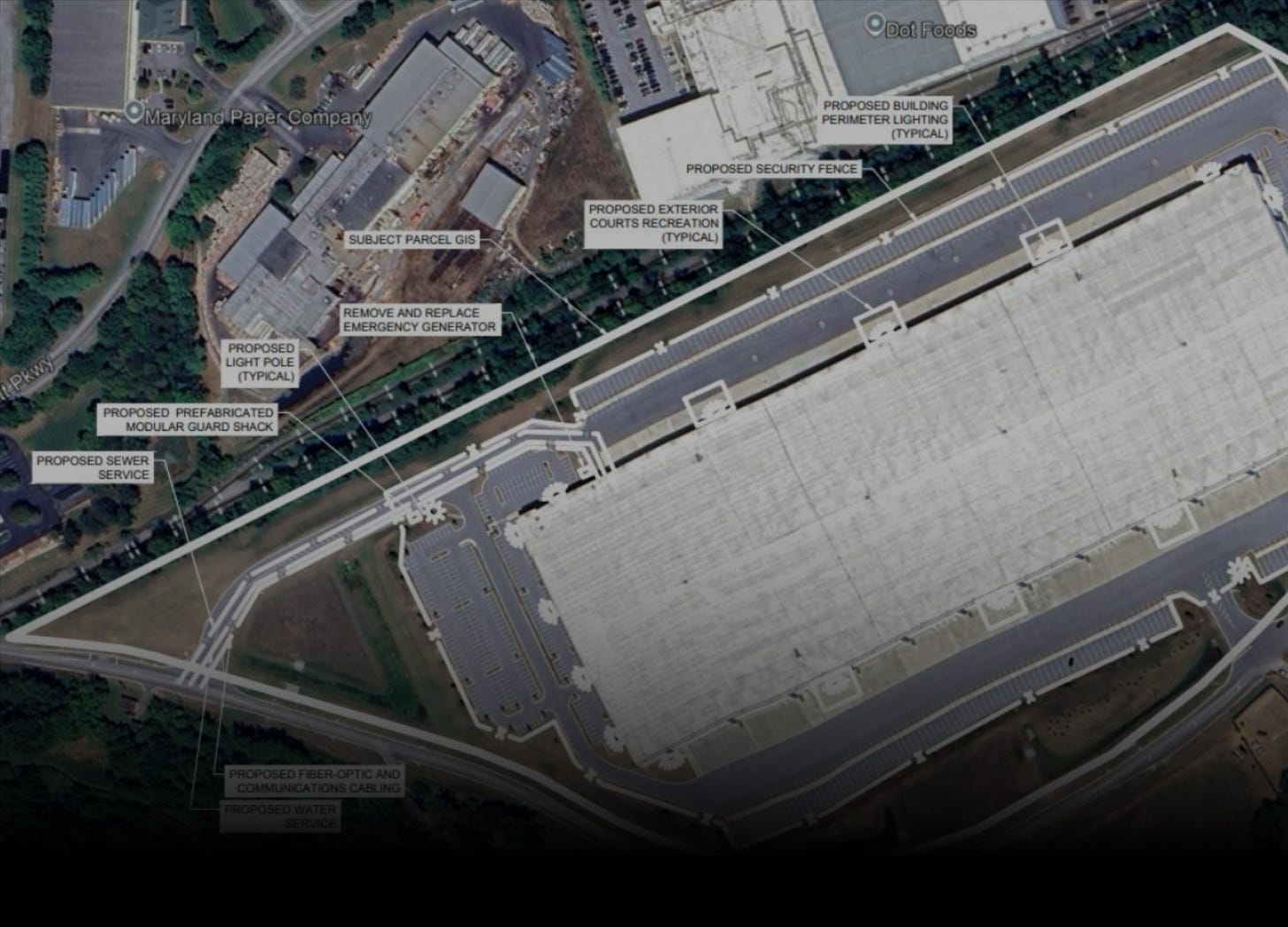
For Washington County, the transaction effectively transforms a private industrial warehouse into a link in the nation’s federal immigration enforcement infrastructure. Situated near the busy nexus of Interstates 70 and 81 — some 70 miles west of Baltimore — the site sits in uneasy proximity to its neighbors: a senior living center to the northwest and a cluster of homes along Hopewell Road to the east.
The federal government’s decision to purchase the site outright, rather than lease it, appears to be a strategic maneuver to bypass local and state interference.
Under Maryland’s “Dignity Not Detention Act,” local jurisdictions are prohibited from entering into new contracts with ICE. However, federal ownership effectively creates a sovereign enclave, insulating the operation from many state-level restrictions.
Local officials, however, say they were left in the dark. While the county maintains it was not consulted on the conversion, federal authorities have yet to disclose a timeline for when the facility will begin operations.
Why does DHS get to spend so much money without a public competitive bidding process?