

Maryland Orders Washington County to Freeze Sewer Expansion for Planned ICE Detention Center
A state environmental order bars the county from expanding its sewer system, the latest obstacle in a legal fight over the federal government's plan to detain immigrants in a warehouse there

Maryland’s top environmental agency issued a binding order on Monday barring Washington County from expanding its sewer system, finding that existing infrastructure cannot handle the waste generated by a proposed federal immigration detention center — and that the county’s sewerage plan, last updated in 2009, is too outdated to evaluate whether it ever could.
The Administrative Order, issued by the Maryland Department of the Environment, was filed the same day in federal court as part of the ongoing lawsuit Maryland brought against federal immigration authorities over their plans to convert a massive warehouse in Williamsport into a detention facility for up to 1,500 immigrants.
The order adds a new legal complication to a project that has faced mounting obstacles since the Department of Homeland Security paid $102.4 million in cash for the 825,620-square-foot warehouse in January — without notifying state or local authorities, filing environmental permits, or contacting the city responsible for supplying the building’s water.
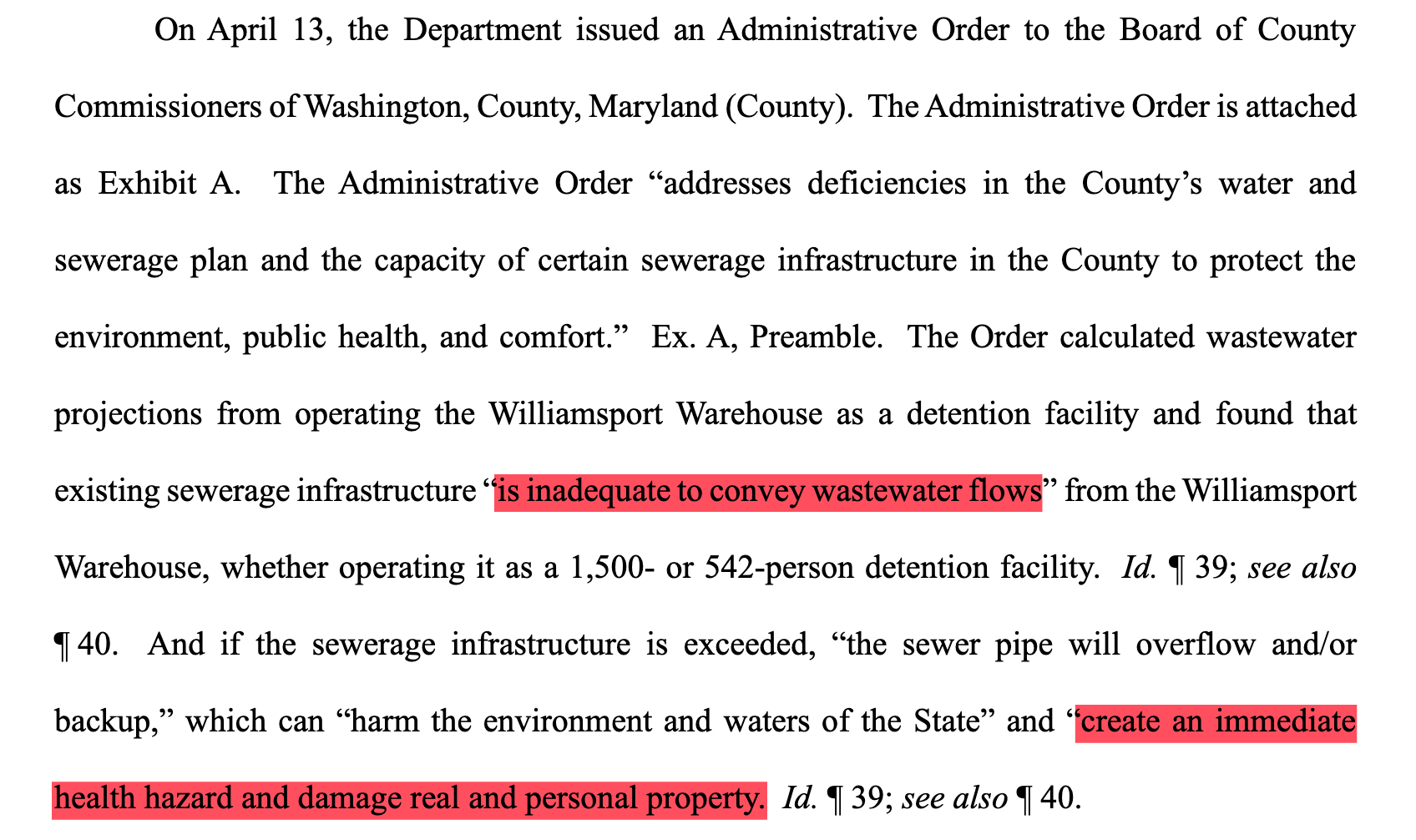
“The sewer pipe will overflow and/or backup,” the order states, describing the consequence of putting the facility into operation. The result, the state warns, would “harm the environment and waters of the State” and “create an immediate health hazard and damage real and personal property.”
The Williamsport warehouse currently receives approximately 800 gallons of water per day — an allocation sized for a small warehouse crew. A detention facility housing 1,500 people, using the per-capita figure from Immigration and Customs Enforcement’s own planning documents, would require an estimated 209,000 gallons daily.
Nancy Hausrath, Hagerstown’s director of utilities, told her city council last month that she had done the math herself. Hagerstown is the sole water supplier for Williamsport, and her department had not received so much as a phone call from federal authorities. “We have not received any contact,” said Ms. Hausrath.
State environmental officials had projected that the facility would generate more than 187,000 gallons of wastewater daily — more than seven times the load from its prior use as a commercial warehouse. The sewer line serving Wright Road, where the facility sits, was not built for that volume. Monday’s order made those projections binding. The Department of the Environment calculated wastewater flows for both a 1,500-person facility and a smaller, 542-person version — a capacity figure that has not previously appeared in public filings and may reflect a scaled-back federal proposal that emerged during litigation. At either size, the agency found, existing infrastructure “is inadequate to convey wastewater flows.”
Until Washington County submits a comprehensive revision of its sewerage plan and receives state approval, it may not “allocate, authorize, or facilitate any increase in sewage flow” and may not “install, modify, or extend any portion of the sewerage system.”
In March, Judge Brendan A. Hurson of the Federal District Court in Maryland issued a temporary restraining order halting all construction at the property for 14 days, finding that Maryland was likely to succeed in its argument that ICE had violated federal environmental law. Judge Hurson noted that the only environmental review he could identify was a brief floodplain notice posted to a Department of Homeland Security website — and that a renovation contract worth more than $100 million was awarded just one day after that comment period closed.
At the same time, six portable restroom trailer units and two water tanker trucks arrived at the Wright Road property. These types of units operate independently of municipal infrastructure, suggesting that federal contractors might be preparing to work around the water and sewer gap rather than resolve it. Whether portable sanitation units fall within the scope of the restraining order is unclear.
Washington County commissioners knew about the infrastructure shortfall before they voted unanimously to support the project. The day after approving the resolution, County Administrator Michelle Gordon wrote to Homeland Security Secretary Kristi Noem to detail what local officials had already identified: the pump station serving the Wright Road property had nearly exhausted its capacity, and the work required to accommodate the facility would cost between $750,000 and $1 million and would need to begin, she wrote, “rather quickly.” The letter also asked Ms. Noem to help secure $300 million to $350 million in federal funding to widen Interstate 81 and $25 million to $30 million to upgrade the county’s regional airport — requests the county tied directly to its cooperation on the detention facility. The county did not raise its infrastructure concerns publicly. In an internal email sent the day the warehouse was purchased, Ms. Gordon had told commissioners that federal supremacy meant the project was “exempt from all State and Local regulations, code and laws.”
Some local officials had recently expressed optimism that ICE was reconsidering its plans, citing a court filing in which the agency said it would not proceed with construction without further environmental review. But ICE made that statement in a brief aimed at defeating a preliminary injunction — arguing there was no imminent harm to halt. The same filing described plans to retrofit the warehouse for an initial capacity of roughly 540 detainees.
Monday’s filing by the office of Maryland Attorney General Anthony G. Brown appeared intended, in part, to press that point before the court. The notice accompanying the Administrative Order told Judge Hurson that the new findings “underscore the inadequacy of existing infrastructure to support the proposed detention facility and the harms that would flow to the State from exceeding the capacity of that infrastructure.”
Stormwater from the Wright Road property drains into Semple Run, which feeds Conococheague Creek, which empties into the Potomac River and eventually the Chesapeake Bay. Maryland has spent tens of millions of dollars restoring the Potomac watershed and has committed to reintroducing 50 million native mussels to the river by 2040. Three state agency secretaries warned in a March letter that sewage overflows from the facility would not stay on the property.
The case is pending before Judge Hurson in Federal District Court in Maryland.
Good news. And hard work by salt box and Hagerstown folks and allies.
It was a $hitty deal and they knew it