

$381 Million. That's What a Maryland County Wanted for Supporting an ICE Warehouse.
Internal records show officials knew the facility's infrastructure would fail and said nothing to residents while seeking hundreds of millions in federal funding and a presidential visit.

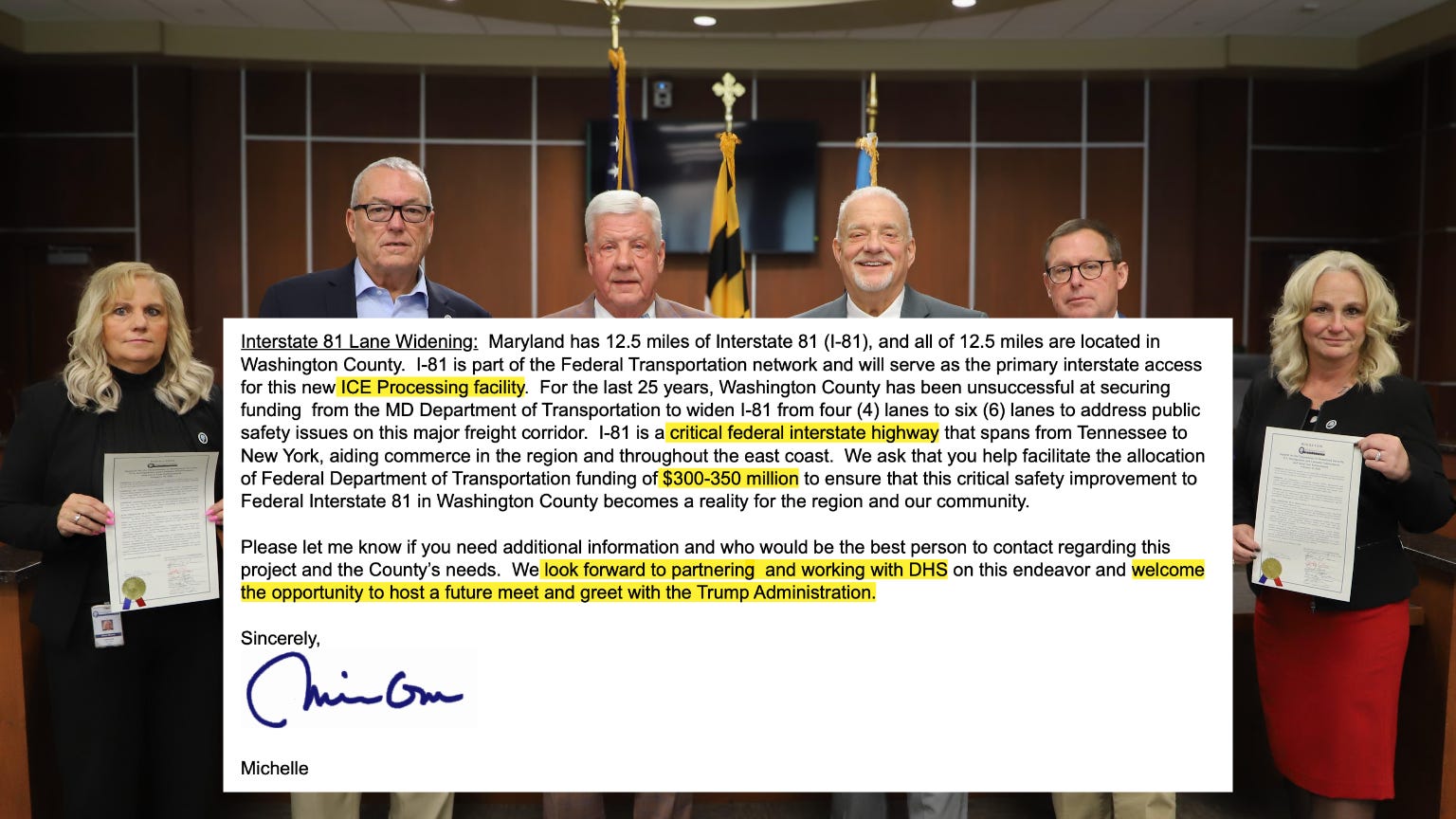
On the morning of February 10, the five members of the Washington County, Md., Board of Commissioners voted unanimously to declare their “full, unwavering support” for the Department of Homeland Security and Immigration and Customs Enforcement. The resolution, stamped with a gold seal, expressed the board’s intent to help federal authorities enforce the nation’s borders and ensure that “all persons are treated with dignity and compassion” in Washington County’s jurisdiction.
The next morning, County Administrator Michelle Gordon wrote a letter to DHS Secretary Kristi Noem asking for $381 million.
The letter, reviewed by Project Salt Box, runs two single-spaced pages. It opens by citing the resolution passed the day before. It closes with an invitation for Noem and President Donald Trump to personally visit Washington County. In between, it makes requests totaling between $375 million and $380 million in federal funding — all tied directly to the county’s new relationship with a federal immigration detention facility that Washington County’s own commissioners had spent weeks telling residents they were powerless to influence.
The letter was copied to the White House at both president@whitehouse.gov and vice.president@whitehouse.gov.

Gordon and the Board of County Commissioners did not respond to requests for comment. Public records requests filed by Project Salt Box with the county in February — seeking communications related to the facility — were not answered within the statutory timeframe and remain open and pending.

The documents were provided to Project Salt Box by Ethan Wechtaluk, a progressive running for the Democratic nomination in Maryland’s 6th Congressional District on a platform centered on government accountability, working-family economic issues, and community investment. The facility at Wright Road would fall within his district if he is elected. He has been among the facility’s most active local critics, partnering with community organizations that have monitored construction activity at the site and documented developments there. The 6th District seat is currently held by Rep. April McClain Delaney, who introduced legislation in February to strip federal funding for the facility.
The funding requests, broken out in Gordon’s letter, are specific. She asked Noem to facilitate $25 to $30 million in FAA funding for improvements to Hagerstown Regional Airport, about 13 miles from the facility, including replacement of a 1973-era air traffic control tower she described as “outdated and obsolete” and relocation of a fuel farm she said “lacks sufficient Jet A capacity” and “is past its useful life.” She asked for $300 to $350 million in federal transportation funding to widen Interstate 81 — which she described as “the primary interstate access for this new ICE Processing facility” — from four lanes to six. The county had been seeking that highway funding unsuccessfully for 25 years. She also flagged that the sewer pump station serving the Wright Road property would require between $750,000 and $1 million in upgrades to handle the facility’s demands — upgrades she said would need to begin “rather quickly.”
The interstate request alone is more than three times what DHS paid for the warehouse.
Since DHS paid $102.4 million in cash for 16220 Wright Road in Williamsport in January — an 825,620-square-foot logistics warehouse that had never had a commercial tenant, purchased at a price more than a third above its most recent appraised value — Washington County’s leadership had maintained a consistent public posture: this is a federal matter, and the county has no authority to act.
That posture was established fast. On January 16, four days after DHS sent a historic preservation consultation letter to the county, Gordon circulated an internal email informing the Board of County Commissioners of the request. Her recommended response, she wrote, was the same as always: “Washington County does not comment on actions being taken by the US Government, Department of Homeland Security.” She added that the federal government could invoke the Supremacy Clause to override local rules regardless. The property, she noted, was zoned industrial general — meaning a detention facility was already a permitted use.
Residents seeking to challenge or even question the facility found limited avenues. Public comment periods before the Board of County Commissioners had been suspended entirely. Advocacy groups organized silent protests, constrained to signs no larger than 12 by 24 inches. Commissioners, when pressed, said their hands were tied.
“While residents were asking questions and getting silence, county officials were rolling out the red carpet for ICE — and even inviting Trump,” said Brandon Thompson of Hagerstown Rapid Response, a local immigrant rights organization that has been monitoring the facility since its purchase. “That should outrage anyone who cares about transparency in this community.”
What makes that silence harder to explain is that the county had a legal avenue to demand answers and chose not to use it. Under the National Historic Preservation Act, local governments with jurisdiction over a federal undertaking are not merely permitted to participate in consultation — they are entitled to it as a matter of right. The Washington County Board of County Commissioners never requested that status. On February 10, they passed a resolution of support instead.
A Different Conversation in Private
What Gordon’s February 11 letter to Noem makes plain is that county officials had developed a detailed and specific understanding of the facility’s infrastructure needs — and of the county’s own exposure — while residents were being told there was nothing to be done.
The sewer disclosure is the most direct example. Gordon’s letter states that the Wright Road pump station serving the facility has just two equivalent dwelling units of remaining capacity, and that upgrading it to handle the detention center’s demands would cost between $750,000 and $1 million. County records show officials had been briefed on this constraint in writing by January 16 — more than three weeks before Hagerstown’s director of utilities, Nancy Hausrath, told a city council work session that her department had received no contact whatsoever from federal authorities about water capacity for the facility. No application, no inquiry, no phone call.
The warehouse’s existing water allocation stands at approximately 800 gallons per day, sized for a small logistics crew. A detention facility housing 1,500 people would require an estimated 209,000 gallons daily — more than 260 times the current supply. Three Maryland state agencies — the Departments of the Environment, Natural Resources, and Transportation — have since warned in writing that without significant infrastructure work, the predictable result would be sewage overflow into waterways feeding the Potomac River.
Hausrath put it plainly at the city council session. “800 gallons a day for 1,500 people is a very low number,” she said, pausing before adding: “Not if it’s a housing facility.” Her department, she confirmed, had received nothing from the federal government. Washington County officials had raised the same concern, in writing, with DHS leadership weeks earlier.
Hagerstown Rapid Response noted the contradiction directly. “The stark contrast between public confidence and private concerns,” the group wrote, “should alarm everyone.”
What the County Knew, and When
DHS purchased the warehouse without public notice, without environmental review, and without consulting state or local authorities. It conducted its historic preservation review under an incorrect address — 10900 Hopewell Road rather than the deed address of 16220 Wright Road, a discrepancy a local resident formally challenged in February, ultimately forcing Maryland’s Historic Trust to reopen its review after finding it had not been given complete information about the project’s scope. More than a month after the purchase closed, DHS posted what it called an “Early Notice” of activity in a floodplain and gave the public eight days to respond. The heads of three state agencies noted in writing that the notice “cannot claim to provide ‘early notice’ when the property was purchased over a month before.” Earlier this month, a federal judge issued a temporary restraining order halting all construction at the site for 14 days, finding Maryland was likely to succeed in its argument that federal authorities had begun work without completing legally required environmental reviews.
Gordon’s February 11 letter to Noem — attaching the resolution of support, itemizing the infrastructure failures, and requesting $381 million — was sent while residents were still trying to determine basic facts about the facility through public records requests that the county has yet to answer.
The documents also reveal a communication that raises questions about what state officials knew, and when. Project Salt Box first reported the warehouse sale on January 27. Two days later, on January 29, Aaron Weiss, Washington County's assistant county attorney, emailed a copy of the DHS historic preservation consultation letter to Dylan Goldberg, the Director of the Office of Intergovernmental Affairs in Governor Wes Moore's office — the official whose specific responsibility is managing the relationship between the governor and Maryland's county governments. County records show officials had been aware of the sale since at least January 16. Commissioner John Barr was copied on the email. Why county officials waited nearly two weeks after learning of the sale to inform a senior aide in the governor's office — and did so only after Project Salt Box made the purchase public — is not known.
January 29 was the same day Maryland’s Historic Trust issued its initial finding that the facility would have no effect on historic properties — a finding the Trust subsequently reopened after residents contacted the agency with information about the project’s scope that DHS had not disclosed.
Members of Hagerstown Rapid Response subsequently contacted Goldberg directly, according to Thompson — underscoring that by the time community groups were asking questions, county officials and a senior aide in the governor’s office had already been in contact about the facility for weeks.
There is no public record that DHS has responded to Gordon’s infrastructure requests. The restraining order halting construction expires within days. For the 1,500 people the facility is designed to detain, no water plan exists.
Surely Washington County can find better county commissioners than liars and thieves.
EVERY👏SINGLE 👏ONE👏REMOVED👏 I've been saying follow the money. This admin is playing a shell game, where's the under the shell..shuffle shuffle shuffle. Ethan has been far more instrumental in finding info than Delaney. This is the kind of work good investigative journalists used to do. I'll keep sending this along to Parnas and V Spehar. Ooooh I'm so mad. I chose Hagerstown after being born and raised in Fl, then going to Shepherd(nearly my worst mistake) and living in NYC off and on for a decade. I've been in this area since 2011...and I'll be damned if racist money grubber spineless wits who bleach bottle dye their hair continue to trounce my selected home.