

Bottom Line Up Front
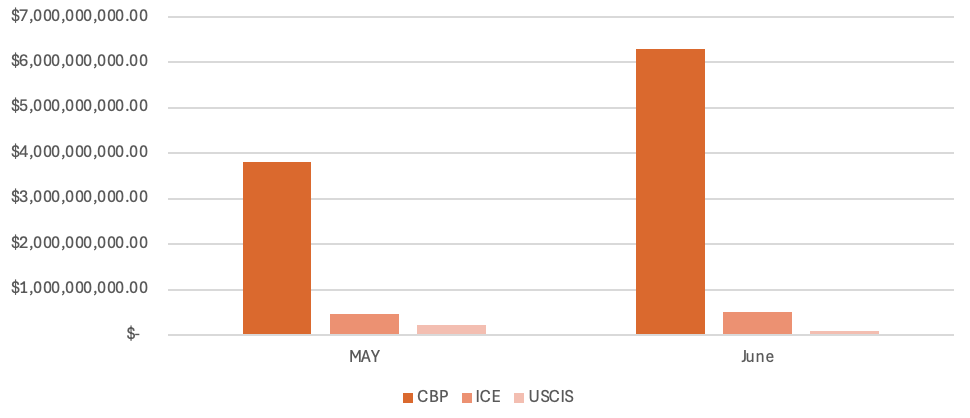
CBP awards record-setting border wall contract: Customs and Border Protection issued what appears to be the largest border wall construction award in its history to Fisher Sand & Gravel - a whopping $2.5 billion for the Big Bend Texas sector. The agency also awarded a $1.3 billion border wall contract to SLS Federal.
DHS Abandons Warehouse Scheme: As first reported by The New York Times, DHS is planning to sell warehouses in Romulus, Mich.; Social Circle and Flowery Branch, Ga.; Hamburg and Tremont, Pa.; Salt Lake City; and Roxbury, N.J.
The end of the road for WEXMAC: In June testimony, Secretary Markwayne Mullin told House appropriators that ICE has stopped using the Navy’s WEXMAC contract for detention services, shutting off the opaque Defense Department vehicle DHS had relied on to expand detention capacity outside normal civilian procurement methods.
DHS pivots from Warehouses to Existing Facilities
DHS is backing away from its most ambitious warehouse conversion plans and shifting back toward more traditional detention real estate: existing jails, prisons, and private facilities that can be brought online faster and with less upfront political risk. After facing lawsuits, protests, and congressional scrutiny, the department is moving to offload or repurpose at least seven warehouses purchased for mega‑centers, while signaling that future capacity increases will rely on “existing detention space with our state and county partners” and on buying operating facilities from private prison companies.
This week, CoreCivic sold two of California’s largest immigration detention centers to the Department of Homeland Security in a $1.5 billion real estate deal, while retaining the lucrative contracts to keep running them for ICE. DHS purchased the 1,994‑bed Otay Mesa Detention Center in San Diego County and the 2,560‑bed California City Detention Facility in Kern County, giving the federal government ownership of the buildings even as CoreCivic continues operations under existing agreements that run into the late 2020s.
CoreCivic expects about $1.1 billion in net proceeds from the sale, which it plans to use mainly to pay down debt and potentially repurchase stock. The deal comes amid broader talks between ICE and major private prison firms about selling additional “turnkey” detention facilities to DHS, a shift away from the now‑stalled warehouse conversion program toward buying and federalizing existing prisons that continue to be operated by the same private vendors.
In parallel, ICE and its contractors are turning to previously closed prisons and long‑dormant sites as the next wave of detention infrastructure. CoreCivic has already reopened shuttered prisons in Kansas, Oklahoma, and Tennessee to house immigrant detainees, and is investing in repairs and upgrades at the closed Prairie Correctional Facility in Appleton, Minnesota, positioning it as a potential ICE hub that would more than double detention capacity in the state if activated.
ICE Says It Has Stopped Using WEXMAC TITUS
Homeland Security Secretary Markwayne Mullin told a House Appropriations subcommittee June 25 that ICE is no longer using the Navy's WEXMAC contract, the Defense Department vehicle DHS relied on to build out detention capacity beyond the disclosure requirements of civilian procurement, according to Federal News Network. As Rep. Veronica Escobar (D-Texas) began asking about ICE's use of the contract to buy detention services, Mullin cut in: “We're not using it anymore, just so you know.”
Task orders issued through WEXMAC TITUS are not publicly advertised, a structure DHS used to award the warehouse conversion contracts in Williamsport, Md., and Surprise, Ariz., that remain in federal litigation. The same vehicle gave ICE fast-track access to The GEO Group after its ceiling was raised to $65 billion, and carried surge support for enforcement operations in St. Paul. A May task order to Acquisition Logistics LLC suggested the department intended to keep relying on the contract. In March, Sens. Elizabeth Warren (D-Mass.) and Jeanne Shaheen (D-N.H.) urged Defense Secretary Pete Hegseth to end the department's support for the arrangement, writing that it was unclear what section of law gave the Pentagon authority to administer detention construction contracts for DHS.
Mullin did not say what will replace WEXMAC for ICE detention purposes. But in April, ICE sought industry input on a set of single-award construction contracts that would let the agency issue detention construction task orders directly, without the limited competition WEXMAC requires and outside Defense Department oversight.
DHS funds investigative contractor network targeting immigrant youth
In late June, DHS and its contractors began building out a nationwide investigative apparatus around immigrant youth placements, with new contracts and job postings that blur the line between child welfare and intelligence work. Under updated performance work statements, contractors are tasked with assessing the “adequacy” and “quality” of minor placements, including probing sponsors or guardians and anyone currently or previously residing at listed addresses. The April modification to the solicitation explicitly expanded that scope to cover people who are no longer minors but were under 18 throughout the period specified in the PWS.
This expansion tracks with a DHS forecast that would give ICE direct access to T‑3 visa applications, a visa category intended for immigrant youth survivors of human trafficking, and with a parallel solicitation for CBP “child caregivers.” These moves combined demonstrate how DHS is building an enforcement‑adjacent pipeline around ostensibly protective programs, tying trafficking‑related claims and child‑focused services into a larger data and investigations architecture.
Who is getting the work
The first award under this structure went to MVM Inc, a firm already known for handling transfers and holding operations for immigrants at Guantánamo Bay. From there, a cluster of companies began actively hiring into these contracts, including SOS International, Savvy Professor dba SVI LLC, Continuity Global Solutions, Alpha Recovery, Delta Point, and others. Open postings describe roles such as “Mission Support Specialist,” “Child Welfare Advocate,” “Youth Counselor,” “Compliance Officer,” and “Field Analyst.”
Many of these titles sound like social services, but the hiring requirements focus on a different set of skills. Experience in investigations and intelligence is often mandatory, while social work is merely “preferred” and bilingual skills are not required. Public bios for company leadership, where available, show deep roots in military intelligence, FBI, defense contracting, security, and other law‑enforcement tracks. Several of the nineteen known companies are newly formed entities with little or no federal contracting history and minimal public information, raising questions about vetting, oversight, and how much of this work will be shielded behind private corporate structures.
Contract values for this emerging network range from roughly $62 million to as high as $3.1 billion. It remains unclear how many subawardees will be brought in, but similar job listings have started appearing at smaller local organizations, including Cayuga Centers, CivTeam, MCHS, and Everstand, suggesting that the operational footprint could spread through community‑based entities that are effectively plugged into a federal investigative framework.
About this Report
All procurement data used in this report is from usaspending.gov and SAM.gov. If there are specific procurements, companies, regions, or topics you would like us to cover in future monthly reports, please reach out to us and let us know.
Targeting the young immigrants makes me the most sick.
Vanguard, Citizens Bank & GEO Group Slave Trade Profiteers: Follow the money
https://thedemlabs.org/2026/06/06/vanguard-citizens-bank-geo-group-slave-trade-profiteers-follow-the-money/