


When Democratic lawmakers this week opened an investigation into the private companies helping build the federal government’s rapidly expanding immigration detention network, they named the obvious targets: CoreCivic and The GEO Group, the country’s largest private prison operators, and some lesser-known newcomers to the immigration detention arena — KVG LLC and GardaWorld, the contractors retrofitting warehouses into detention facilities. They also named PNK LLC — seller of the Social Circle, Ga., warehouse — and the Gosin Group, which represented Newmark affiliated properties in Oklahoma City.
Those companies deserve that scrutiny. Meanwhile, a broad-scope analysis of federal real estate records, contracting data and government financial disclosures shows that the financial beneficiaries of the detention expansion extend well beyond the firms Congress named — reaching into commercial real estate investment vehicles, industrial property funds and holding companies that sold warehouses to the federal government at prices that bore little relationship to what those properties were previously worth.
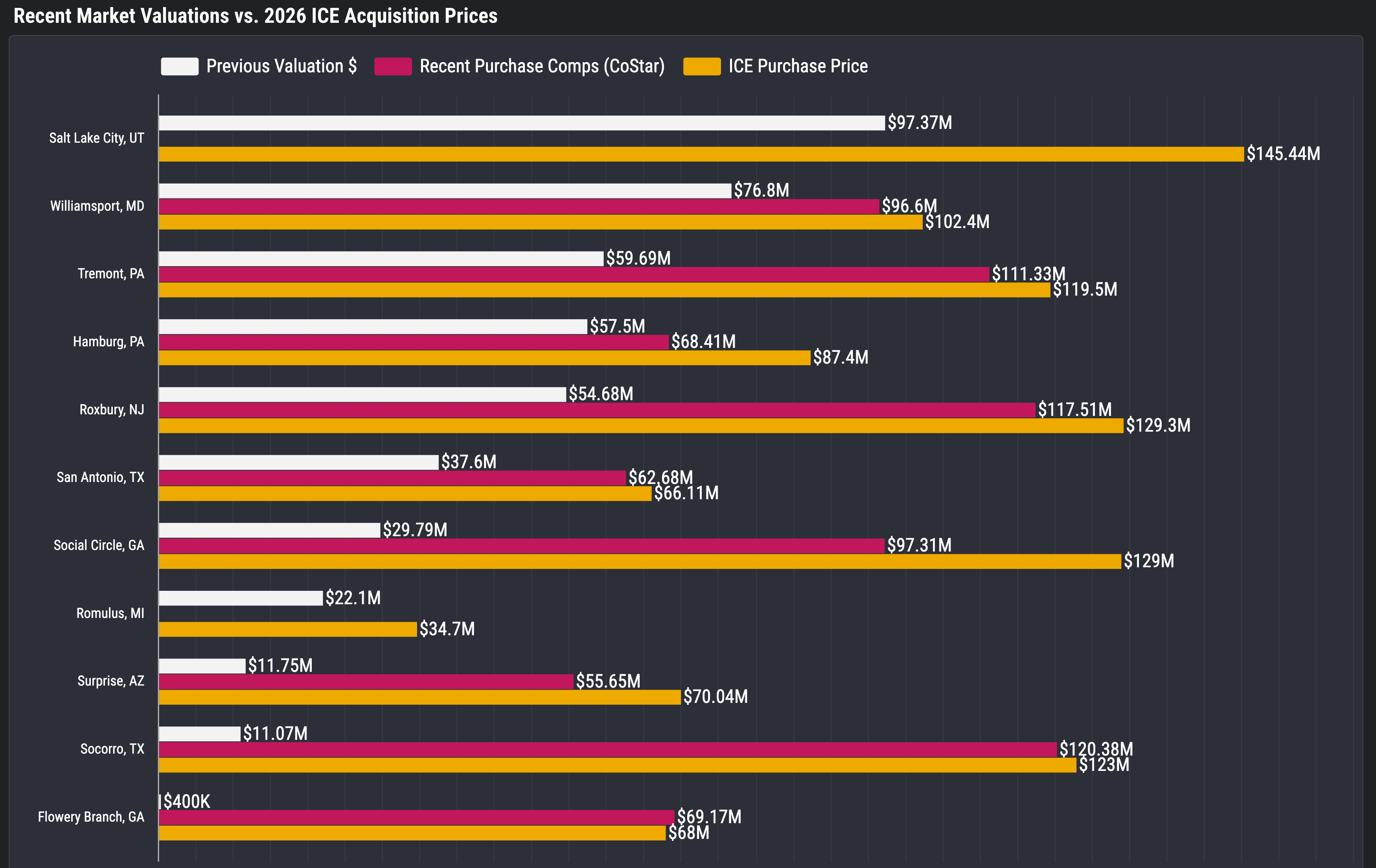
And those numbers are striking. Across more than a dozen warehouse acquisitions, ICE paid prices that exceeded both prior property valuations and recent market comparables at nearly every site. In Salt Lake City, the agency paid $145 million for a property previously valued at $97 million. In Social Circle, Ga., it paid $129 million for a property previously valued at $29 million. In Socorro, Texas, a property carried on the books at $11 million sold for $123 million.
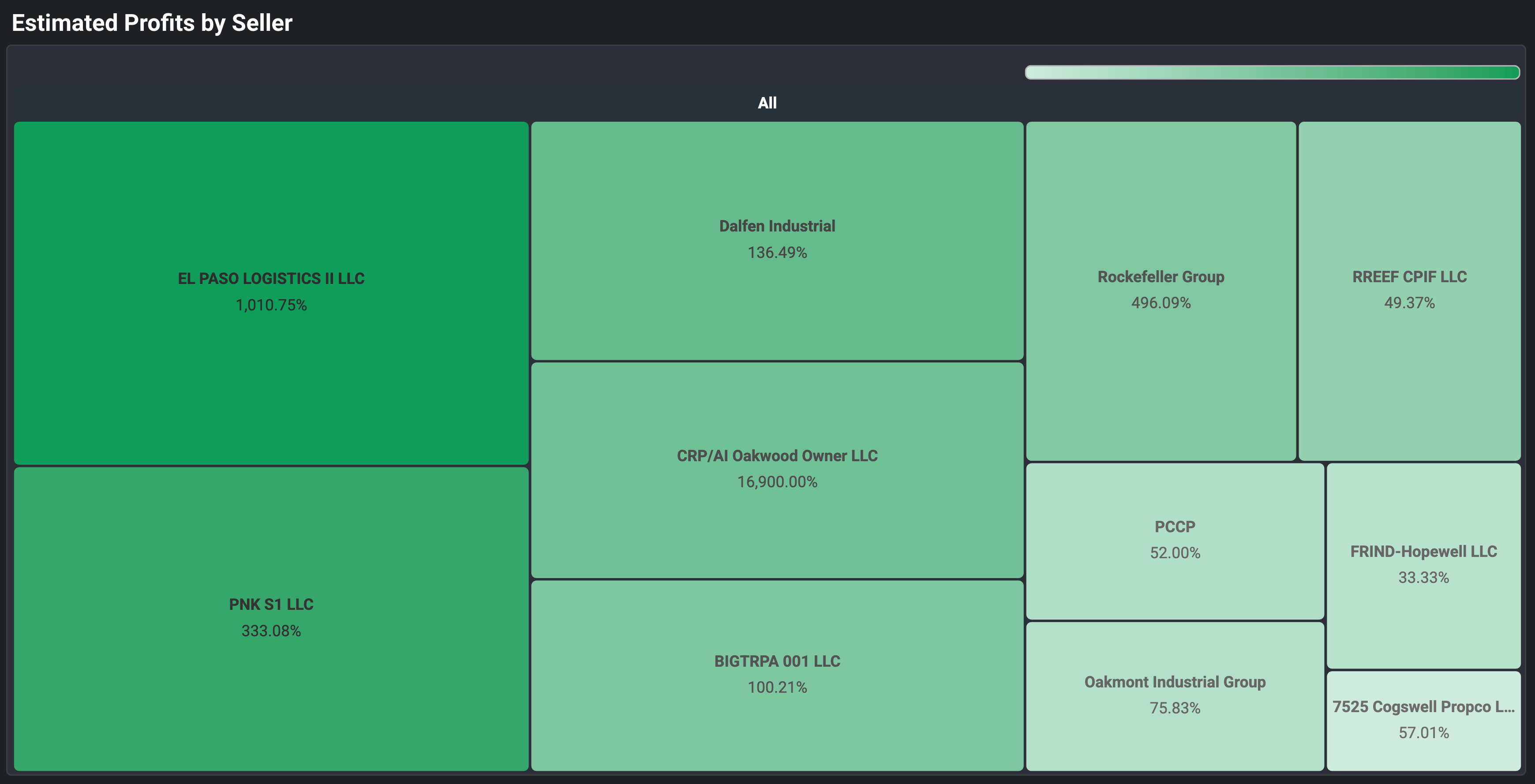
The sellers who captured those gains are largely unknown to the public. El Paso Logistics II LLC, which sold the Socorro warehouse, realized an estimated profit of more than 1,000 percent. CRP/AI Oakwood Owner LLC recorded an estimated gain of 16,900 percent. The Rockefeller Group realized roughly 496 percent. These are not the detention contractors that congressional investigators have focused on. They are the landlords who cashed out.
The real estate firm whose name appears most frequently across the warehouse transactions is CBRE, which reporting has linked to brokerage roles in deals including the El Paso, Surprise and Romulus sites.
Steven Kelley, the former CEO and Vice-Chairman of DoD logistics provider J&J Worldwide Federal — which was acquired by CBRE last summer — left the company in August 2025 to establish SK2 LLC. That small firm was granted a nearly $6 million contract earlier this year for its services in brokering the warehouse deals on behalf of DHS.
Fundrise — the investment platform whose vehicle sold the Williamsport, Md., warehouse to ICE for $102 million — even alluded to the “largest real estate brokerage firm in the country” as negotiating the deal on behalf of ICE in an email to an investor earlier this month. CBRE matches that description. Why Fundrise described CBRE and not SK2 is not clear. Fundrise did not respond to a request for comment.
Financial disclosure records obtained by ProPublica during the first year of the Trump administration show that CBRE stock is among the most widely held equities among administration officials — appearing in the portfolios of more than two dozen appointees, including Thomas Homan, the administration’s border czar; Energy Secretary Christopher Wright; and Edward Forst, the administrator of the General Services Administration, the agency that oversees federal real property. Robert T. Law, the DHS Undersecretary for Strategy, Policy, and Plans — one of the officials with the most direct role in the detention expansion — also disclosed holdings in a CBRE real estate fund.
Federal ethics rules require officials to recuse themselves from matters that could directly affect their financial interests. But those rules were built for a normal procurement environment — not one in which a single firm is potentially involved in billions of dollars of real estate transactions moving on timelines sometimes measured in days. Whether recusal was required, or sought, for any of these transactions is not publicly known.
The Fundrise connection is even more direct, and has investors among administration officials as well. Morgan Dewitt, a special assistant to the president for personnel at the White House, has a spouse who holds Fundrise fund investments. Peter Lamelas, the ambassador to Argentina, disclosed holdings across at least nine Fundrise funds. Arjun Mody, the deputy commissioner of the Social Security Administration, holds both Fundrise and CBRE investments.
None of this establishes that any official influenced any transaction on behalf of their portfolio. Financial disclosures exist precisely to surface these overlaps, and most of the holdings are modest. But the breadth of the connections — CBRE stock held by the border czar, the GSA administrator, the DHS policy undersecretary and the president himself; Fundrise funds held by a White House personnel official as the Williamsport deal closed — is precisely what oversight is designed to scrutinize. Congress has not yet examined it.
A separate inquiry sent last week by Ms. Warren and Senator Jeanne Shaheen to Defense Secretary Pete Hegseth highlights a much different but no less crucial dimension to ICE’s push: the contracting mechanisms enabling the projects.
In that letter, the senators raised concerns about the use of a Navy contracting vehicle known as WEXMAC TITUS, originally built to support military logistics abroad. The contract was modified last year to cover detention and custody support inside the United States, its spending ceiling was raised by 550 percent to $65 billion, and 23 new companies were added to its vendor pool — among them The GEO Group. Because work issued through WEXMAC TITUS is not publicly advertised, neither Congress nor the public has meaningful visibility into how contractors are selected, what work they might perform, or what standards they are ultimately held to.
The agency has compounded that opacity through its reliance on sole-source contracts — awards made without competitive bidding. As my colleague Em Knepp reported yesterday, in the past month alone, ICE posted only two competitive solicitations on SAM.gov while awarding at least ten contracts without competition, more than half of them justified on the grounds that only one vendor could do the work. One such award, worth roughly $1.2 billion, went to Amentum Services to manage Camp East Montana, a facility previously cited for serious problems. Amentum had been working there as a subcontractor when its predecessor’s contract was terminated. ICE then handed the same company a larger, noncompetitive contract.
The speed of the acquisitions has been matched by a systematic avoidance of required reviews. In Maryland, ICE executed the $102 million deed for the Williamsport warehouse just four days after initiating required historic preservation consultation, without waiting for a response, and notified county officials only days before the sale closed; the state attorney general has since filed suit seeking relief, and a judge recently extended a temporary block on the project. In Michigan, federal officials never directly contacted local leaders about a site in Romulus that sits within a mile of an elementary school on flood-prone land, prompting the state to sue to halt the conversion. And in New Jersey, the agency did not assess whether the building met basic standards for detention use before completing the purchase, and the state attorney general has filed a similar lawsuit seeking to block the project.
The Warren-Raskin investigation is a legitimate and much-needed exercise of congressional oversight. The letters are pointed, the questions are the right ones, and the named companies should be made to answer them. But as currently scoped, the inquiry focuses on a small cross-section of the contractors and operators enabling these facilities. The sellers who profited from the acquisitions, the brokers who facilitated them, and the officials whose financial disclosures overlap with both remain yet unchallenged.
Follow the money. Their cruelty is only matched by their corruption. Thank you for bringing transparency to their deals and holding them accountable. You are heroes!
Some of the names on this list- Rockefeller Group and CBRE are not surprising. Both are leading real estate firms that develop and manage warehouse logistics assets. I mean, you'd expect to see them in these deals given that DHS has developed an entire strategy of buying large warehouse facilities and converting them to concentration camps.
What is worth running to ground very closely is the ridiculous transaction prices and profit margins being made on these deals. The least corrupt explanation I can come up with is- DHS, with billions of dollars sloshing around in its budget, is slapping huge stacks of cash on the deal table so they can close these deals in a Blitz Krieg fashion and set about to converting facilities super fast before the public can figure out what has happened- essentially throw tons of money at these warehouses and move fast. That's the least corrupt scenario I can think of.
It's probably more plausible these are all sweetheart deals structured to line the pockets of friends of the regime.