

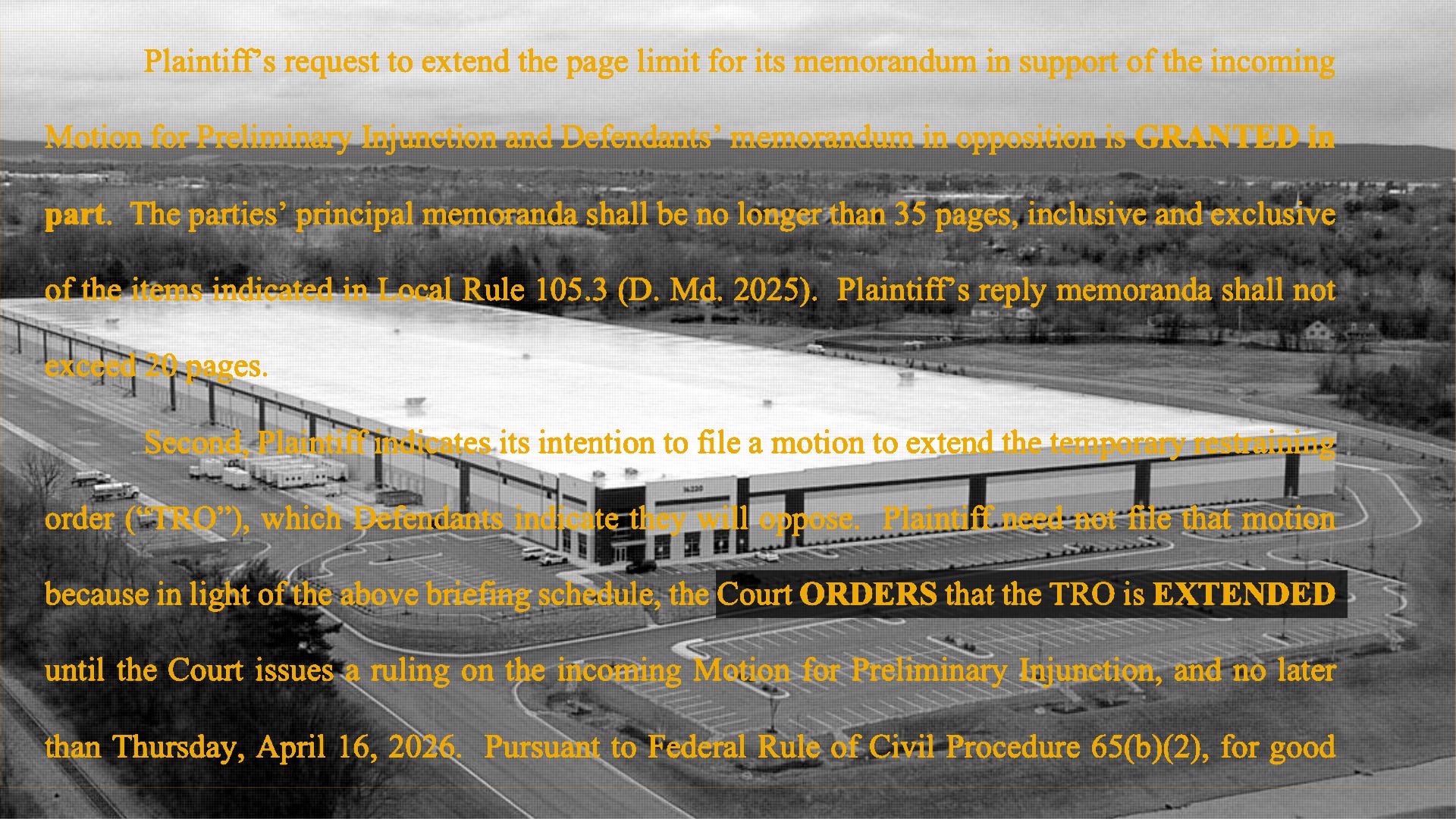
A federal judge on Thursday extended a construction halt on a warehouse the Trump administration is converting into an immigration detention center in Western Maryland, keeping work stopped through at least mid-April and scheduling a hearing that could determine whether the project is frozen for the duration of a lawsuit.
U.S. District Judge Brendan A. Hurson extended the block until no later than April 16, and said he expects to rule on a longer-lasting injunction at or immediately after a hearing the week of April 13. The extension came as part of a joint scheduling order the parties negotiated together.
The ruling forecloses any resumption of work at the Williamsport Warehouse, a 825,000-square-foot property in Washington County that the Department of Homeland Security purchased for $102.4 million and contracted to convert into a detention warehouse for $113 million more. The facility was intended to hold up to 1,500 immigration detainees.
The order also surfaced a new development: the federal government has asked the court to clarify or modify the restraining order to permit certain unspecified work at the property. Judge Hurson declined to rule on the request, directing the government instead to file a formal motion explaining precisely what it wants to do and why less invasive alternatives — he suggested hiring a security guard — cannot suffice in the interim.

The April hearing will be the first time the federal government must substantively defend the project in open court. Under the briefing schedule Judge Hurson set, Maryland must file its motion for a preliminary injunction today; the government's opposition is due April 2, with Maryland's reply following on April 9.
A preliminary injunction, if granted, would extend the construction freeze for the duration of the litigation and require Judge Hurson to reach more definitive conclusions on the core legal questions in the case, rather than the preliminary assessments that supported the original restraining order.
The central dispute is whether federal agencies were required under the National Environmental Policy Act to complete an environmental review before beginning construction. Maryland argues they did neither. Judge Hurson found in his initial ruling that the state was likely to succeed on that argument, noting that DHS awarded its renovation contract just one day after a public comment period closed on a limited floodplain notice the agency had posted to its website — a timeline he said could not support a finding that officials took a genuine look at environmental consequences before acting.
If Judge Hurson grants a preliminary injunction in April, the administration would likely face a choice between initiating the environmental review process the court says was probably required — something the existing order already permits — or seeking a stay from the Fourth Circuit Court of Appeals. A similar stay was granted in a parallel Florida case last fall, but on grounds the judge has already distinguished: that case turned on the absence of federal funding, while here the federal government has spent $215 million acquiring and contracting to renovate the property.
For Washington County officials, who have backed the project as an economic development opportunity, the extended pause prolongs uncertainty. For Maryland and the environmental groups that filed comment letters during the brief public notice period, it sustains a block they argue is necessary to protect three downstream waterways — Semple Run, Conococheague Creek, and the Potomac River — and state-listed endangered species in the surrounding watershed.
The specific hearing date has not been set; Judge Hurson directed the parties to confer and contact his chambers with a preferred date during the week of April 13, noting that he is unavailable on April 17. The parties were also asked to account for witnesses as well as argument when estimating the hearing’s length.
This is great news, thank you for keeping us informed!
An observation: The supposed economic development opportunity boasted by our local representatives deserves a closer look.
Maryland and West Virginia have Reciprocal Tax Agreements, relative to personal income taxes. So when a resident of West Virginia works in Maryland, they pay income taxes to West Viriginia, not Maryland. Our state with this warehouse will make no state or local income taxes off of West Virginia workers employed at the facility.
This is important, because Williamsport, MD borders West Virginia. You can cross a bridge between the states in less than a couple minutes, and West Virginia residents regularly seek employment in Maryland...better wages, better benefits, but they do not pay their income taxes to Maryland.
Thanks for doing this work! American heroes! ✌🏻🇺🇸
I got a silly question, how should I in Baltimore keep track of an 🧊 blitz?