

The United States federal government is the world’s largest single purchaser of goods and services. Every year the US government spends hundreds of billions of dollars on everything from janitorial services to Boeing 747s. The Department of Homeland Security is a big part of that spending. Last year, DHS spent $90–100 billion, and Congress layered an additional $191 billion in multiyear enforcement money on top of that through the One Big Beautiful Bill Act (OB3). As of early 2026, DHS still has roughly $150 billion in unspent funds from the OB3 on top of its regular annual budget in the tens of billions.
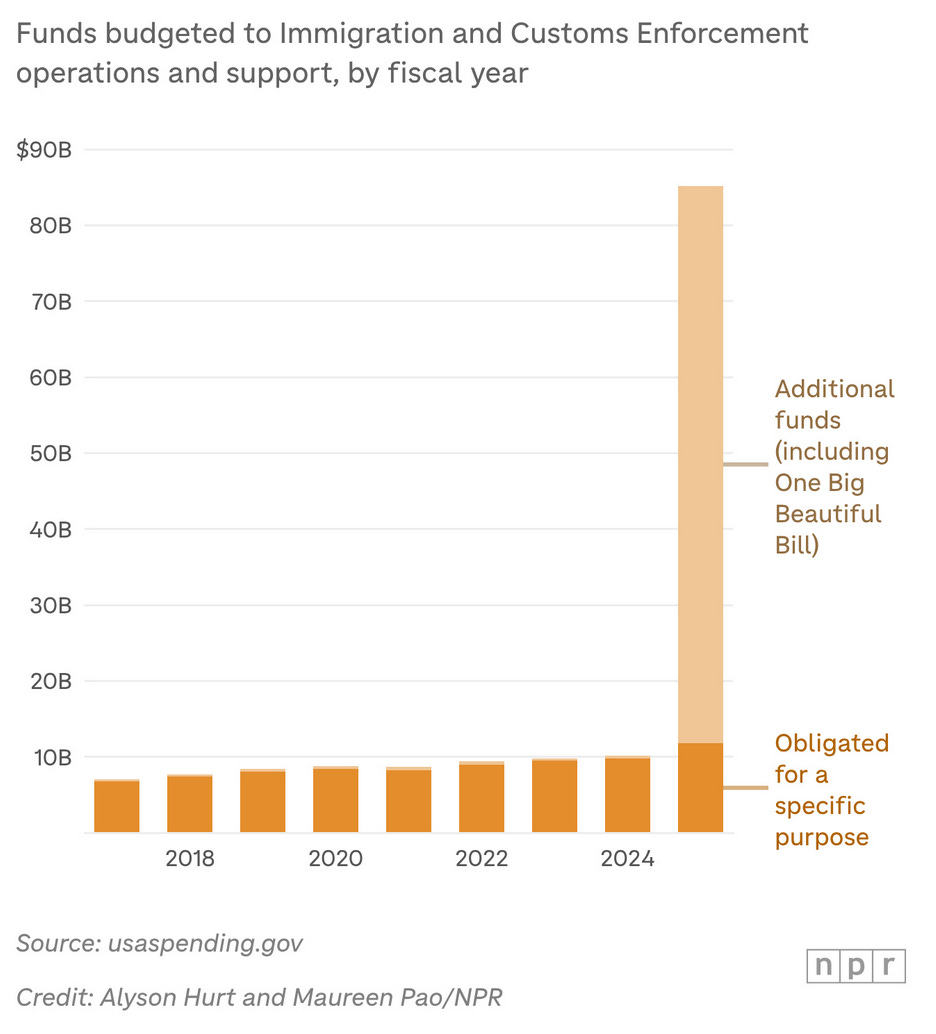
DHS is spending massive amounts of taxpayer dollars on recruitment, spyware, border wall construction, and new detention facilities, but the mechanisms through which the agency spends its money are largely unknown – likely because the federal procurement process is incredibly complex. Laws governing federal procurement are scattered across the U.S. Code, the Federal Acquisition Regulation (FAR), and agency-specific supplements.
As DHS – and ICE in particular – races through billions in public money with steadily decreasing transparency, it is critical for activists, attorneys, public officials, and anyone concerned with accountability to understand at least the basic rules that are supposed to govern how the agency spends their taxpayer-funded budget.
Competitive vs. Non-Competitive Purchases
When the government wants to buy something over a certain dollar threshold (typically in the tens of thousands of dollars, depending on the type of purchase), it is generally required to use a competitive procurement process. This involves issuing a Request for Proposals (RFP), allowing interested vendors to bid on the work, evaluating those proposals against stated criteria, and selecting a winning offer. Project Salt Box has reported on several competitive procurements, including the recent Safety Verification Initiative. Those RFPs were posted on SAM.gov, the main public website the federal government uses to advertise open competitive contract opportunities, although agencies can also compete work through pre‑established contract vehicles. This competitive process is meant to promote fairness, accountability, and transparency in how taxpayer money is spent.
As with most rules, there are exceptions to competitive purchasing. In certain circumstances, agencies can issue a “sole-source” contract to a company, effectively bypassing the RFP process. These circumstances include, but are not limited to:
Only one responsible source exists (proprietary, patented, or unique product/service)
Vendor holds unique data rights, software, or IP that others cannot legally/technically use
Urgent and compelling need (true emergency where delay for competition would harm the mission)
Disaster or crisis response where there is not enough time for competition
National security considerations that limit who can perform
Highly specialized consulting or technical work where the expertise is one-of-a-kind
While sole-sourced contracts limit competitive bidding, they are built into the legal procurement system, and in many cases, they are genuinely necessary. During a major hurricane or wildfire, for example, the government cannot wait out a months‑long bidding process just to get temporary housing, emergency communications gear, or debris removal underway; it needs contractor support in days, not weeks. Or, an agency might rely on a proprietary climate‑modeling system to predict flood risks, or a specialized air‑traffic control software to manage flights safely, where only one company owns the code and has the expertise to update or support it. There are many legitimate reasons to sole-source a contract, and – perhaps unsurprisingly – there are ways to exploit the system.
How ICE is Pushing the Boundaries:
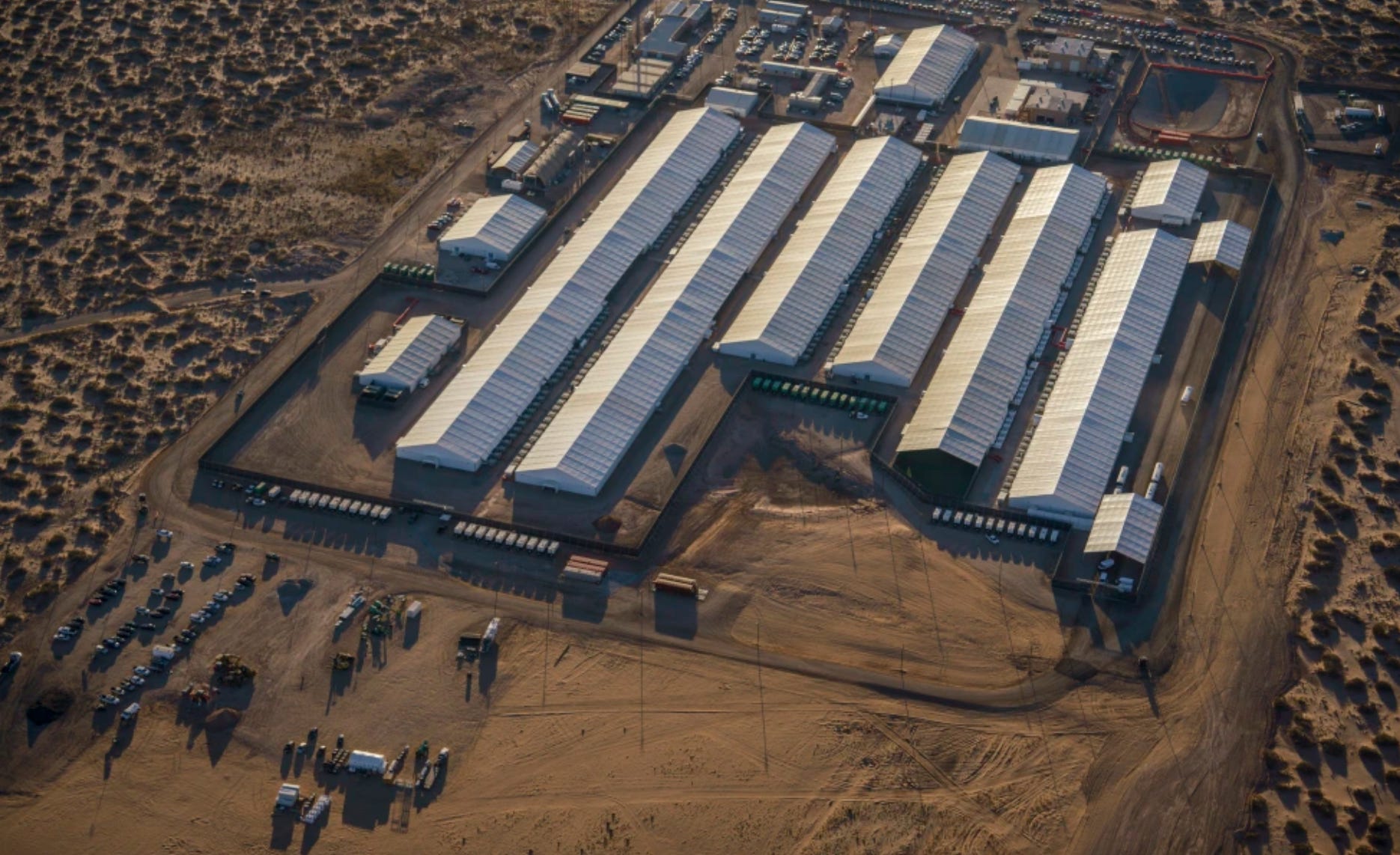
Lately, ICE has been increasingly turning to sole-source contracts over competitive bidding processes. In the last month alone, there have been only two competitive RFPs posted on SAM.gov. In that same period, ICE awarded at least ten sole-source contracts. Of those, over half were justified by the reasoning that “only one responsible source exists” to carry out the work, including an award to Amentum Services to take over the detention and facility management of Camp East Montana. The value of that contract is roughly $1.2 billion. In its justification document, ICE stated that “the proprietary nature of the facility’s infrastructure, including housing units, generators, and food service equipment, precludes competition as no other vendor possesses the necessary rights or operational control to provide uninterrupted services at this location.”
Amentum Services had previously worked at Camp East Montana as a subcontractor to Acquisition Logistics, the prime contractor whose contract was terminated after widely reported concerns about conditions at the facility. Given Amentum’s size, capabilities, and role on the ground, it is likely that they were performing much of the day‑to‑day operations even before the Acquisition Logistics’ contract was pulled. In effect, the government is now awarding a new sole‑source contract to the same large company that was already deeply involved in running a facility cited for serious problems, rather than opening the work to broader competition.
Another contract was awarded to IMPLAN, a company with economic modeling software that is likely being used for the agency’s economic impact analyses of their warehouse purchases. ICE cited “unusual and compelling circumstances” to avoid a competitive procurement and stated that “the urgency of this requirement is such that adhering to normal competitive procedures would result in unacceptable delays.” Meanwhile, several state Attorneys General are arguing that ICE is moving so fast on the warehouse build‑outs that it is skirting basic legal safeguards, including required environmental reviews and public input.
ICE’s use of sole‑source contracts is not illegal. The agency is operating within the federal procurement framework laid out in the FAR. At the same time, its reduced reliance on competitive procurement raises legitimate questions about how often, and how well, those exceptions are being scrutinized. When an agency repeatedly awards large, noncompetitive contracts — including awards exceeding $1 billion — it warrants closer examination from watchdogs, lawmakers, and the public.
Contract Vehicles
SAM.gov is the main public website for federal RFPs, but a lot of contracting actions happen through separate “contract vehicles.” A contract vehicle is basically a pre-approved list of vendors. The government runs a big competition up front that any company can participate in, picks a subset of companies who win the ability to bid on future work, and then sends work opportunities only to that group. Later, when agencies have specific projects, they issue RFPs (often called task orders) only to the pre‑selected pool, and those vendors compete amongst themselves instead of against the entire market.
The exact number of contract vehicles being used by the government is unknown, but it is in the hundreds, if not thousands. They vary in size, from major government-wide vehicles with thousands of pre-approved vendors, to smaller agency-specific contracts that only include a handful of companies. All contract vehicles have a defined scope, meaning they can only be used to buy certain types of work. Some vehicles are IT‑focused, some cover logistics, and others have broader “professional services” scopes. The idea is that an agency can move faster by buying from a pre‑vetted group of companies it already knows are qualified to do that specific kind of work.
How ICE is Pushing the Boundaries:
Like most government agencies, ICE uses a wide range of contract vehicles to buy goods and services. Among others, the agency uses an NIH-administered, government-wide acquisition contract (GWAC) called CIO-SP3 to procure IT services and solutions, a GSA contract vehicle called OASIS+ to buy consulting, financial, and other professional services, and a NASA-administered vehicle called SEWP to buy IT equipment. This is common and even best practice in government procurement. Contract vehicles offer a streamlined way for the government to buy what they need, while still allowing for competitive bidding.

Where the agency is raising eyebrows — and concerns — is in its recent use of a Navy contracting vehicle known as WEXMAC TITUS. Originally established to provide rapid‑deployment logistics and base support services for military operations overseas, WEXMAC TITUS was modified last year to do four big things: expand its scope to work inside the continental United States; explicitly cover detention‑ and custody‑style support services, such as facility management, transport, and infrastructure setup; raise the contract’s ceiling by 550% to $65 billion (up from the original $10 billion ceiling); and on‑ramp 23 new companies in January, including The GEO Group, one of the country’s largest private prison and immigration detention operators.
ICE has already used WEXMAC TITUS to award two warehouse conversion contracts for the recently acquired sites in Williamsport, MD and Surprise, AZ. KVG, LLC and Gardaworld Federal Services were awarded construction contracts valued at $641 million and $704 million, respectively. Because of the closed nature of contract vehicles, the public – including Congress – has little-to-no visibility into these contracts. From publicly available data, we know that each of the warehouse conversion contracts were competed amongst the WEXMAC TITUS companies and that six companies bid on the Surprise, AZ contract, with four bidding on the Williamsport work.
Outside of that, we are in the dark. It is unclear what the exact scope of work is, what subcontractors are assisting, how the government evaluated and selected KVG and Gardaworld, and what quality and performance standards they will be held to. Without transparency into deliverables, oversight mechanisms, or accountability provisions, lawmakers and the taxpaying public have no way to assess whether these massive detention construction efforts comply with procurement law, human rights obligations, environmental and safety regulations, or basic standards of fiscal responsibility.
It is also unclear how WEXMAC TITUS was authorized to include the United States as an area of performance and how detention and custody-support services were added to its scope. In a recent letter to Defense Secretary Pete Hegseth, Senators Elizabeth Warren and Jeanne Shaheen raised their concerns about the use of WEXMAC. “It is unclear whether there is any other section of law that provides DoD with contracting authority for this arrangement with DHS,” they state. The letter continues, “DoD should not be allowing DHS to use the WEXMAC 2.2 TITUS contract vehicle to bypass federal acquisition procedures and fast-track the construction of migrant detention facilities throughout the United States.” The senators conclude with a detailed list of questions seeking clarification on the legal authority and approval process behind the arrangement, the subcontractors and oversight mechanisms involved, the handling of costs, reimbursements, and human rights safeguards, and the extent of Navy and DoD involvement in site selection, management, and compliance with congressional reporting requirements.
Secretary Hegseth has until April 13 to respond.
Real Property Purchases

Real property (land, buildings, warehouses, prisons) does not fall under the same laws as buying goods and services. Instead of the FAR, real estate purchases are governed by a different set of laws and regulations centered on Title 40 of the U.S. Code and the government’s real property rules. The General Services Administration (GSA) is the primary landlord for civilian agencies. If an agency needs space, the default is that it first tells GSA what it needs, then GSA scouts sites, orders appraisals, negotiates with owners, checks the title, and either buys the building or signs a lease for the agency to use.
This centralization of real estate purchase and management under GSA is meant to ensure that the government is buying legitimate property, avoiding unnecessary space (thus wasting taxpayer money), estimating long‑term costs, presenting budgets to Congress for approval and oversight, and evaluating the broader environmental and community impacts of new facilities before purchase.
In most cases, agencies are supposed to go through GSA, but there are some important exceptions where they are permitted to buy property themselves. Certain agencies have their own real estate authority written into statute—Defense, Veterans Affairs, or parts of Homeland Security—and can acquire or build facilities directly when Congress has clearly given them that power. Agencies can also sometimes operate under delegated authority from GSA, which lets them handle specific projects or types of property on their own while still being bound by the broader federal real property rules.
In practice, that means an agency like DHS can argue it has the power to buy and control facilities (e.g. detention sites) when it can point to a mission‑specific statute and dedicated funding, even if it is stepping outside the usual GSA‑managed route.
How ICE is Pushing the Boundaries:
DHS can sometimes buy or control its own property, but it is still supposed to operate inside a formal real property system. The department has a Real Property Management Manual that requires components like ICE to justify new facilities through capital planning, use or request GSA support where possible, document why a particular site is needed, and complete environmental and historic‑preservation review before large, long‑term projects. Even when DHS acts under its own or delegated authority, the manual is meant to keep decisions about land and buildings tied to mission need, long‑term cost, and community impact.
Separately, under immigration law (8 U.S.C. § 1231) DHS has the authority to detain certain people with final removal orders and “arrange for appropriate places of detention.” The law goes on to say that when suitable government or rental space is unavailable, it may “acquire land and … acquire, build, remodel, repair, and operate facilities” for detention. The statute also says DHS should consider using existing prisons, jails, or comparable facilities before building new ones. In other words, Congress has given DHS both a detention mandate and explicit authority to obtain facilities for that purpose—but it has not erased the expectation that DHS should still follow its own real property policies and broader federal safeguards when it chooses where and how to do that.
The recent lawsuits in Maryland, Michigan, and New Jersey highlight how DHS is using its detention mandate to skirt required review and public process. The Maryland lawsuit points out that ICE executed a $102 million deed for the Williamsport warehouse “just four days after initiating NHPA consultation, and without awaiting any response” from the state historic‑preservation office, and that county officials were notified only days before the sale.

Michigan’s complaint over the Romulus site highlights that federal officials “have not directly communicated with local leaders,” that the warehouse is within a mile of an elementary school and on a flood‑prone site, and asks the court to vacate the decision and enjoin any conversion or operation as a detention center.
New Jersey argues that DHS never meaningfully considered whether the building is an “appropriate place of detention” given limited water, sewage, and public safety capacity, while also failing to comply with NEPA, the Intergovernmental Cooperation Act, and the AP.
These lawsuits allege that DHS is using a broad detention statute to justify buying and converting warehouses, but it is not following the real property procedures required by its own manual and by federal law. They argue there has been no serious alternatives analysis, no genuine environmental and community review, and little to no advance engagement with the states and towns that will be living next to these “appropriate places of detention.”
Through sole‑source contracts, opaque contract vehicles like WEXMAC TITUS, and aggressive real property acquisitions, ICE is turning narrow exceptions in federal procurement rules into its standard way of doing business. On an individual basis, these actions are within the confines of federal procurement, but together they suggest a deliberate strategy to move billions of dollars and build new detention infrastructure with as little scrutiny as possible.
@Project Salt Box are tracking this closely 🙏
Excellent and very comprehensive discussion of what sounds like procurement abuses. I know little about the structure of DHS, and that Trump has eliminated most Inspector Generals (IG). Are these documents subject to the Freedom of Information Act? I don't think operating a prison like facility should contain classified information. Contracting officers are responsible for the appropriate use of government funds and compliance with regulation, making it a difficult job for those who try to follow requirements. These omnibus contracts have been around for quite a while, and are subject to abuse, thus the need for oversight by levels above the contracting office, but without an IG in place, what could go wrong? Usually, competition keeps procurement processes fair and open, but that another problem with these omnibus contracts. Perhaps the Navy has some oversight role in that it is a Navy contract, but the problem is that Trump has his minions in place in DoD, too.