


This morning, ICE launched a market research effort to establish multiple “highly flexible construction contracting vehicle[s] to support mission-critical facility needs.” According to the record on SAM.gov, the agency is considering awarding contracts to several companies to establish a portfolio of single‑award construction contracts (SACC) that would let it rapidly design, build, renovate, and demolish ICE facilities across the country over the next five years.
The scope of work for SACC is broad. It includes, but is not limited to:
General design and construction management
Site planning and environmental planning assessments to support ICE compliance with the National Environmental Policy Act and other federal and state environmental requirements
Alteration, modification, and renovation of existing facilities
Maintenance and repair of existing buildings and infrastructure
Demolition of structures and facilities
Engineering analysis and site assessments (for example, geotechnical surveys) to support design‑build of real property assets
Design‑build renovation and new construction services
Of note, ICE is assigning this work to NAICS code 236220, a federal industry category for commercial and institutional building construction. Using 236220 is a sign that the agency anticipates using these contracts for large-scale, institutional building work, not small projects or repairs.
More, the solicitation specifies that the SACC IDIQs are also intended to “support emergency responses to natural disasters and emergencies.” It’s not clear why ICE — whose core mission is immigration enforcement — would need a construction contracting vehicle that accommodates disaster response, a function that traditionally falls to FEMA.
“Highly flexible construction contracting”
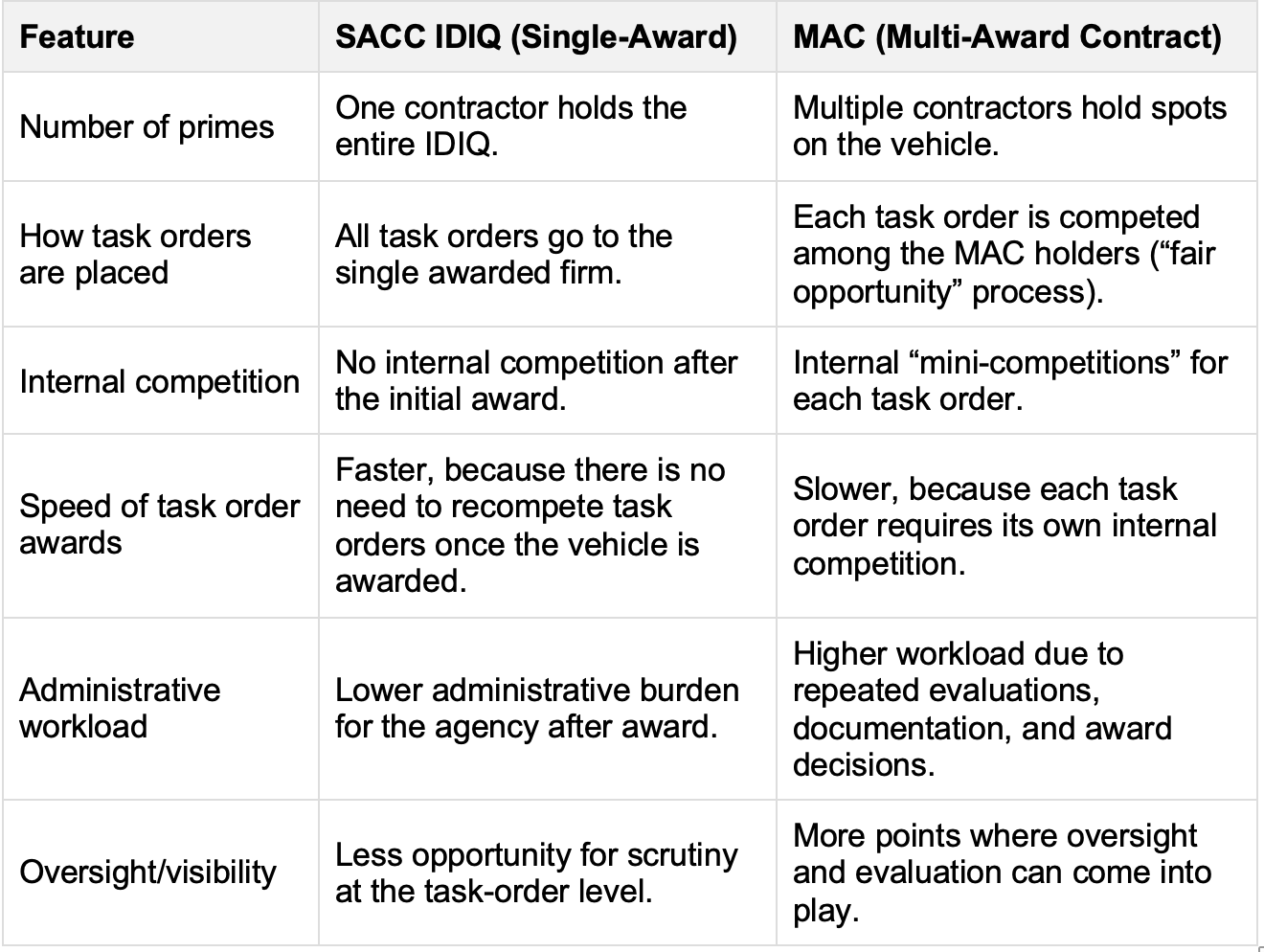
While the RFI notice is brief, it mentions the need for “highly flexible construction contracting” multiple times and stresses that contractors will be expected to manage multiple task orders simultaneously. That flexibility is baked into the contract structure ICE is proposing. By setting up several single‑award, indefinite‑delivery/indefinite‑quantity contracts, the agency won’t have to compete each individual task order — instead, it will have a small bench of pre‑cleared companies it can tap quickly, avoiding both the delays and the oversight that come with a more competitive process.
This would be even faster than what ICE is currently using. DHS has been relying on WEXMAC TITUS, a Navy logistics program originally designed for international expeditionary contracts, to retrofit warehouses into detention facilities domestically. WEXMAC is a multiple‑award contract, which is faster than full and open competition, but still involves bidding among a defined pool of companies. Four firms competed for the Williamsport, Md., warehouse renovation; six bid on the site in Surprise, AZ.
The proposed SACC model might skip even that limited competition and transparency. ICE could pre‑award contracts to a select group of firms and issue task orders directly on an as-needed basis.
And there’s an even bigger strategic shift at play: where WEXMAC TITUS is a Pentagon program pressed into immigration enforcement use — one that Senators Elizabeth Warren (D-MA) and Jeanne Shaheen (D-NH) have already challenged, demanding the Defense Department end its agreement with DHS — an ICE-owned contracting vehicle would move detention construction back in-house and entirely out of Pentagon oversight — and the scrutiny that has come with it.
A Search for Large, Experienced Construction Firms
In addition to the typical information required in an RFI (business information, point of contact, etc.), ICE specifically asks for a signed letter from a qualified bonding company confirming that the contractor is currently approved for at least $10 million in bonding on any single project and at least $300 million in total bonded work across all projects.
In plain terms, this means that ICE is looking for construction firms whose insurance company will cover them for up to $300 million. This appears to be a way to filter out smaller and mid-sized firms who are unable to get bonding approvals at that scale.
What to Watch Next
ICE is just now entering the market research phase of this initiative. Interested vendors have until May 6th to respond, and from there, the agency will draft a procurement package. Given ICE’s emphasis on speed, it would not be surprising to see an RFP released on this in the coming months.
Once the full solicitation is out, we should get a clearer picture of the work ICE is planning, which locations each contract will cover, and, ideally, which facilities are likely to be prioritized.
ICE did not immediately respond to a request for comment.
I was afraid this was coming. They really want to spend that "One Big Beautiful Bill" money ASAP, although now that it was approved by Congress, I doubt midterms or a change in the Trump Regime (25th amendment, whatever) could stop this from proceeding. No daycare or healthcare for you, Americans! We have a border to "protect", brown people to deport and illegal, unprovoked wars to fight!
A couple of comments:
"Using 236220 is a sign that the agency anticipates using these contracts for large-scale, institutional building work, not small projects or repairs."
This is not necessarily true, and the solicitation/sources sought notice mentions repairs, demolition and upgrades to existing facilities in addition to engineering and environmental compliance (yeah I chuckled at that too). Virtually all that is signaled by the use of NAICS Code 236220 is that these SACCs will be used for 'vertical' construction projects (as opposed to 'horizontal' projects like levee and land-based border fences and floating waterborne barriers) - so, likely repairs and additions to existing buildings and new design-build (DB) construction of smaller stations and checkpoints. Most of the "joint processing centers" (i.e., immigrant prisons built according to "corrections facility" standards) are too high in $ magnitude for me to think they'd be acquired under the resulting SACC contracting vehicles....if they ever end up getting awarded at all. Furthermore, there is currently another $10Bn IDIQ already in final source selection. Anyone can download the documents here, including the scope of work: https://sam.gov/workspace/contract/opp/98cdd5a9942a41a399b0ea7ecff2a529/view Nearly equivalent to what this SACC program seems to be aiming for. More on that toward the end of my comment.
That said, you are correct when pointing out that the bonding capacity limitations might point to screening out smaller firms, however $10M single/ $300M aggregate would allow for mid-size firms to qualify. Most Small Business firms are able to bond $10M single projects and typical Small Business(es according to the NAICS 236220 size standard* can usually bond $50-$80M aggregate). It's the aggregate of $300M that in itself is interesting because most *larger* firms don't want to be performing numerous concurrent $10-20M projects and would rather be awarded one or two $150M+ projects. And to flesh out your explanation of what this means, a construction firm doing business with the government has to provide a bid bond with their proposal (assuming for an actual construction project), and then performance and payment bonds upon award.
Also, being very familiar with the government construction sector, I would point out that a "sources sought" *is* merely market research - the results of which may cause them to open up the eventual acquisition to small businesses including the socioeconomic categories they listed (WOSB, HUBZone, 8(a)**, SDVOSB, etc.). IOW, depending on the industry feedback they get, the ultimate solicitation and resulting contracts could include a SB set-aside pool for smaller projects.
What I would guess here is that they want to award multiple SACCs to individual firms so that they can 'efficiently' assign out projects without further scrutiny to pre-qualified contractors. This is what DHS CBP is currently doing under what I call their shadow border wall program, which was just awarded in 2025 after the previous MATOC program expired. https://factually.co/fact-checks/politics/largest-us-mexico-border-wall-contracts-through-2025-98d86b.
In essence they did a no-bid award to several of the firms (aka short listed) who were already on the previous MATOC and they're farming out "task orders" (basically border wall segments) to contract holders individually. This prevents protests and fast-tracks time to award and completion. Personally I think it's in violation of the FAR, but as we've seen with the Trump Regime, accountability and legality are things of the past. So yeah, this looks like what they're doing is developing a short list and then issuing sole-source solicitations/awards to individual SACC holders so that they can estimate/bid them and be awarded with no further scrutiny.
Additionally, I found it interesting that they didn't even specify a target 'ceiling' value for the overall program (see the SAM link I provided above for the MATOC). Generally that is information firms responding to this type of market research want to know because they are going to evaluate whether it's worth it to spend any time on this kind of 'business development' activity. And to a previous point, most large, established firms don't want, say, 12 concurrent ~$10M rinky dink projects spread out all over the country. Which also makes me wonder if the eventual solicitation ends up breaking the awards out into regions.
This will be an interesting one to follow, because the stated scope is already attainable via existing and upcoming contract awards, so the way I look at this SACC program is a means to funnel taxpayer money to a group of well-connected firms who don't happen to be among the group that the article above alludes to. Probably Trump and associate cronies with direct ties to the regime.
Also, they said they won't be answering any questions, LOL.
* - The first asterisk is a referral to the NAICS 236220 size standard, which effectively means a business cannot qualify as a "Small Business" if its rolling 5-year annual average revenues exceed $45M (this may have been upped recently). Being a "Prime Contractor" Small Business according to the SBA and NAICS standards carries advantages in terms of set-asides, and being a subcontractor Small Business means that larger firms are required to farm out a certain % of large government contracts to SBA designated Small Businesses.
**- The asterisk by 8(a) was because Pete Kegsbreath's Department of WAR has basically waged war on the SBA's 8(a) program and I was surprised to see it mentioned by DHS.
Makes me wonder if these are going to be camps for dissidents/political prisoners.