

Bottom Line Up Front
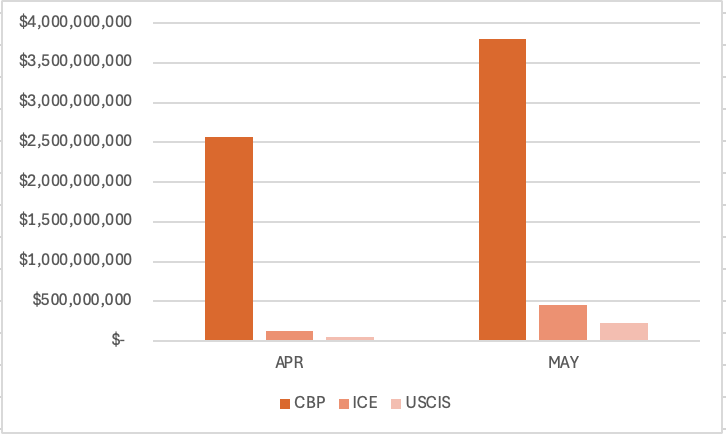
Spending Increases following April dip: After a quieter April, DHS detention and enforcement contracting activity picked back up in May, with both total obligations and the size of individual awards trending higher. The rebound was driven largely by large border wall contracts and sizable modifications to existing ICE agreements.
Work Resumes at Surprise, Az. Warehouse: The stop work order on the GardaWorld contract was rescinded on May 6 and since then, the company has ramped up its recruitment efforts, claiming they are “currently building a pipeline…with an expected start date of later this year.”
ICE Continues use of Navy Contract: A May task order issued to Acquisition Logistics LLC is the first on WEXMAC TITUS since Secretary Markwayne Mullin’s transition in. The award indicates that DHS intends to keep relying on this Defense Department contract structure, despite ongoing criticism from transparency advocates and members of Congress.
USCIS Reaches new Year‑to‑Date Spending Peak: USCIS posted its highest monthly obligations so far this year in May, more than doubling its April spending from about $55 million to roughly $230 million - a 317% increase.
May’s Biggest Contracts
Since we started this report back in January, the largest contracts each month have been related to border wall construction, and May was no exception. Southwest Valley Constructors received the month’s largest award - a $1.7 billion award funding more border wall construction in the Big Bend sector of Texas. This is the second-largest border wall contract in CBP history (the largest was issued to Fisher Sand & Gravel back in January). Fisher Sand & Gravel and Sundt Construction also secured wall construction awards, each valued in the hundreds of millions.
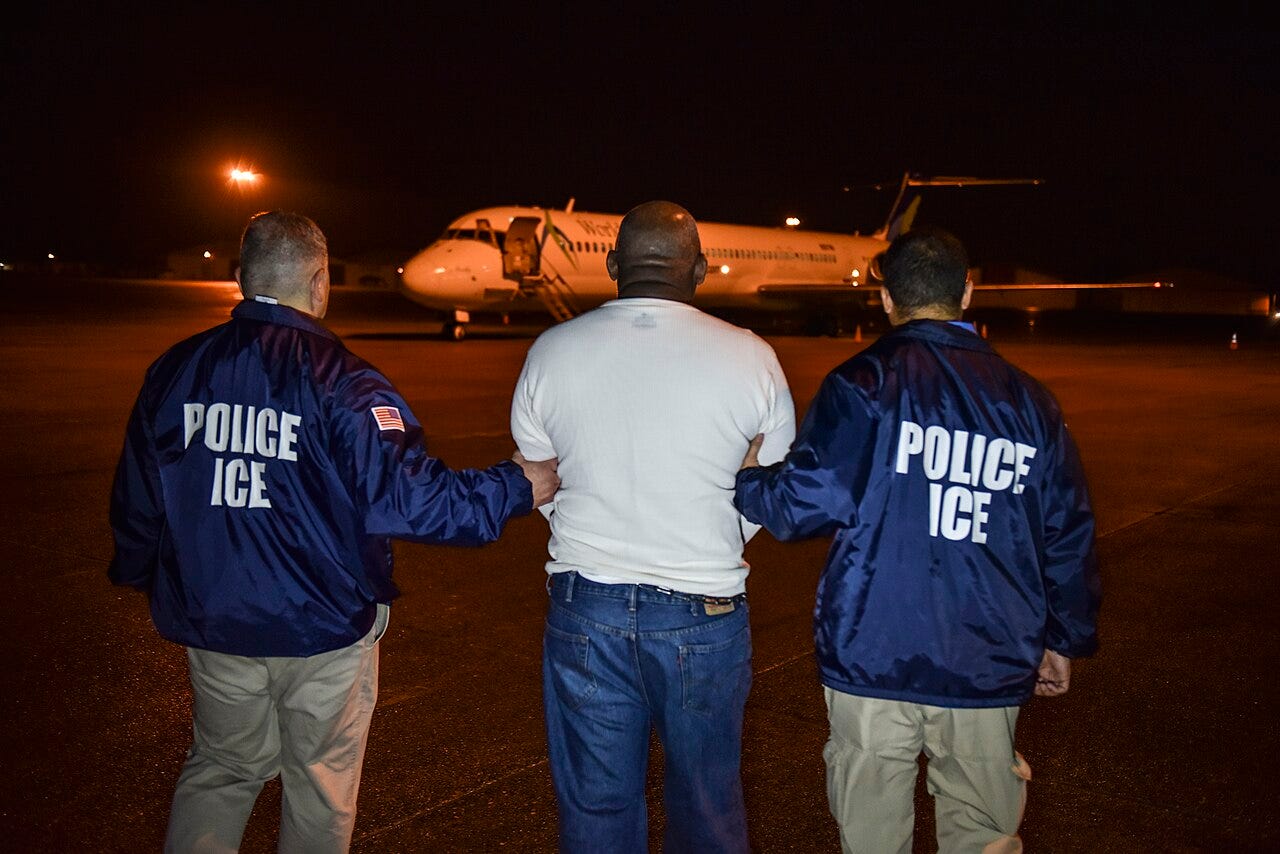
The majority of the over $450 million in funds obligated by ICE was spent in modifications to existing contracts, not on new ones. For example, CSI Aviation, the company who runs ICE deportation flights, was awarded an additional $119 million. The GEO Group and CoreCivic also received continued funding through their existing detention and transportation contracts, collectively netting over $104 million.
One new ICE contract of note was the $25 million award to Bi2 Technologies for 1,570 iris scanners. As we reported earlier this month, these scanners are in addition to the 200 ICE bought in September of last year, and are part of a sweeping expansion of biometric and data-analysis tools across federal law enforcement. The agency also awarded yet another task order on the Navy’s WEXMAC TITUS contract, this time to Acquisition Logistics LLC for detention and ground transportation services in the Los Angeles, Ca. area of responsibility.
Over at USCIS, the agency had its highest spending month to date this year. Half of that spend went to one company - Amentum Services. The agency spent $116 million funding another year of the company’s contract to support operations collecting applicant biometric and biographical data.
Analysis and Trends
Warehouse Work Continues, Despite Lawsuits: Contracting activity in May shows that work has restarted at the Surprise, Arizona warehouse, even as lawsuits from the state attorney general and local opponents move forward in federal court. DHS’s decision to resume construction there tracks with reporting that, while the department has paused purchases of new warehouse sites, it appears to be concentrating its efforts in states and localities where it expects less sustained resistance.
ICE Spending Increased Over 200% from April: April was the slowest month of ICE contracting so far this year in both total obligations and the size of individual awards, reflecting a brief transition period as Secretary Markwayne Mullin reviewed inherited contracts and warehouse plans. The more than 200 percent jump in ICE spending from April to May suggests that this pause is over and that the agency has returned to an aggressive pace of obligations, leaning heavily on existing detention, transportation, and surveillance vendors to ramp up operations.
Continued Investment in Biometric Data Collection: May’s contracts show that DHS is deepening its reliance on biometric systems across multiple components. ICE’s $25 million award to BI2 Technologies for 1,570 additional iris scanners points to a rapid build‑out of biometric screening as standard infrastructure in detention and enforcement operations. At the same time, USCIS devoted roughly half of its May spending to Amentum Services to keep collecting applicants’ biometric and biographical data for another year, signaling that large‑scale identity collection remains a priority across DHS.
About this Report
All procurement data used in this report is from usaspending.gov and SAM.gov. If there are specific procurements, companies, regions, or topics you would like us to cover in future monthly reports, please reach out to us and let us know.
Excellent intel, thank you. Been wondering what those fine folks are up to, and now we know. Appreciate the heads up. They are clever little weasels. . . . Truly welcome this kind of reporting, not seeing it anywhere else. Onward.
Any money for a wall in Big end State Park is wasted as the terrain over the mountains is a natural deterrant, but then when it is the taxpayers' money, it doesn't seem to matter.