

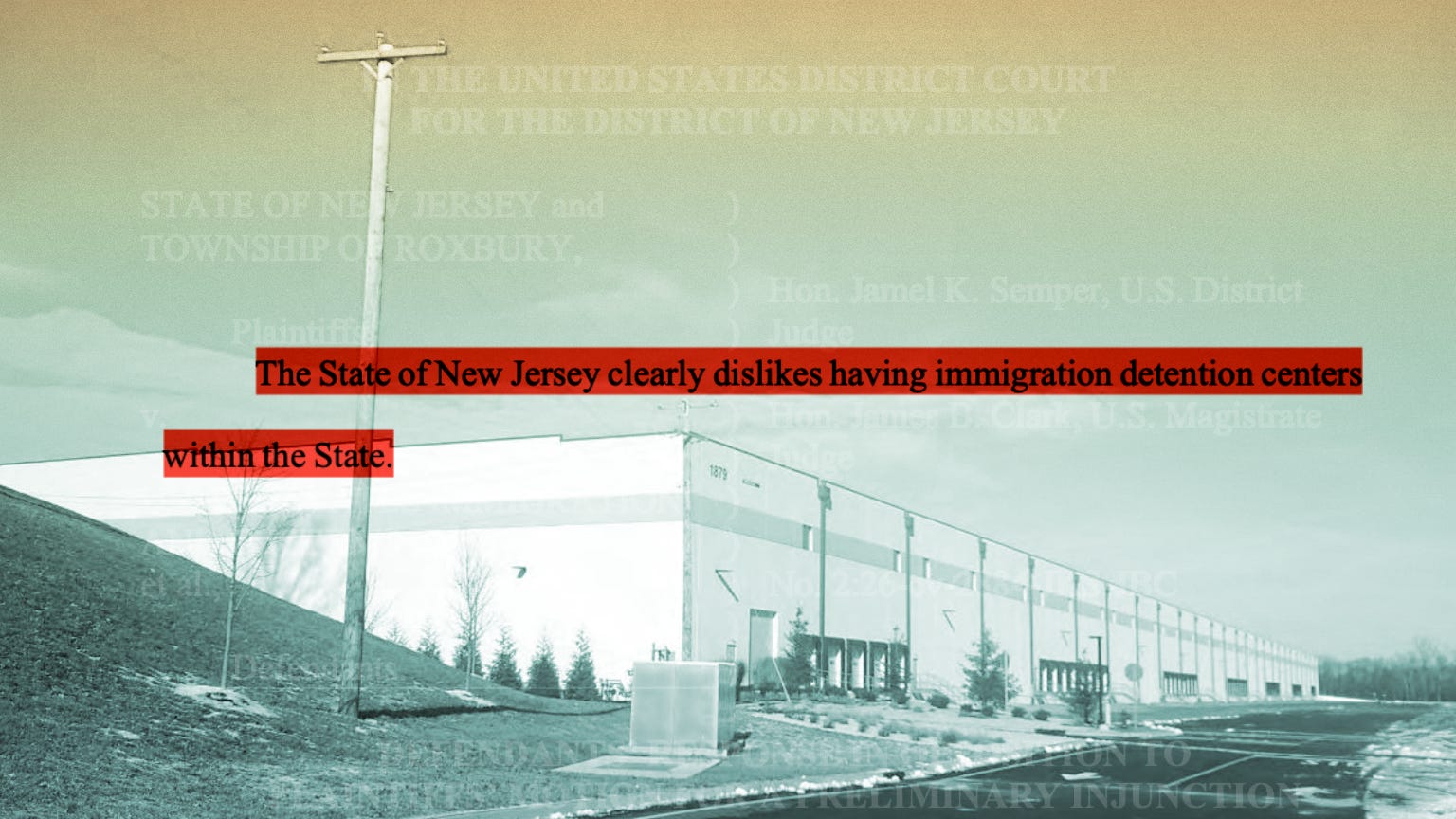
The Department of Homeland Security was back in court Thursday — in New Jersey, this time — defending the same argument it has now made in three states: that buying a warehouse and retrofitting it for detention does not trigger the environmental review that federal law typically requires.
In a 36-page filing that opens by observing that New Jersey “clearly dislikes having immigration detention centers within the State,” the Department of Homeland Security asked a federal court to reject the state’s bid to halt the conversion.

The substance of that filing matches its tone. The government’s case rests on a single proposition: the court is being asked to rule on a building, not a detention center, and the two are not yet the same thing.
Modifying an existing building, the government says, is not the same as constructing a new one, and therefore does not require the same level of scrutiny. What a facility will do once it opens — and what pressures it will put on local water systems, sewers and roads — are questions for later.
That position is now being tested in federal courts in New Jersey, Maryland and Michigan, where judges are being asked to decide whether the government can separate the physical building from the detention camp it is intended to be.
David Broderick, a member of Project NINJA, a volunteer civil liberties group in Warren County formed to oppose the Roxbury conversion, compared the agency's definition of the project to Humpty Dumpty's theory of language. “When I use a word it means just what I choose it to mean,” he said, quoting Lewis Carroll. DHS, he argued, has redefined “project” to mean only the physical work of securing the building — not the end use that work builds to. Federal guidance instructs agencies not to divide connected actions into smaller parts to avoid environmental review. Broderick said that is precisely what is happening here.
How the government cleared the review
Under the National Environmental Policy Act, or NEPA, federal agencies are generally required to assess the environmental impact of major projects before proceeding. But the law allows for exceptions — known as categorical exclusions — when a project is deemed unlikely to cause significant harm. The government has relied on those exclusions, repeatedly, to move forward with the warehouse conversions under its Detention Reengineering Initiative — now paused as the agency undergoes a transition in leadership and a rewickering of its core policies and strategies in the wake of Secretary Noem’s ouster last month.
The mechanism of review runs through a document called a Record of Environmental Consideration, or REC — an internal analysis that agencies use to justify bypassing a more detailed review. According to documents reviewed by Project Salt Box, the analyses in these cases were conducted by Solv LLC, an environmental consulting firm working under a fiscal year 2026 contract with ICE’s facilities management office worth roughly $1.7 million.
The REC for the New Jersey facility, located in Roxbury, concluded that the project qualified for multiple categorical exclusions. It defined the work as retrofitting an existing building with security and infrastructure upgrades — nothing built from the ground up. That definition is what allowed the agency to avoid a more detailed review.
The government goes further, claiming that when accounting for the facility’s intended use as a detention center, any physical changes needed are modest enough that existing infrastructure can absorb them. The facility is designed for 542 detainees — a figure the government used to rebut the state’s water calculations, which assumed nearly three times that number. Upgraded sewer connections, if needed at all, would be handled through routine permitting. None of this, the government argues, rises to the level of extraordinary circumstances that would override the exclusions.
The document does acknowledge what the facility is ultimately for — housing units, security systems, and support infrastructure already planned. But it treats those details as belonging to a separate, later stage of the project. Questions about wastewater upgrades and sewer connections, it says, will be addressed in “final engineering review” and future permitting — not now.
But that argument works only if a court agrees to treat the retrofit and the detention center as two separate things: the building as it is purchased, and the detention camp it will become.
State and local officials previously raised concerns about water use, wastewater capacity, traffic and public health. Today, DHS lawyers dismissed them: those problems, the government said, belong to a later stage of the project, once it is clear how the facility will actually run. Based on its narrow definition of the project, the agency concluded it posed no significant environmental risk and required no further scrutiny.
The same argument, three courts
The New Jersey filing is the second time this week the government has made this argument in court. The playbook is roughly the same across all three cases, though each has its own procedural wrinkle.
In Maryland, a federal judge halted a similar conversion after finding that the environmental review had been completed in “just hours” before the property closed. The judge concluded that the agency had decided to proceed before the review was done — that the analysis recorded a conclusion rather than reached one. The court also found that by separating the retrofit from the facility’s intended use, ICE had drawn the boundaries of the project too narrowly. Shortly after, the agency moved ahead with contracting tied to the facility — a sequence the court found had compromised the process, and grounds enough to grant the state’s injunction.
In Michigan, ICE purchased a warehouse near Detroit in early February and did not complete its environmental review until late March — the same day the state filed suit. The review came after the decision, not before it.
In New Jersey, the timeline is longer. The Roxbury review began in late January, was signed off on February 6 and approved on February 24 — one day after the property was purchased. That sequence of events avoids the compressed timing cited in Maryland, but the underlying logic is unchanged.
What a ruling would mean
The legal question in all three cases is one Judge Brendan Hurson in Maryland answered, at least provisionally, when he granted a preliminary injunction last week: can a federal agency define a project so narrowly that it excludes the very purpose the project is meant to serve?
If courts accept that a building and the operation it houses are legally distinct, the government will have leave to expand detention capacity across the nearly dozen warehouses it has already purchased, with little environmental scrutiny required.
You may be interested in my post this week about the court case in Maryland, the popular outpouring against it, downstream harms that could endure for generations, and the hope I take away from bearing witness here: https://remembertheworld.substack.com/p/hope-for-democracy-part-3-downstream
The Government is obviously playing word games here: the intended use of a building should always be considered.
Just because "environmental law doesn't yet require them to consider what a building will be used for", it is obvious that if you want to have 20,000 cows, for example, some consideration has to be taken for the use of water, (in and out), the foot print of the building, the use of electricity etc.
Perhaps New Jersey lawmakers should address this lack of requirement, IF indeed it is lacking...
and it appears that they are lying :
"Yes, New Jersey environmental law, particularly under the Environmental Justice Law and specific land-use regulations, requires that the eventual use of a building be considered during renovation, especially if it changes the impact on the surrounding community".
This might be a big wrinkle:
"Certificate of Occupancy: A building cannot change its use or occupy a renovated space without a Certificate of Occupancy, as outlined in N.J. Admin. Code § 5:23-2.23, which requires approval of the building's use.
Also:
"Land Use/Exemptions: Exemptions from regulations often depend on keeping the same footprint, but this exemption may not apply if a building is being converted, for example, changing from an agricultural use to a non-agricultural use.
Construction/Zoning Permits: Beyond environmental, almost all renovation work requires zoning approval to ensure the proposed use is permitted, notes Holmdel Township.