


A requirement that private contractors report to Immigration and Customs Enforcement each month on every detainee they transport was deleted Thursday afternoon from the contract documents for four proposed “turnkey” detention centers, in an amendment ICE posted to the federal contracting site SAM.gov.
The solicitation seeks space for 5,500 detainees on 10-year contracts, with 1,800 in central Pennsylvania, 1,500 near Denver, 1,500 near Seattle and 700 near Miami — sites currently owned and operated by The GEO Group.
The removed provision had directed contractors to send the agency’s Transport Analysis and Support office a monthly file containing the trip data from every Form G-391, the order that authorizes moving a person out of a detention facility. The form records who is being moved, to where and for what purpose. No detainee may leave a facility without one.
It was the only requirement in either document that would have tracked that information beyond the facility where it originated.
Individual G-391 forms are still filled out and kept on file there for three years under ICE detention standards, but nothing now requires anyone to consolidate them into a single, agency-wide record.
It is unclear who, if anyone, would compile that record centrally.
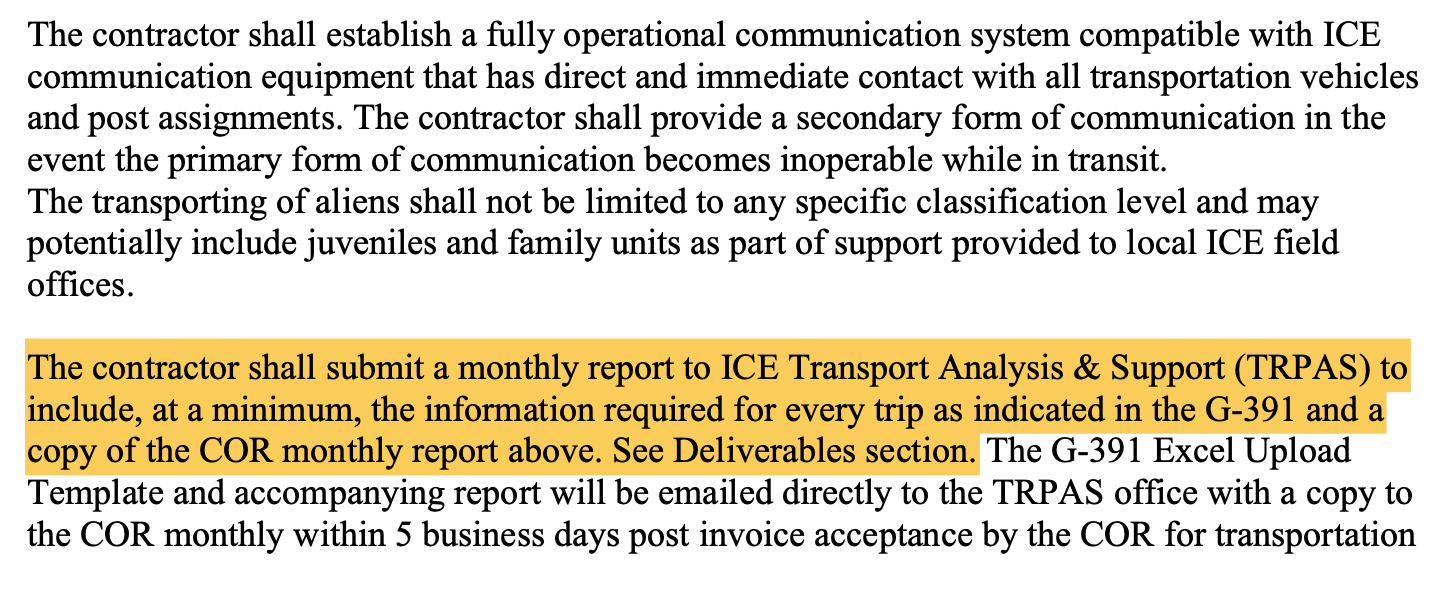
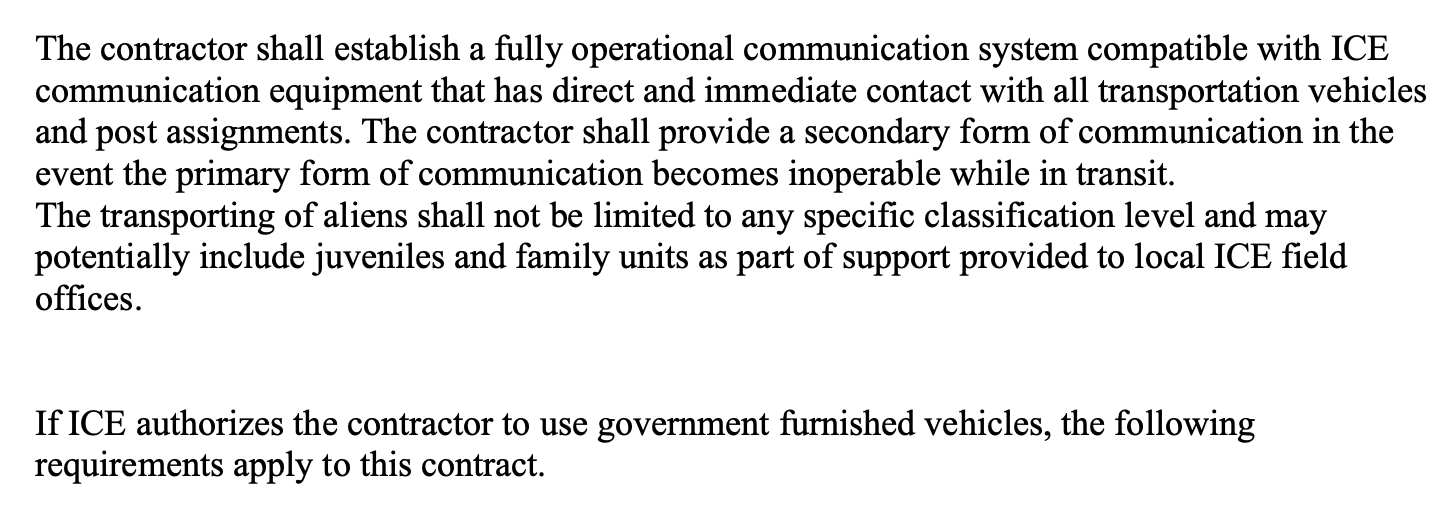
The deletion applies to all four sites. It was one of two substantive changes in the first amendment to the solicitation, issued Thursday afternoon. The other removed requirements for around-the-clock ambulance service and fire suppression at sites in Denver, Philadelphia, and Miami.
The contract officer for this request for proposals, Shane Crowl, did not respond to questions sent by Project Salt Box about the changes.
Each facility would be furnished and operated by a private company, using an existing building or new construction. Project Salt Box first reported on the solicitation July 10.
A pricing worksheet posted the same afternoon requires bidders to price each facility twice.
One version assumes the company owns the building and operates it, the arrangement ICE calls a Contract Detention Facility. The other assumes the government owns the building while the company maintains it and runs everything inside, which the worksheet labels a Service Processing Center. Both sets of rates cover the full 10 years.
The solicitation itself, in the section explaining how to format a price proposal, gives the reason: because the government may consider future acquisition of one or more awarded sites, bidders must submit rates under both models. The pricing worksheet is more direct. “The government may be interested in acquiring contractor owned sites,” its instructions say, “therefeore [sic] the establishment of SPC pricing is critical.”
Neither document commits the agency to a purchase, and ICE has not said whether it is in discussions over any site.
The instructions tell bidders what to leave out of the government-owned version: rent, utilities, depreciation, property taxes, insurance and equipment, down to washers, dryers, ovens and refrigeration units.
Denver’s worksheet includes a line none of the other sites have: Detention Modernization, billed monthly for all 10 years. It does not say what that charge covers, and it only appears on the version in which the contractor owns the building. On the government-owned version of the same facility, the charge disappears. ICE is currently soliciting bids for construction firms to update and modernize ICE-owned facilities.
ICE has separately been building up a roster of construction firms to build and modernize detention facilities on land it already owns, part of a program the agency turned to after lawsuits and political pressure stalled its warehouse-conversion plan, Project Salt Box has previously reported. If ICE bought a site like Denver’s, it would already have contractors on tap to do that work itself.
Bidder questions are due Friday. Proposals are due Sept. 11.
Given that ICE is refusing to pay healthcare.contractors, concontractors should be careful. Trump is known for refusing to pay contractors, so it's not surprising that ICE is not paying. Also, bidding on these contracts puts a black mark on the contractors. Finally, 10 years only exists on paper. After the current administration, all bets are off on contracts. The federal government is a nightmare customer when it wants to cancel a contract. It won't be worth keeping the contract if the government wants out.
If the goal is deportation, then why do we need these warehouses?