

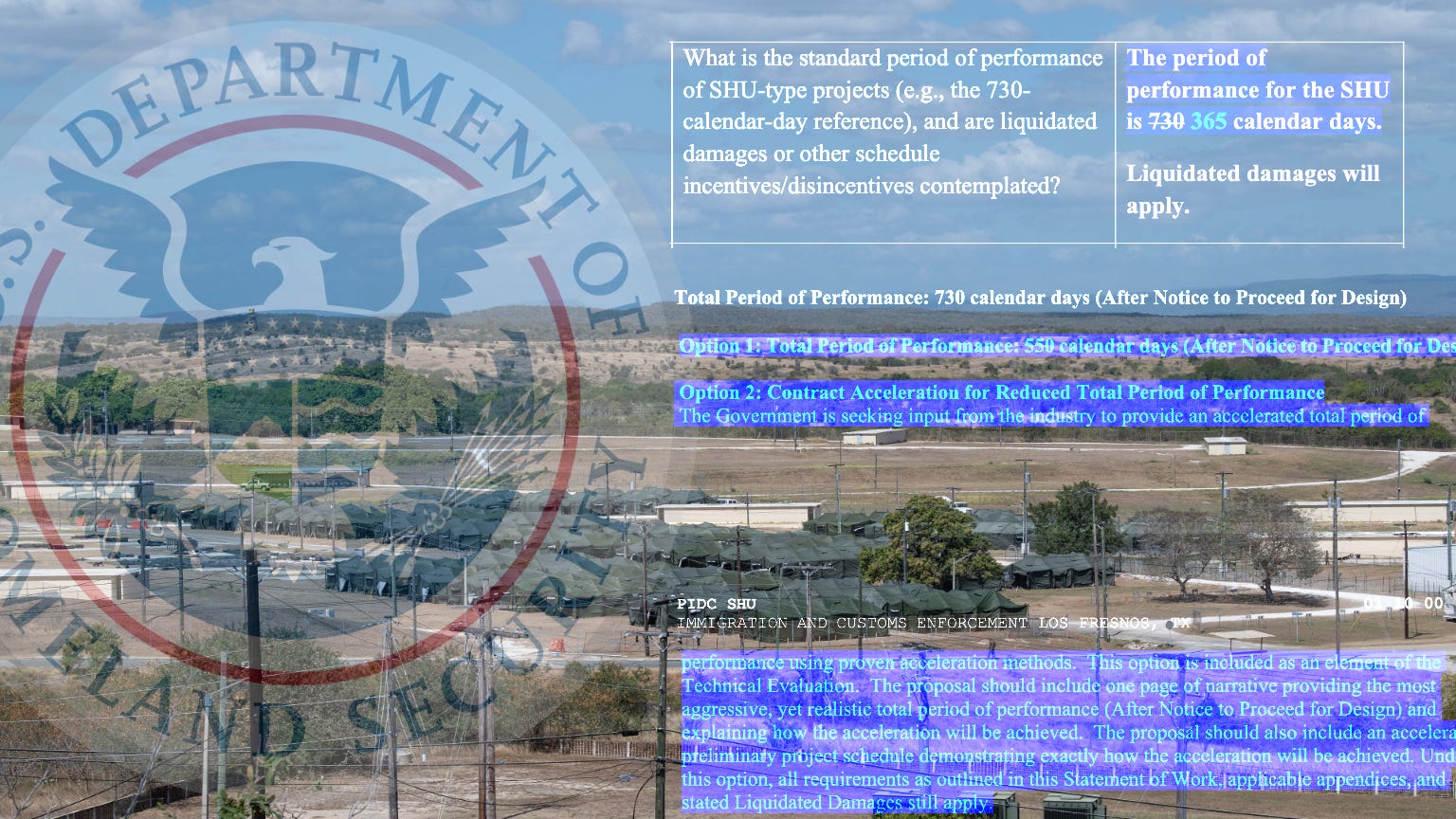
U.S. Immigration and Customs Enforcement is pressing the companies that would build its new detention housing to work faster, cutting its own construction timeline in half and offering higher scores in the competition to bidders who commit to the most aggressive schedule.

The condensed timing, first detailed in the agency's Aug. 13 answers to contractors' questions, is the latest glimpse into a program through which ICE intends to build immigrant detention space on land it already owns — the approach it has ostensibly turned to after lawsuits and political pressure stalled earlier efforts to convert warehouses it had purchased for over $1 billion and to route the work through a Navy construction program.
In its written responses, the agency struck the two-year deadline to design and build a secure housing unit — a wing of individual cells — and replaced it with one year, keeping the financial penalties for finishing late. The documents for the program's only funded unit, at the Port Isabel Service Processing Center near Los Fresnos, Texas, go further, inviting bidders to propose an even shorter "accelerated" schedule — one that would count in their favor and that the government would then hold them to.
In its July 2026 update, TRAC listed a capacity of 1,175 people at Port Isabel. KRGV, a local news station, counted more than a thousand people in custody there during a tour this summer. The Texas Tribune has documented a long record of complaints over conditions and medical care at the facility, and people have died after being held there, among them Adrian Andreas Florian, an 85-year-old German man who died in June after more than seven months hospitalized in ICE custody.
Even as it pressed for speed, the agency refused the construction methods that could reasonably deliver it, ruling out any project start before a design is finished, rejecting the purchase of materials or the off-site fabrication of components during the design phase, and declining to credit the modular or prefabricated approaches that let builders move quickly.
The answers, which also pushed the bid deadline to Aug. 31, cleared up contradictions Project Salt Box identified when the solicitation was first posted in July. The agency said the program could be worth as much as $10 billion, not the $300 million figure that appears elsewhere in the same document, and that one company could win as many as two of the contracts. It also lowered the financial bar to compete, cutting the guarantee that a job will be finished if the builder fails — called a bond — from $10 billion to $2 billion.
Outside one grouping the solicitation labels “Mega Hub DC,” ICE has split the work by region, with each contract covering a separate geographic area. That grouping includes seven sites into a single contract.
According to the contracting documents, one company would build all of them — “concurrently,” as ICE put it — in Broadview, Ill., outside Chicago; Oakdale, La.; Huntsville, Texas; Honolulu; Aguadilla, P.R.; St. Thomas, in the U.S. Virgin Islands; and the Navy base at Guantánamo Bay, Cuba. Five of the seven have no ICE-owned detention facility today.
At Guantánamo, a presidential memorandum in January 2025 ordered the migrant operations center expanded to full capacity, a buildup the Trump Administration said would hold 30,000 people.
I wonder where these Immigration EMPLOEES will go once the Democrats are back in power...surely can't go to Canada. 🧐
please provide a list of the prequalified or bidding general contractors (and if relevant, architects and engineers)