

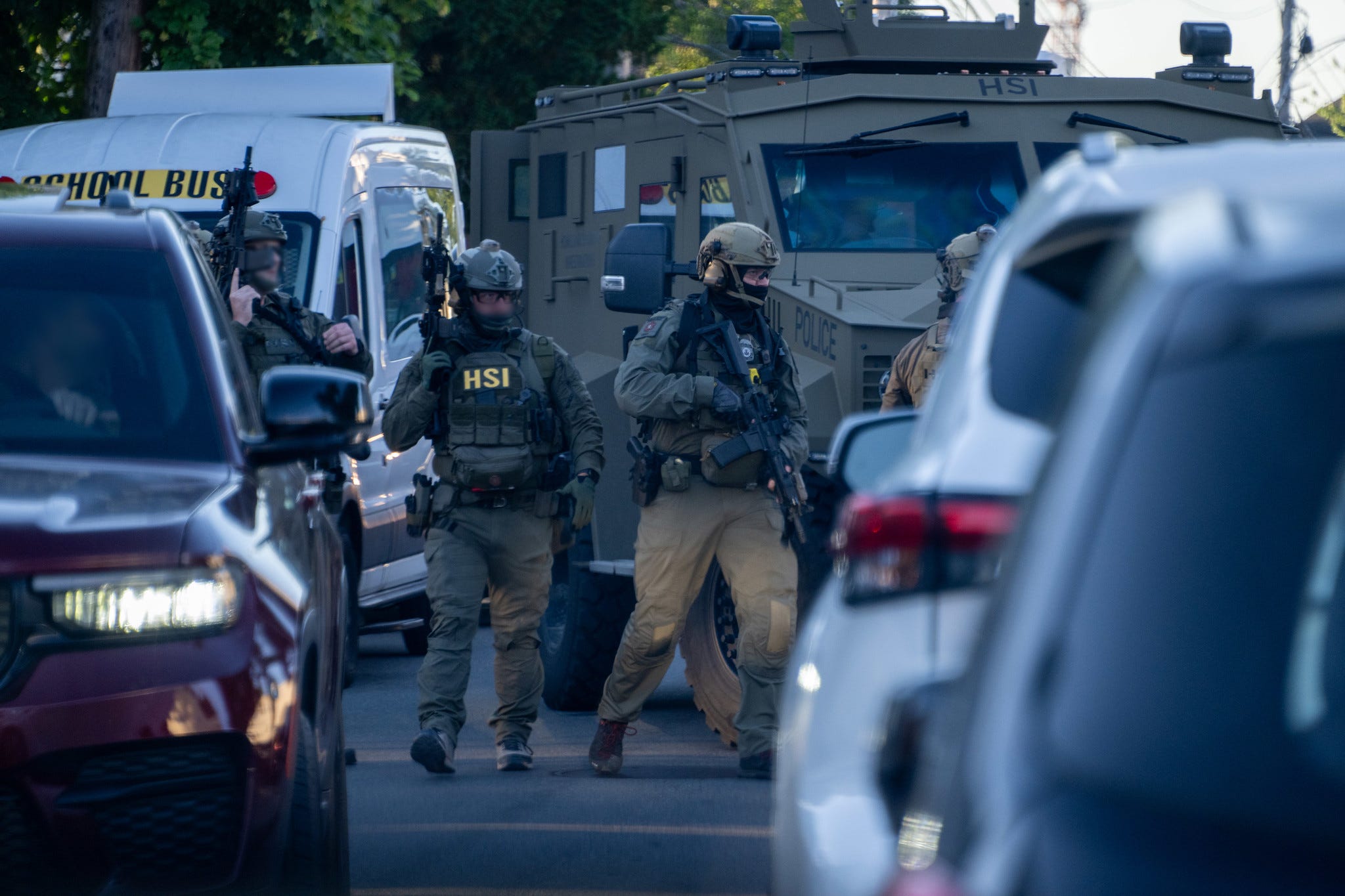
U.S. Immigration and Customs Enforcement asked private contractors Friday morning for at least 5,500 new detention beds across four regions of the country, in facilities that must start holding detainees within 30 days of a contract award. The agency gave the industry just one week to respond.
The request for information, posted to the federal contracting site SAM.gov, seeks detention facilities that contractors would operate near Denver, Miami and Seattle, and in central Pennsylvania. Responses to the notice, which includes a 160-page draft statement of work, are due in just five business days — by July 17 at 4 p.m.
According to procurement documents, ICE plans to award four regional contracts under a flexible structure that lets the agency order detention services as needed rather than committing to a fixed amount upfront. The required minimum capacities include 1,500 beds near Denver, 1,500 near Seattle, 700 near Miami, and 1,800 in Pennsylvania—the largest allocation of the four.

The mandate requires each facility to be reserved exclusively for ICE. The agency will accept sites built for low- and medium-custody populations, but prefers those capable of handling high-custody detainees.
While contracting documents reviewed by Project Salt Box state that turnkey properties, renovations, and new construction are all eligible, the timeline tells a much different story. In practice, a strict requirement to begin housing detainees within 30 days of an award effectively limits the field to only existing, fully staffed, and functional buildings.
ICE also specified exactly where the detention centers must be located. The Denver facility must be located within 30 driving miles of the field office in Centennial, Colorado. The Miami detention center must be within 50 driving miles of the field office in Plantation, Florida. The Seattle facility must be within 30 driving miles of the field office in Tukwila, Washington. For the Philadelphia field office, the detention center must be located near the airport in State College, Pennsylvania.
Those geographic requirements align precisely with four detention facilities currently operated by the GEO Group that ICE already relies on: the Aurora ICE Processing Center in Colorado, the Broward Transitional Center in Florida, the Northwest ICE Processing Center in Washington and the Moshannon Valley Processing Center in Pennsylvania.
ICE did not explicitly identify these facilities in the notice, name the GEO Group as a prospective contractor or indicate whether current operators would receive new contracts. Instead, the agency described the notice as market research intended to gather information from potential providers. Contract officers at ICE did not respond for requests for comment in time for publication.
The request comes as the future of several major detention centers remains uncertain. ICE has discussed potentially purchasing multiple GEO-operated facilities, according to reporting by Project Salt Box and public remarks from George Zoley, the private prison company's chief executive. At the same time, the agency is seeking new contracts to continue using its existing footprint.
As written, the RFI outlines plans for an Indefinite Delivery Contract (IDC) award. In federal procurement, an IDC establishes a binding framework with predefined pricing and operational standards, but allows the agency to dynamically order services via task orders as needs arise rather than committing to a fixed, upfront service volume. However, establishing an IDC framework does not prevent the government from executing a parallel property buyout later.
A procurement search built around existing facilities
By design, the listed procurement criteria heavily favor facilities that are already operational.
Prospective contractors face an exhaustive list of hurdles, including proving legal control of the property, securing necessary occupancy approvals, and providing detailed staffing and environmental documentation. ICE is also demanding comprehensive operational blueprints for medical care, transportation, security, attorney visitation, maintenance and on-site immigration court operations.
Under the draft statement of work, dedicated court space is non-negotiable. For a facility housing roughly 1,600 detainees, a bidder must provide five video-equipped courtrooms, judges’ chambers with separate secure entrances and dedicated interview offices for asylum officers.
Rather than simply selecting the lowest bidder, ICE plans to use a “best-value” evaluation model that prioritizes operational readiness and management experience over cost alone.
Though new construction is technically eligible, a strict 30-day window to begin housing detainees effectively disqualifies unbuilt sites. Because a winning bidder must be ready almost immediately, the procurement framework functions as a mirror for the exact detention centers ICE already uses.
Why seek contracts for facilities ICE already uses?
Soliciting new contracts for facilities already under agency control raises an obvious question: Why replicate an existing network?
Driving this sudden push is an impending deadline. All four GEO Group-operated facilities matching the geographic footprints in the notice are running on contracts or operating agreements set to expire between August and October, forcing ICE to act quickly to avoid losing detention capacity.
The Aurora, Broward, Northwest and Moshannon Valley processing centers currently anchor ICE’s regional enforcement network. The new solicitation provides a legal pathway to maintain access to those locations before current agreements lapse.
The focus on central Pennsylvania coincides with recent shifts in the agency’s aviation logistics. Regional flight tracking logs analyzed by JJ in DC at Habeas Flight Watch show a steady stream of ICE charter operations out of University Park Airport near State College, totaling 15 flights in the past 30 days. The flights, typically using Air Wisconsin CRJ-200 passenger jets operating on behalf of the agency's transit network, run a loop connecting to an ICE operational hub in Alexandria, La. Logistical data indicates that roughly three flights a week stay overnight at the airport, suggesting that a charter flight crew may now be basing out of State College.
Gillian Brockell, an independent journalist who tracks ICE flight operations, noted that it is highly unusual for a federal detention charter to lay over in a non-base city, reinforcing indications that the airport is functioning as a base for the agency. Brockell added that ICE also appears to have shifted some regional enforcement roundups from Baltimore-Washington International Airport to Harrisburg — a relatively new pattern that may reflect a broader consolidation of aviation logistics toward central Pennsylvania.
The solicitations also overlap with a separate effort by ICE to buy privately operated detention facilities outright. Project Salt Box previously reported that the agency was exploring the purchase of at least 10 turnkey detention sites.
That acquisition strategy materialized earlier this month in California, when the Department of Homeland Security executed a $1.5 billion deal to buy two facilities from CoreCivic, including the Otay Mesa Detention Center — just six months after renewing its operations contract. Under that transaction, the federal government assumed ownership of the infrastructure while CoreCivic retained a management contract to run the facility through December 2029. As that California deal demonstrates, securing or renewing an operational service contract does not prevent the government from buying the underlying real estate.
Two of the centers aligned with the new RFI — the Aurora and Northwest ICE processing centers — were on that initial list of 10 acquisition targets. While ICE has not disclosed whether those buyouts are still active, a federal purchase would fundamentally change the legal status of the properties. Owning the facilities could allow ICE to operate the sites directly or through third-party contractors under a different legal framework than privately owned centers.
That jurisdictional dispute is already playing out in Washington, where state officials have spent years seeking access to the Northwest ICE Processing Center in Tacoma for health inspections. A federal judge on Thursday ordered the GEO Group to allow state inspectors inside, granting Washington’s request for a preliminary injunction after the company refused access.
The legal push for local oversight coincides with newly released internal agency records. A June 2026 inspection report from ICE’s Office of Professional Responsibility (OPR) flagged three safety and medical compliance failures at the Tacoma facility, including delayed comprehensive health assessments and missed welfare checks for detainees on suicide watch. The report also disclosed an ongoing federal investigation into a April 17, 2026, allegation that a female detainee was physically assaulted by medical staff during a seizure
The Tacoma findings underscore the exact friction testing a state's authority to regulate a privately run federal facility.
For ICE, federal ownership could offer a tempting legal shield, potentially insulating these high-stakes facilities from state-level crackdowns on private immigration detention.
Expanding the Regional Footprint
The recent notice arrived just one day after ICE awarded the GEO Group a $528.7 million contract to reactivate the Big Horn detention facility in Hudson, Colorado. The facility, which has sat vacant since 2014, could provide ICE with capacity for more than 1,000 additional detainees once operational, according to a Project Salt Box analysis of agency detention records.
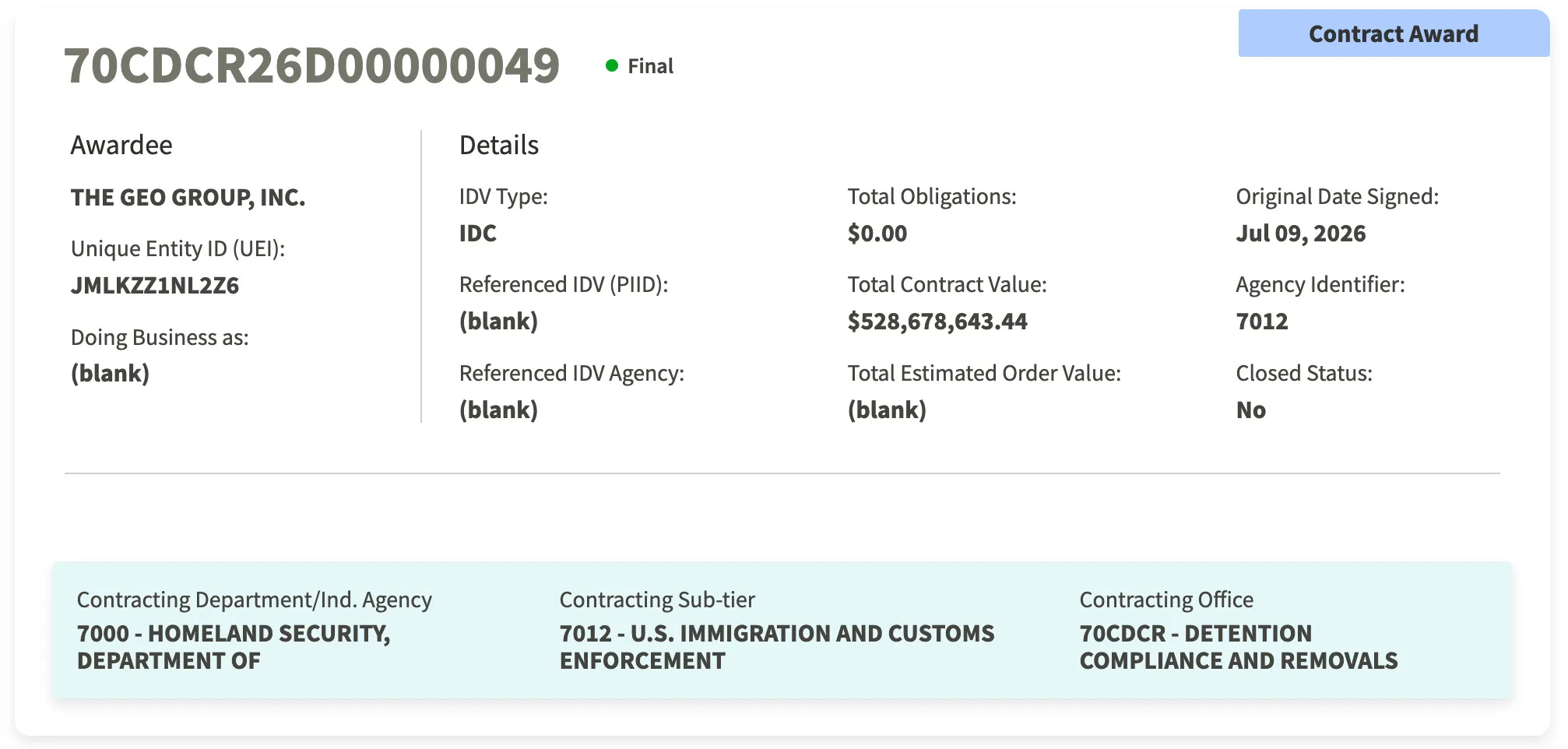
The award follows months of bureaucratic maneuvering over the empty facility. ICE previously entered into a $39 million letter contract with the GEO Group covering six months beginning in April 2025, despite the site remaining entirely empty during that window. A second letter contract followed in December, though its specific terms and pricing were redacted.
The Big Horn contract and the latest RFI highlight the immediate logistical challenge facing ICE: rapidly securing and expanding detention capacity as the agency pushes to increase its overall enforcement footprint in the wake of its abandoned warehouse conversion scheme.
Beyond Colorado, the agency is leveraging alternative procurement channels to scale up capacity in the Southwest. In Marana, Ariz., ICE recently issued a sole-source contract award to Management and Training Corporation to convert a shuttered state prison into an immigration detention center.
A June 2026 Department of Homeland Security environmental notice revealed plans to upgrade that facility’s baseline capacity from 506 to 775 detainees, with provisions for an additional 600 temporary beds. The planned enhancements would push total capacity past 1,300 inside a designated 100-year floodplain.
Whether reviving a mothballed facility in rural Colorado or expanding a prison footprint in an Arizona floodplain the strategy remains uniform. Nationwide, ICE is moving aggressively on multiple procurement tracks to solidify its grip on any facility it can to hold detainees.
This is extremely bad. This explains why ICE is trying to offload those warehouses they were going to convert. This new plan of contracting existing facilities that are already running eliminates the need for a number of regulatory steps (public announcements of properties purchases, and environmental impact studies and construction permit applications that had to be submitted to local planning and zoning boards, etc.) that alerted the public that a detention center was about to be opened in their back yard. This will make it much easier for ICE to hide how many detention centers they have and how many people are incarcerated. It is no coincidence that these calls for contracts went out specifically in regions where the contracts for existing GEO group facilities are about to expire between Aug and Oct this year. These are essentially no bid contracts that will be awarded to Geo Group as noted in the article:
"Rather than simply selecting the lowest bidder, ICE plans to use a “best-value” evaluation model that prioritizes operational readiness and management experience over cost alone."
As a reminder GEO Group runs the Delaney Hall detention center in Newark, NJ, where its employees are responsible for a multitude of atrocities against detainees and peaceful protesters.
This lack of transparency cannot be tolerated.
Send ICE to Iran, no, send them to Russia no, send them to North Korea!