

Editor’s Note: This is a long story. If your email client doesn’t display the full article, please follow the link to read it in full at projectsaltbox.com.
A federal contract solicitation posted Friday lays out, in more detail than any document yet made public, how U.S. Immigration and Customs Enforcement intends to arrest, hold, try, and deport people at scale in the wake of its failed warehouse conversion plot.
In performance work documents and requirements notices, ICE describes a streamlined operation, run almost entirely by private contractors, that carries a person from the moment of arrest to the flight out of the country.

Contractors would hold people in vans at the scene of arrests. They would drive them more than a million miles a year across at least a dozen states. They would house them in buildings that private companies own but that the documents call “the federal facility.” They would staff the immigration courtrooms inside those buildings, prepare the removal paperwork, complete the flight manifests and, in ICE’s words, “effectuate departures.”
The solicitation seeks 5,500 detention beds in four regions on contracts running 10 years each, with 1,800 beds in central Pennsylvania, 1,500 near Denver, 1,500 near Seattle and 700 near Miami.
At each site a single contractor would furnish the building and run everything inside it. The stated objective is “comprehensive detention, transportation, food services, and operations and maintenance,” delivered with the contractor’s own staff, vehicles and equipment, including firearms, ammunition, body restraints, non-lethal devices and body armor, around the clock and every day of the year.
ICE did not respond to a list of questions emailed by Project Salt Box.
Holding People in Vans
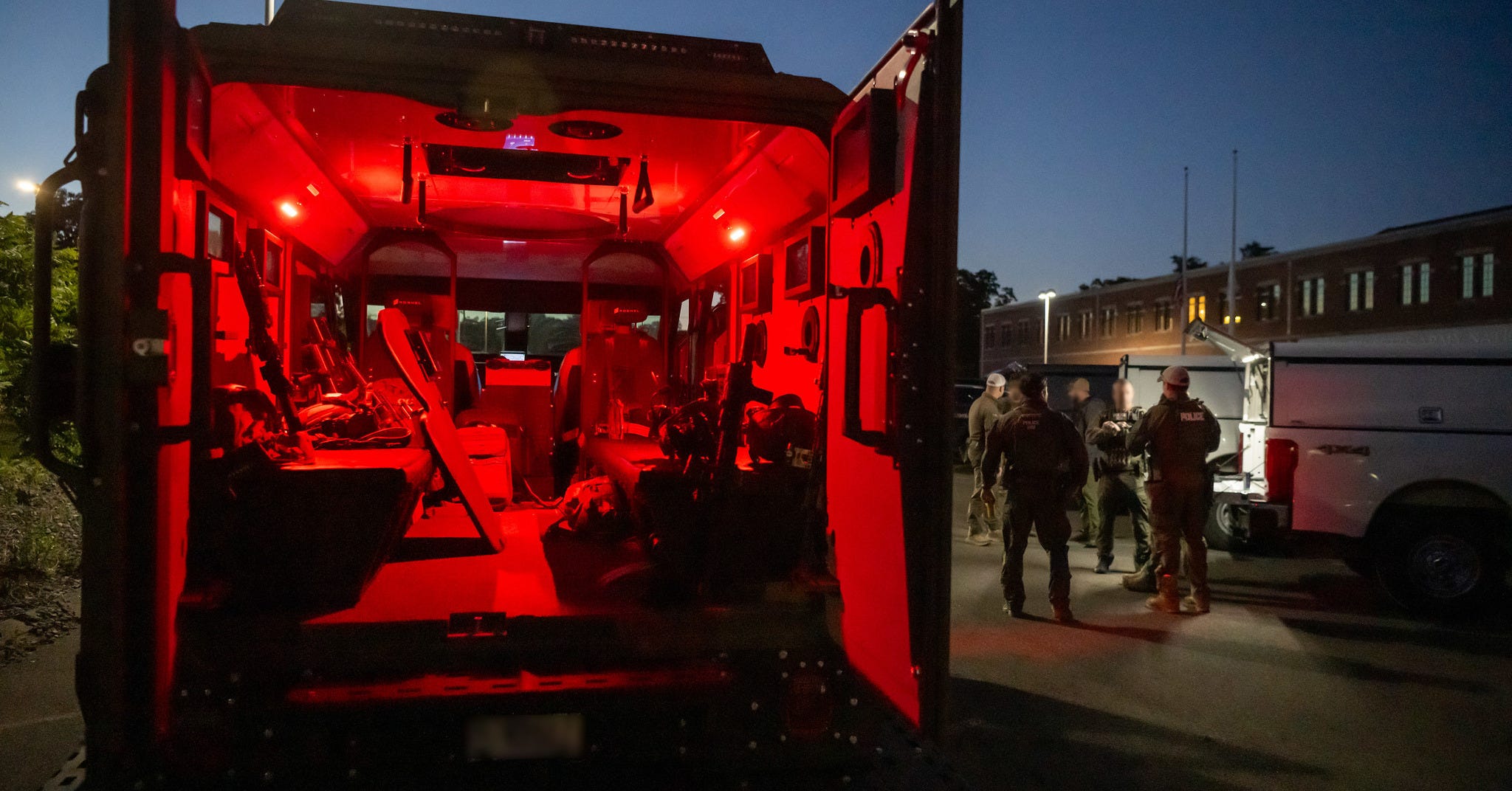
The transportation requirements for the Philadelphia region, which covers Pennsylvania and Delaware, describe an arrangement ICE describes as mobile detention facilities.
These assets would be assigned to arrest teams at the hub site that would remain in a staging location nearby from the arrest teams. These teams would act as “mobile detention facility” until the vans are full and/or all operations in the area are completed.
The document explains that holding people in vans at the scene spares officers the drive back to an office and keeps them making arrests. Writing about a proposed hub in Pittsburgh, ICE says deportation officers “are better utilized as a force multiplier in the field to make more arrests.”
To run it, the agency asks for 12 additional transport teams a day, seven days a week, at seven locations, along with new hub sites at Pittsburgh and at Dover, Del. It also designates the hold rooms in York, Pa., as “a central staging facility for many of the transportation routes across the AOR.”
The Seattle documents never use the phrase, though they describe something adjacent. Contractor transportation officers would be stationed at ICE offices in Tukwila, Tacoma and Yakima, Wash., and in Portland, Ore., and when they are not driving they would be assigned guard duties “generally associated with but not limited to ICE detainees in holding cells.”
Nothing comparable appears in the Denver or Miami work statements.
Across the entire solicitation, a single provision limits how long a person may be held in a vehicle.
Except in emergency situations females may not be transported by bus for more than ten hours.
Because that is the only durational limit anywhere in the package, no rule governs how long men may be held, and none governs travel by van.
The documents are equally silent on food, water, restrooms, temperature and medical attention for people in transit. The one provision addressing their treatment sits in a list of motor vehicle regulations, between a rule about seat belts and one about defensive driving, and it requires “transporting detainees in a safe and humane manner.”
Officers are covered in more detail. Where a run exceeds a 12-hour workday, the contractor is reimbursed for the officer’s lodging and meals at federal per diem rates.
So are the vehicles, which must have interior cages, acrylic panels between driver and passengers, door and window locks, backup radios, and one ADA-equipped unit per fleet. Drivers need commercial licenses and may not drink alcohol within eight hours of a shift, every trip requires two officers, and all transportation officers must be armed.
Missing a scheduled departure costs the contractor money, while nothing in the documents attaches a penalty to what happens inside a vehicle.
ICE listed the routes it expects contractors to drive and stated the assumption behind its estimates, an average speed of 45 mph.
By that measure, the bus from Denver to Phoenix — 865 miles one way — would take about 19 hours. Seven other bus routes out of Denver also run past the 10-hour mark, and two of them, both to El Paso, Texas, are labeled in the agency’s own spreadsheet as removals.
Both performance work statements add that this transportation “shall not be limited to any specific classification level and may potentially include juveniles and family units as part of support provided to local ICE field offices.”
Miami’s list alone runs 58 routes and roughly 784,000 miles a year, while Pennsylvania’s adds another 372,000 on top of what is driven there now, across a network of county jails, federal prisons, and field offices.
One Pennsylvania route runs every day of the week, a bus from the Pittsburgh sub-office to Youngstown Airport in Ohio on a trip the document classifies as “Flight Line transfers.” WKYC-TV verified more than 1,000 ICE flights in and out of Youngstown between April 2025 and the first quarter of 2026, though the runway is now under reconstruction and the flights have moved to Akron-Canton.
In Florida, a van covers the 205 miles from the Broward Transitional Center to the Orlando sub-office every weekday.
Who drives them now?
The route lists include a further column asking whether a contractor already performs each trip, and the Denver and Miami answers point in opposite directions.
In Denver, all 24 routes name the same provider, “GEO/GTI,” a reference to The GEO Group and its transportation subsidiary, GEO Transport Inc. All 24 carry the same note in the next column: “Included in Denver CDF contract.”
In Miami, all 58 routes answer “No,” and when a second column asks whether an existing contract could absorb the work, all 58 answer “No” again.
So the bids for the four regions are not doing the same thing. Denver is largely a recompete, and Seattle appears to be one as well, since its documents describe contractor transportation officers already stationed at four ICE offices. Miami would hand a contractor roughly 784,000 miles a year of work ICE has previously kept in-house, with the requested facility sitting at the center of a network that reaches from Tallahassee to Fort Myers. Pennsylvania is a new build-out, adding hub sites, round-the-clock coverage for what ICE calls a surge of incoming arrests, and, of course, the holding vans.
Holding Sites Designed for Detention and Immigration Hearings
Every route ends at a facility the government intends to contract from prospective private prison firms, and the specifications describe an all-encompassing detention and deportation machine.
Each site must contain five video-equipped immigration courtrooms, judges’ chambers with a separate secured entrance, contiguous offices for ICE attorneys with an entrance of their own, and soundproofed rooms where asylum officers conduct interviews.
Facilities must also provide private booths for virtual attorney visits, soundproofed to between 30 and 35 decibels and available at least eight hours a day on weekdays. The same requirement adds that when the booths are not being used for legal visits, they “may be used for asylum interviews, credible fear interviews, forensic competency evaluations, or immigration judge review hearings,” and it states that ICE’s performance measures for attorney access do not apply during those uses.
Contractor employees would facilitate the process. They are required to coordinate dockets with the immigration courts, help ICE attorneys pull criminal history records before hearings, prepare removal documents, complete “ICE Air scheduling and manifest(s)” and file signed warrants of removal.
A later section states the obligation directly, saying the contractor “shall effectuate departures” and that its employees must “affirm, swear, and witness to all actions of effectuating departure” in depositions and in court.
The Four Sites
Three of the four sites are anchored to ICE field offices, as past detention contracts were, falling within 30 driving miles of Centennial, Colo., 50 miles of Plantation, Fla., and 30 miles of Tukwila, Wash.
Pennsylvania is anchored instead to an airport in State College, Pa., roughly 180 miles from the Philadelphia field office it would serve. Flight trackers at Habeas Flight Watch logged 15 ICE charter operations out of University Park Airport there over 30 days, with about three a week staying overnight.
As Project Salt Box reported in July, the market research ICE conducted before this solicitation described buildings that already exist. The bed counts, the mileage radiuses and the field office anchors matched four detention centers operated by The GEO Group under agreements that expire between August and October: the Aurora ICE Processing Center in Colorado, Broward Transitional Center in Florida, the Northwest ICE Processing Center in Tacoma, Wash., and Moshannon Valley Processing Center in Pennsylvania.
The solicitation identifies those facilities as the “historical location” for the four corresponding requirements. That gives GEO an incumbent advantage in the competition, but the solicitation permits offers based on other existing facilities as well as expansions, conversions, major renovations, or new construction.
A Federal Designation to Sidestep State Law
Both performance work statements open by requiring the contractor to furnish “the federal facility,” and both explain that “facility” and “federal facility” are used interchangeably throughout, even though all four buildings would be privately owned and privately operated on behalf of the government.
A few paragraphs later, the documents set out what that designation is meant to accomplish.
Otherwise applicable or more stringent state or local laws or regulations shall not apply to the performance under this contract when they would directly or indirectly regulate, dictate, or control the contractor’s performance under these standards.
The same section adds that nothing in the document waives “federal supremacy or the immunity of the Government or its contractor,” and a related provision commits ICE to asking the Justice Department to dismiss a sued contractor from the case, substitute ICE as the defendant, or move the case to federal court. That commitment survives the end of the contract.
A federal judge in Washington rejected this reasoning in July, holding that a contract cannot preempt state law and ordering GEO to let state health inspectors into the Tacoma facility, which the state said had turned inspectors away 10 times.
The solicitation names who may inspect, listing DHS, ICE, other federal entities and ICE-approved third-party inspectors, and state agencies are not among them. Requests to visit from nongovernmental organizations, academics and state and local government agencies go to the ICE field office rather than to the facility, and everyone in the group is background-checked.
A New Life for the Warehouse Plan
The design described in the solicitation is not new. In February, officials in Social Circle, Ga., published an account of what the Department of Homeland Security had told them about a facility proposed for their city, along with the documents DHS provided.
DHS said it “will fully implement a new detention model by the end of Fiscal Year 2026,” according to the city, and described a plan to move ICE detention from private operations to government-owned facilities. The agency called it a “Hub and Spoke Model,” in which four smaller processing facilities would feed into larger ones. It said it would cut the number of ICE facilities nationwide from roughly 300 to 34, with eight of them “mega centers” holding 7,500 to 10,000 people each.
The documents DHS supplied described what a mega center would contain: holding areas, intake areas, indoor and outdoor recreation, cafeterias, laundry facilities, on-site health services, a gun range and court facilities.
That plan collapsed earlier this year, following the ouster of then-Secretary Kristi Noem. ICE bought roughly a dozen commercial warehouses in the first three months of the year, spending upward of $1 billion, and Maryland and other jurisdictions sued, alleging the agency had violated federal environmental and administrative law by purchasing properties and starting conversion without review. Federal judges questioned whether ICE had complied. The DHS inspector general opened an investigation. By June the agency was offloading seven of the 11 properties it still held.
What survived is the design. This solicitation requires the same combination DHS described in Georgia: courtrooms, on-site medical care, intake, food service, recreation and laundry, all built around detention space for as many as 1,800 people.
The hub and spoke language survived too. The hub sites ICE wants at Pittsburgh and Dover and the staging rooms at York are that model described in transportation terms, with every route feeding the Pennsylvania facility.
What did not survive is government ownership. The warehouse plan was built on moving detention out of private hands. This solicitation leaves the buildings in private hands and calls them “federal” in the contract text instead.
The four facilities sought here are also far smaller than the mega centers DHS described, at 700 to 1,800 beds rather than 7,500 to 10,000. Whether ICE considers them the smaller processing facilities its hub and spoke model calls for is a question the agency has not answered.
A Boilerplate Justification for More Capacity
Companies bidding on any of the four contracts must file environmental assessments, and a separate attachment tells them what those assessments will say.
Rather than describing the required content, ICE supplies it in quotation marks, introduced by the words “shall be as follows.” The passage ends:
The CDF is required because the capacity to support the effective detention of persons in the area has been reached.
Bidders must assert that capacity has run out, but nothing in the guidance asks them to show it.
ICE’s own contracting records point the other way. Nine days before the agency published the notice that preceded this solicitation, it awarded GEO $528.7 million to reopen the Big Horn facility in Hudson, Colo., which has been empty since 2014 and holds more than 1,000 people. The Aurora detention center 40 miles away is licensed for 1,532, and the Denver requirement asks for 1,500 more.
The picture in Washington is similar. The Tacoma facility held 919 people against a maximum of 1,575 as of a visit earlier this month by U.S. Rep. Suzan DelBene, according to her office, and units there have been consolidated, with at least two closed, according to Lydia Zepeda, a member of Tacoma’s Commission on Immigration and Refugee Affairs who visits several times a week.
Inside the documents, ICE directs bidders to its 2016 environmental assessment for a Houston detention facility as the model, and that document says capacity “within ICE-owned facilities or other leased space in the area has been reached.”
The claim is that capacity everywhere in the region is gone, including at the facilities ICE already contracts for, and that new space is therefore needed.
The Houston document also explained itself in ways the new template does not, noting that the existing contract was expiring, that the stopgap could not be renewed indefinitely and that the building did not meet current standards. All three are true again now, and none of them appear in the text ICE wrote for bidders.
That text does include one further instruction. Bidders must write that the contractor “would be responsible for ensuring that the facility is operated in a manner consistent with the mission of ICE and state and federal laws and regulations,” which is the opposite of what the performance work statement says, and the environmental assessment is the version ICE will publish.
Bidding Requirements
To advance past the first round, a company must already control a building with the beds configured, the occupancy and fire approvals in hand, the zoning secured, the staff lined up, and the vehicles on the lot.
The expedited deadlines ICE provides leave little room to assemble any of that. Questions are due Sept. 4, first-round proposals are due Sept. 11, and second-round proposals are expected around Sept. 18, while earlier documents required the facility to begin accepting detainees within 30 days of award and to be reserved for ICE alone.
For this work, ICE does not actually require a finished building. The performance work statements describe the site throughout as “whether expansion or an existing physical plant,” and the environmental guidance covers “the construction, renovation, and/or operation” of a facility, directing bidders to work through permits, historic preservation review, endangered species consultation and whatever mitigation their site would need.
Whoever wins will not be able to discuss it. Contractors may not make public disclosures without ICE approval, must notify the agency whenever a member of Congress or a news organization asks a question, and must require employees to attach disclaimers to anything they write about the work.
This is horrendous. Who has standing to bring a lawsuit to stop this?
The fascist determination and secrecy are mind-blowing. A sickening use of taxpayer dollars.