


The Department of Homeland Security on Sunday signed five construction contracts worth up to a combined $7.3 billion to expand immigration detention at government-owned sites in New York, Texas, Arizona, Florida, and California, including a center in El Centro, Calif., that ICE stopped using in 2014 and that a private prison giant The GEO Group now runs for the U.S. Marshals Service.
The contracts are the first under a new building program that Project Salt Box first reported on July 9 and that ICE has said could reach $10 billion. Each contract lets ICE hire the winning company on an as-needed business to design and build at a specific site over the next five years.
ICE has not yet ordered any work or committed any money under the contracts, according to a review of federal contracting records.
The California contract, worth $1.2 billion, covers a site in El Centro. It went to Rudiarius Holdings Corp., a Wyoming company registered at an address in Boston’s Dorchester neighborhood that Project Salt Box identified in April as the office of Rise Construction Management.
Rise was founded by Boston developer James Grossmann, whose name appears on records tied to ICE's purchases of warehouses and a $1.5 billion prison deal.
Grossmann and his company have faced more than a dozen lawsuits, including suits by two banks over unpaid loans of $25 million and $10 million, The Lever reported in July.
The largest contract, about $2.2 billion, covers El Paso, Texas. It went to Rapid Deployment Inc., a company based in Mobile, Ala., which also won $1.5 billion for the detention center in Batavia, N.Y.
GardaWorld Federal Services, an Arlington, Va., subsidiary of the Montreal-based security company GardaWorld, won the contracts for Florence, Ariz., and Miami, each worth $1.2 billion.
Five companies competed for each contract. Two of the winners — GardaWorld and Rapid Deployment — also hold contracts under a Navy construction program that ICE used to speed up its detention expansion before dropping it this summer.
After the warehouse plan failed, a shift to building from scratch
Last year, ICE began buying commercial warehouses to turn into detention centers, spending just over $1 billion on 11 of them. To handle the construction, it hired companies through a Navy program built for fast construction and supply work.
GardaWorld, which won two of the new contracts Sunday, was one of them. It was hired to convert a $70 million warehouse in Surprise, Ariz.
The warehouse projects drew at least six federal lawsuits from states and local governments. Arizona sued in April to stop the Surprise project, arguing ICE had bought the building next to a hazardous chemical facility without the required environmental review.
Sens. Elizabeth Warren (D-Mass.) and Jeanne Shaheen (D-N.H.) pressed the Pentagon to stop letting DHS use the Navy program, which ICE later abandoned.
The agency has since moved to sell seven of the warehouses.
In June, a federal contractor with direct knowledge of the matter told Project Salt Box that ICE was shifting away from converting warehouses and toward building new facilities on land it controls.
A month later, the agency asked companies to bid on that work.
The contract descriptions available in public records describe the work only as “a broad range of construction-related services” at each location.
In August, ICE announced it wanted each building designed and finished within one year of ordering the work.
Secure housing units may come first
The first work ICE orders under its new detention construction contracts will likely be a set of small, standardized cell blocks the agency calls secure housing units. ICE told bidders to price one at each of the five sites covered by the contracts, estimating the cost at $24 million to $42 million apiece.
The units would be a small first draw on contracts worth up to $7.3 billion, but they would add detention space at facilities ICE already controls.
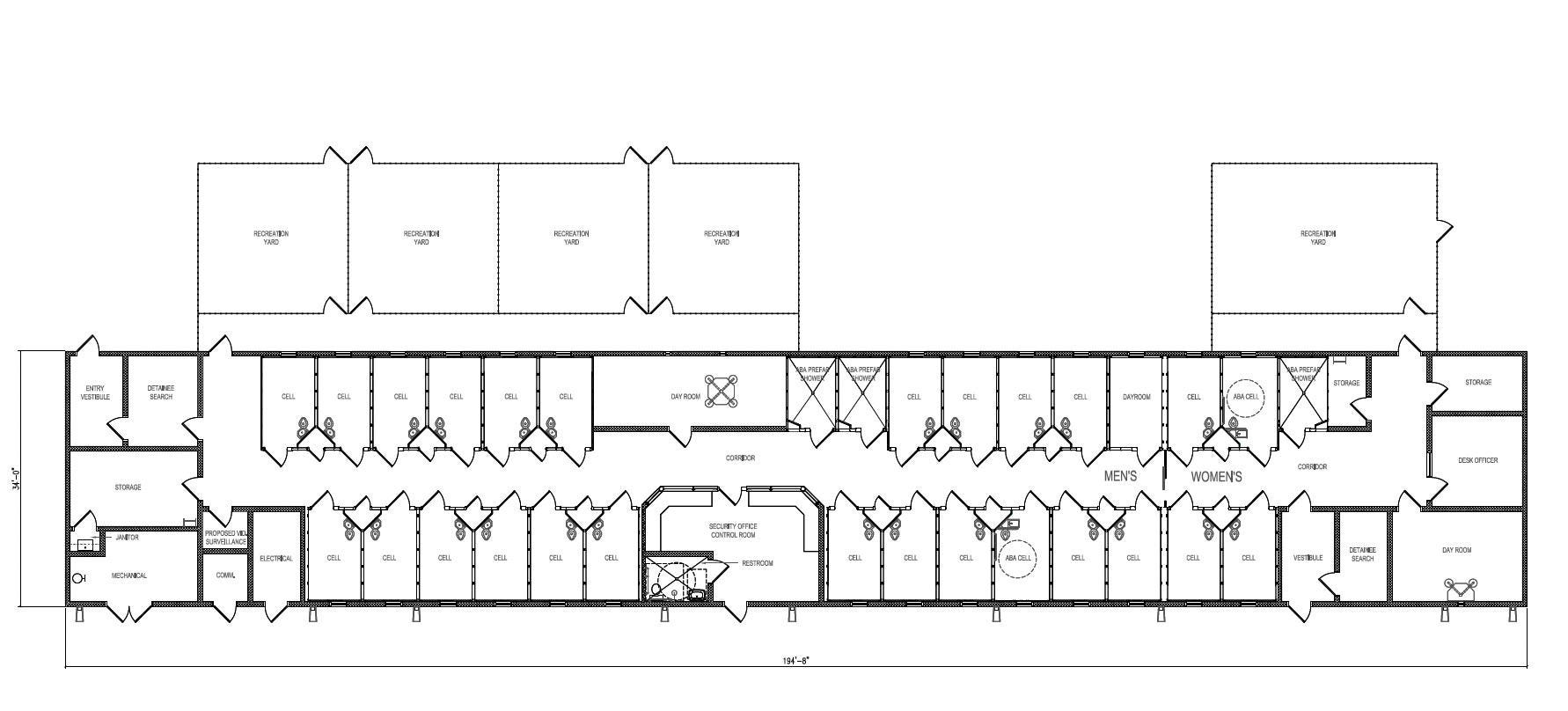
The plans for Port Isabel show what ICE means by a secure housing unit. The proposed one-story building has 26 steel cells: 21 in a men’s section, three in a women’s section, and two built to meet accessibility rules, one on each side. It would also have three day rooms, three showers, two soundproof search rooms, secure entry vestibules, a control room, staff offices, and storage space. The men’s and women’s sections would have separate fenced recreation yards.
Port Isabel is the furthest along. It was the only unit ICE said was funded when it put the work out for bid, and the agency already has a detailed scope of work, concept drawings, and a security layout. ICE has not awarded a contract for Port Isabel, and it has not said when or whether it will order similar units at the five sites covered by Sunday’s contracts. The Port Isabel plans, though, give the agency a template for 26-cell additions elsewhere once it orders the work and commits money.
In Batavia, a third step toward expansion since June
Three of the contracts signed Sunday cover detention centers where ICE was already preparing to grow. In June, the agency hired First American Title Insurance Company, without seeking other bids, to handle land purchases at Batavia, Florence, and the Krome detention center in Miami. A document explaining that decision said the centers “will be expanded to enable additional administrative, medical, training and detention facilities and space.”
The Miami contract signed Sunday names the city but not a specific facility.
The Batavia center, about 35 miles east of Buffalo, is the only federally-owned detention center ICE runs in New York. In February, it held 745 people in a space rated for 650, according to WHAM-TV.
DHS has said it needs more space there because of New York laws that bar counties from holding people for ICE, the latest of which took effect Aug. 25. In August, ICE said it planned to hire Akima Infrastructure Protection, the company that runs migrant detention at Guantánamo Bay, to put up a 100-bed “temporary detention structure” at the center.
The $1.5 billion contract signed Sunday is a separate contract with a different company.
In July, Gov. Kathy Hochul wrote to Homeland Security Secretary Markwayne Mullin asking about construction in the state. “So I ask: is your Department building or expanding immigration detention facilities in New York?” she wrote. “If so, where, to what capacity, and under what authority?”
A $1.2 billion contract for a center that has not held detainees since 2014
ICE stopped holding detainees at its El Centro jail in California’s Imperial Valley in October 2014 and moved them to a privately run facility in Calexico, Calif. When ICE asked for bids in July, it told companies to estimate costs at every site using a soil report written for its Port Isabel center in South Texas and to “assume the same soil conditions.” At El Centro, that meant pricing construction in one of the most earthquake-prone regions in the country with soil data from a coastal plain on the Gulf of Mexico.
The company that won the El Centro contract has ties to earlier stages of ICE’s expansion. Rudiarius Holdings was registered in Wyoming in July 2025, and its original state filing listed a Dorchester home owned by Grossmann, according to state records and Project Salt Box’s April reporting. Its federal registration lists Rise’s office address.
That April reporting found that Rudiarius paid for the environmental review of a warehouse ICE bought in Roxbury, N.J. The Lever reported that Grossmann signed a memo telling officials in Social Circle, Ga., that turning a warehouse there into a detention center would have “no adverse effect on the community,” and that his name appears on the $1.5 billion deal under which the government bought two California detention centers from the private prison company CoreCivic.
As of April, Rudiarius had no direct contract with DHS.
Among the lawsuits against Rise, a property owner sued in January 2024, alleging what it called a “massive fraudulent billing scheme,” and a judge ordered the company to pay $20 million this April, The Lever reported. One bank told a court that Rise was in “perilous financial condition.” Most of the suits were still pending as of July.
ICE’s July request said small businesses could not compete for these contracts, and it required each company to show it could obtain $2 billion in insurance guaranteeing the work would be finished if the company failed.
The government’s record of the award lists Rudiarius as a small business and does not show how it met the insurance requirement.
Asked by The Lever in July about his role in the CoreCivic purchase, which was brokered by a firm called SK2, Grossmann said, “I don't have a contract working with them.”
Sites from Texas to Guantánamo are still unassigned
The contracts signed Sunday do not include the one project ICE had money for when it asked for bids: a new wing at its Port Isabel detention center near Los Fresnos, Texas.
They also do not cover seven locations ICE grouped under the label “Mega Hub DC,” a term it has not explained, and planned to assign to a single company. The group includes Honolulu, St. Thomas in the U.S. Virgin Islands, and the naval base at Guantánamo Bay, Cuba. Five of the seven have no ICE-owned detention center today.
The five contracts account for $7.3 billion of the program’s $10 billion limit, leaving about $2.7 billion for the remaining sites.
None of the contracts says how many people the new buildings would hold. The plans ICE shared with bidders show each wing with 26 cells, a security camera in every cell, and three showers for the whole building, but they do not say whether each cell would hold one person or two.
I feel ill every time I read about ICE detention expansion. Are we going to survive another 2+ years of this insanity? S. Miller should be the one in permanent detention!!
This is our tax money being spent and I for one am not happy about it.