

A federal plan to convert a warehouse in Washington County, Md., into an immigration processing facility is on hold under a court injunction, after a federal judge found the project failed to comply with federal environmental review requirements.
But meeting notes from a March 16 briefing between Immigration and Customs Enforcement officials and county leaders offer the clearest account to date of how the project was advancing — including how federal officials discussed compensating the county and addressing infrastructure demands, even as key terms remained unsettled.
The briefing came after Washington County Administrator Michelle Gordon sent a list of requests in February to Homeland Security Secretary Kristi Noem, outlining local concerns tied to the project, including nearly $380 million in infrastructure demands and its fiscal impact.
In an opinion issued April 17, Judge Adam B. Hurson of the U.S. District Court for the District of Maryland halted the project, describing it as “a crystal-clear example” of federal officials failing to comply with the National Environmental Policy Act.

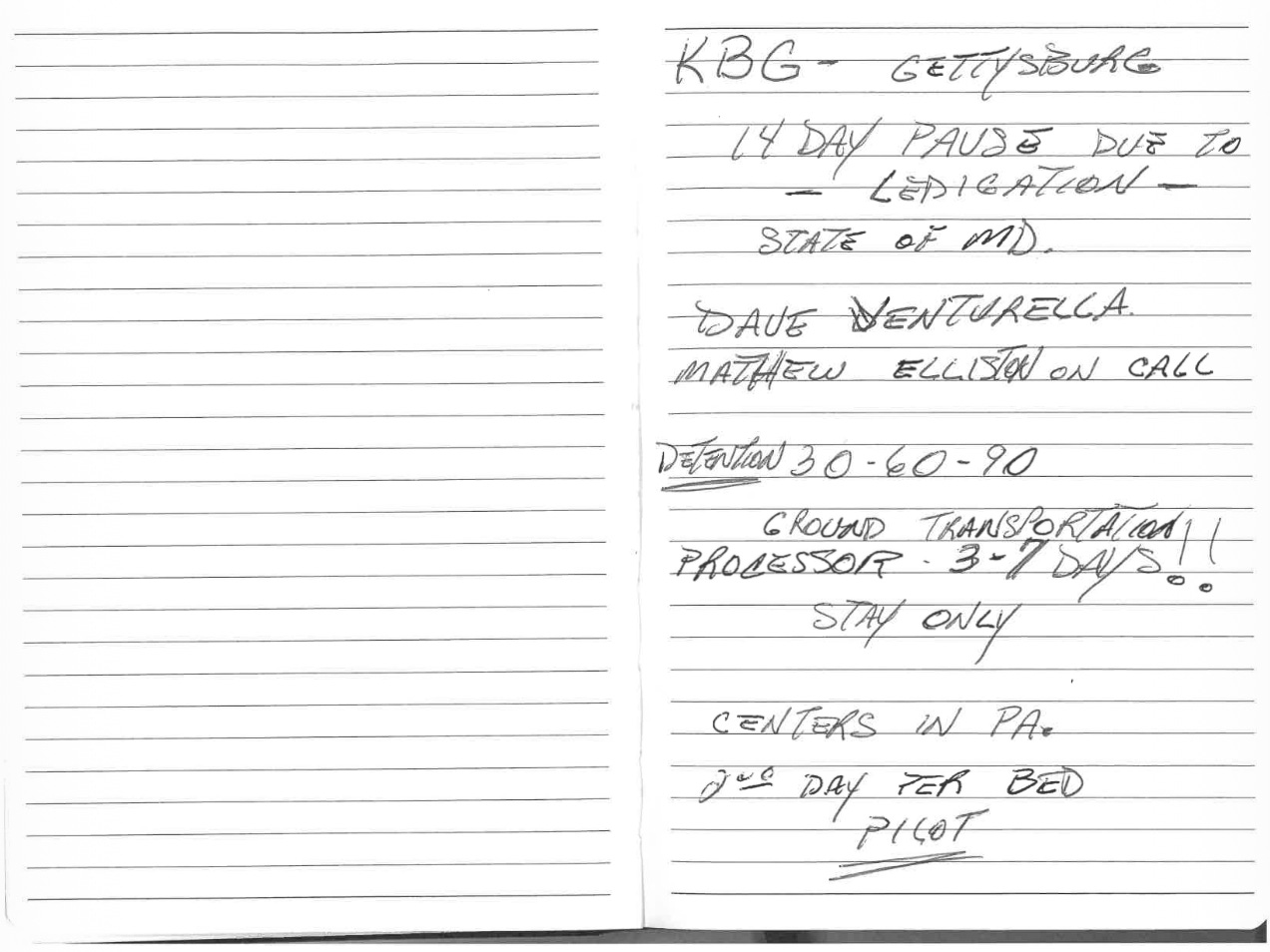
The records, released through the county’s public information portal and reviewed by Project Saltbox, provide a detailed view of how the federal government is structuring financial and operational arrangements with local jurisdictions as it moves to expand detention capacity. In the margin of one page, a handwritten note reads “paused 14 days due to ledigation [sic],” a reference to the temporary restraining order that halted work.
Participants in the March 16 briefing included Dave Venturella, a senior ICE advisor and former executive at the private detention company GEO Group, and Matt Elliston, an assistant director at the agency, along with Ms. Gordon and county commissioners.
Because federally owned property is exempt from local taxation, the notes outline a proposed workaround: a Payment in Lieu of Taxes, or PILOT, set at $2 per bed, per day. The figure appears in both typed and handwritten notes. No formal agreement is included, and the documents do not specify how the payment would be calculated — whether based on maximum capacity, operational capacity, or another measure.
At 1,500 beds — a figure cited in leaked ICE documents and as a “surge” ceiling in court filings — the formula would generate about $1.1 million annually. But ICE has referenced smaller configurations elsewhere, as low as about 520 beds, which would reduce the payment to roughly $380,000. The notes do not indicate which figure would apply. The court noted that even conservative estimates suggested the facility could increase the surrounding population by nearly 50 percent.
The disparity underscores a broader tension reflected in the documents: while county officials were outlining hundreds of millions of dollars in potential infrastructure needs, the federal proposal described in the meeting notes would provide a fixed daily payment tied to bed count.
The notes describe the facility as a short-term processing site, with stays of three to seven days. That model would mean a steady flow of people moving through the site, increasing demand on local infrastructure. The documents do not specify how the proposed payment would be calculated, including whether it would account for that throughput. It aligns with the agency’s description of a “processing center” in its Detention Reengineering Initiative.
The notes also suggest that individuals would be transferred out of state. One entry states simply that individuals would be transferred to a detention facility in Pennsylvania, without further detail on the purpose or specific destination.
Based on Project Saltbox’s analysis of ICE’s recent acquisitions, Pennsylvania is home to at least one large-scale “mega center” in Tremont designed to hold 7,500 individuals, part of a broader network of massive sites intended to receive transfers from short-term processing locations.
During the call, county officials raised concerns about infrastructure, including water and wastewater capacity, road access and electrical load — constraints later echoed by state regulators, who directed Washington County to revisit its wastewater planning.
In response to questions from Project Saltbox, county officials said federal authorities indicated that the work would be handled by KVG, LLC, a contractor hired to renovate the site. According to the county, KVG is responsible for engineering assessments and construction, including evaluating water and wastewater capacity. The company was awarded a $113 million contract, with a ceiling of $641 million, for conversion work at the warehouse. A stop-work order was issued in early April following a temporary restraining order from Judge Hurson.
County officials said federal authorities indicated that the government would pay fees associated with any additional water or wastewater capacity and cover upgrades to the Wright Road sewage pump station. KVG, they said, would also be responsible for temporary solutions if existing capacity proves insufficient.
The March 16 meeting notes include a similar statement, that “DHS/Vendor will pay for infrastructure upgrades,” but do not provide details on scope, cost or timing, and no formal agreement is included in the record. The statements outline a plan for addressing infrastructure needs, but stop short of documenting enforceable commitments.
An email summarizing the March 16 briefing, sent by Washington County official Michelle Gordon to County Attorney Zachary Kieffer, outlines how the project was expected to operate in practice. The notes describe the site as a short-term processing facility with stays of three to seven days and estimate about 500 individuals “on any given day,” even as capacity targets ranged higher. They indicate that “EMS services [are] not anticipated,” with plans for a “full medical unit on staff” and a private ambulance contract, and note that individuals could be “transferred to [a] detention facility in PA,” without further detail.
The email also references infrastructure changes, including an upgrade to the county air traffic control tower, increased utility demand to accommodate detainee capacity, and anticipated coordination with transportation officials over Interstate 81.
It also draws a comparison between the Williamsport warehouse and a “comparable processing center” in Philipsburg, Pa., a reference to the Moshannon Valley Processing Center, an existing ICE detention facility.
The note lists attendees including Tim Kaiser, a division chief at U.S. Citizenship and Immigration Services who has appeared in internal Detention Reengineering Initiative materials. Reporting and document metadata reviewed independently by Project Saltbox and WIRED show Kaiser participating in planning documents about the structure and duration of ICE’s proposed detention network, including facilities designed to hold individuals for up to 60 days, linking the Maryland project to a broader system of short-term processing sites feeding into larger detention centers.
The Washington County project is part of a broader push to expand detention capacity through large warehouse conversions. ICE has purchased 11 warehouses across the United States, with planned populations ranging from about 500 to 8,500 beds.
In total, the agency has spent more than $1 billion on warehouse acquisitions, according to Project Saltbox analysis. Using the $2-per-bed, per-day structure outlined in the Maryland notes, a facility at the upper end of that range would generate roughly $6.2 million in PILOT funds annually for the host jurisdiction.
The Maryland records do not indicate whether similar arrangements are being considered elsewhere. But they show how the project was advancing before the injunction, even as key financial and operational terms — including capacity, infrastructure costs and local compensation — remained unsettled.
THANK YOU for your diligent reporting. Such important work. Helps keep the eyes open. Much appreciated.
Great sleuthing!! This could be any county in Maryland whose city or county council is ICE friendly and willing to be “bribed”.