

Follow the Money - April 2026: ICE Spending Slows to Lowest Point this Year
Project Salt Box's monthly report on ICE and CBP procurement activities

Bottom Line Up Front
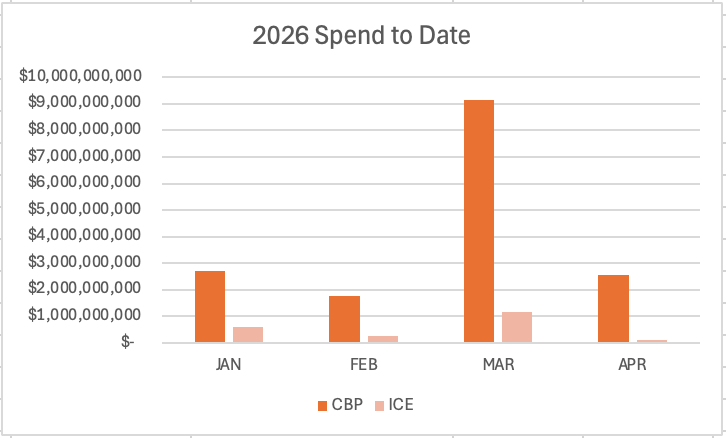
ICE Spending Drops Dramatically: This month, ICE spent $130 million - an 88% decrease from last month and the agency’s lowest monthly spend so far this year. The drop in spending is likely due to Markwayne Mullin’s transition-in as Secretary, ongoing litigation, and internal contract reviews.
Border Wall Construction Continues: Outside of March, which saw a massive jump in spending, CBP’s border wall contracts have been relatively constant this year. The agency is spending, on average, $2 billion a month on border wall construction along the southern border.
Private Prison Companies Continue to Profit: Despite the drop in overall spending, April was business as usual for companies like The GEO Group, CoreCivic, and Akima. Each received tens of millions of dollars in continued detention and transportation contracts.
April’s Biggest Contracts
For the fourth month in a row, border contracts continue to dominate CBP and ICE spending. Barnard Construction and Fisher Sand & Gravel were each awarded another contract for border wall construction, this time in El Paso and San Diego, respectively. These two contracts alone totaled over $2 billion.
Additional new contracts included a $15 million award to Acuity-CHS LLC for pre-employment medical testing of potential CBP hires and a $12 million award to Edge Ops, LLC to support Homeland Security Investigations (HSI) with “Project Safe Haven” - described as an “analytic capability to identify, track, and map movement of criminal and terrorist organizations.”
In April, the bulk of ICE’s spending flowed through modifications to existing contracts - only 17% went to new awards. The GEO Group received over $20 million, including $16 million in funding for the detention facility they operate in Aurora, CO. CoreCivic received additional funds to continue operations at the Central Arizona Correctional Complex.
Warehouse Conversion Contracts On Pause

The contracts awarded to KVG, LLC and Gardaworld Federal were both paused within a month of starting. The KVG contract to convert the Hagerstown/Williamsport, Md. warehouse into a detention facility was hit with a stop‑work order due to the ongoing lawsuit between the Maryland Attorney General and DHS. Interestingly, the Surprise, Az. stop-work order was issued one day before the Arizona Attorney General filed a similar lawsuit against the agency.
On April 15, Judge Brendan Hurson granted a preliminary injunction blocking work on the Maryland warehouse. In his opinion, Judge Hurson stated that the case “provides a crystal-clear example of a federal agency failing to comply with the basic requirements of the National Environmental Policy Act” and that “the State has met its burden of showing a clear likelihood of imminent irreparable harm should Defendants be allowed to proceed with their proposed course of action at the Williamsport Warehouse.”
There are currently four ongoing lawsuits against DHS in relation to the warehouses in Maryland, Arizona, New Jersey, and Michigan. Project Salt Box is following these cases in our Litigation Tracker.
Analysis and Trends
Reliance on existing contracts over new awards: In April, ICE largely relied on modifying existing contracts rather than initiating new ones, with only 17% of the agency’s spending going to new awards. This drop in new awards is likely tied to a combination of factors, including the partial government shutdown, Markwayne Mullin’s transition as the new Secretary, and a possible agency‑wide push to avoid new awards that could invite additional scrutiny. It also underscores that, even without new contracts, ICE has already built a robust detention and transportation infrastructure that can keep operating through existing agreements.
Analytics and surveillance capability are expanding, even during “slow” month: Even as ICE’s overall spending fell to its lowest level so far this year, DHS continued to invest in the analytic backbone of immigration enforcement. In addition to the Edge Ops contract supporting Project Safe Haven, ICE ERO paid Palantir over $86 million for their case management and analytics platform. The agency also purchased additional Cellebrite tools for mobile forensics, along with “forensic kits” from firms like Impres Technology and FCN. These awards show how DHS is deepening its capacity to collect, analyze, and act on data about people in the immigration system.
Border wall construction continues: Border wall construction remained a dominant feature of DHS spending, with CBP obligating roughly 2 billion dollars this month to wall projects along the southern border. Large awards to firms like Barnard Construction and Fisher Sand & Gravel continue to drive this spending, with just a few contracts accounting for billions in obligations. This year has seen a steady flow of money into a small group of border infrastructure contractors, underscoring just how central wall construction remains to DHS’s agenda, despite volatility elsewhere in the department’s budget. Based on a Project Salt Box analysis of over 60 contracts, CBP has spent over $20B on the border wall since August 2025.
A Momentary Lull in the Spending Surge
Despite a low spending month for ICE, this slowdown is unlikely to last. The agency is moving forward with its plans to lease office space for over 300 personnel nationwide, and, as we previously reported, is conducting market research to establish its own fast-track construction contract vehicle. On top of that, ICE continues its hiring surge, with over 60 new job openings listed on LinkedIn in the last week alone. Thanks to the One Big Beautiful Bill Act, the agency still has access to billions in funding, and spending is likely to pick up again over the next few months.
About this Report
All procurement data used in this report is from usaspending.gov and SAM.gov. This is the fourth monthly report from Project Salt Box. If there are specific procurements, companies, regions, or topics you would like us to cover in future monthly reports, please reach out to us and let us know.
This is good news. Let's hope the trend continues.
Mar-a-lago