

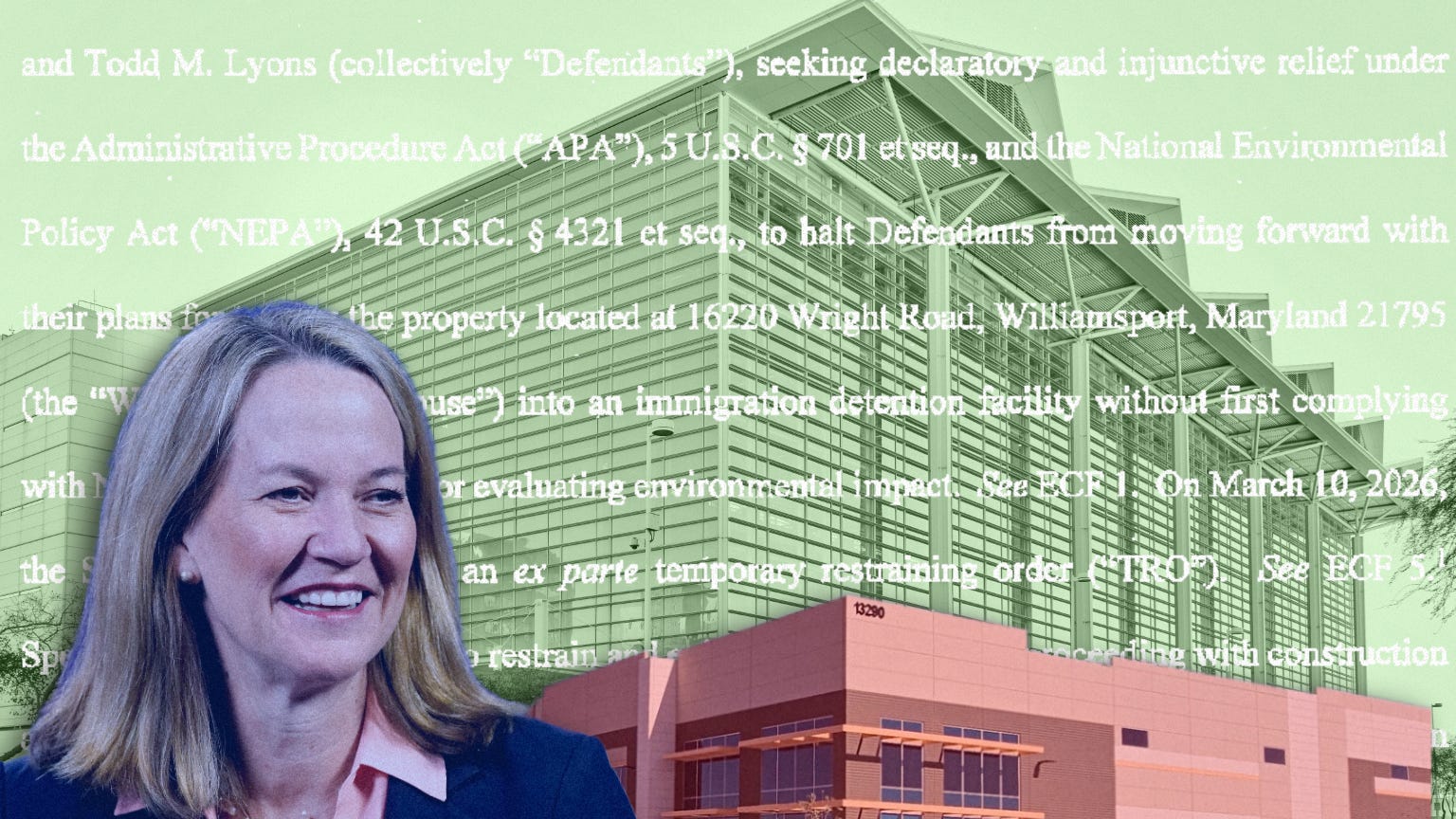
In January, the Department of Homeland Security paid $70 million for a warehouse in Surprise, Ariz. — a 418,000 square feet industrial shell near the intersection of Waddell and Dysart roads — and said nothing to the city about it until the deed was recorded. When Surprise residents found out, more than 800 of them showed up to a City Council meeting to object. The council had no answers.
What followed has become, at this point, formulaic. DHS posted a floodplain review notice to its own website — not the Federal Register, where such notices are required to appear — opened a public comment period, and then, when the period closed, took the notice down. This happened so quickly that even the Wayback Machine failed to archive it. Shortly after, ICE awarded GardaWorld Federal Services a $313.4 million contract to fit out the facility for 1,500 detainees. The comment period had been a formality.
This is the same sequence that played out in Williamsport, Md., where DHS bought an 825,000-square-foot warehouse for $102.4 million and awarded a renovation contract one day after an identical floodplain comment period closed. It was that timeline — a contract awarded soon after a review that had appeared on a DHS webpage and nowhere else — that a federal judge found he could not ignore.
On March 11, U.S. District Judge Brendan A. Hurson halted all construction at the Williamsport site. The National Environmental Policy Act requires federal agencies to conduct a genuine environmental review before breaking ground on a major project, and the government had not done that. A comment period that closes Monday and produces a contract by Tuesday is not a good-faith review. On March 19, Hurson extended the freeze through mid-April and scheduled a hearing that could hold it in place for the life of the case. The federal government has spent $215 million on a project that sits idle.
The legal theory is fifty years old and deeply embedded in federal regulatory practice. What is new is a federal judge applying it to facts this specific — a floodplain notice posted to an agency webpage, a contract awarded days later — and finding them wanting.
NEPA — the National Environmental Policy Act, signed into law in 1970 — was built on the straightforward premise that the federal government should have to reckon, openly and in advance, with the environmental consequences of what it does. Before an agency acts, it must assess the impact, publish that assessment, and it must give the public a genuine opportunity to respond — not as a courtesy, but as a legal requirement. NEPA declares a national policy to use all practicable means so that humans and nature can exist in “productive and enjoyable harmony,” and to prevent or reduce environmental damage while promoting human health and welfare.
The Administrative Procedure Act, the APA, operates on a related but distinct principle. Passed in 1946 in the wake of a vast expansion of federal power, it established that agencies are not sovereign. They derive their authority from Congress, they are bound by their own regulations, and when they act arbitrarily — when they cut corners, ignore their own procedures, or offer the appearance of process without its substance — courts have the authority to intervene. Between them, the two laws encode a single democratic idea: that power exercised without accountability is power exercised unlawfully.
That is what is happening here. Posting a notice to an agency webpage and pulling it down before anyone could meaningfully respond does not satisfy the spirit of public comment. Awarding a nine-figure contract the following day does not constitute deliberation. What these agencies have offered is the form of compliance without the substance — and that, historically, is precisely what these laws were designed to catch.
What is new is a federal judge applying it to facts this specific — a floodplain notice posted to an agency webpage, a contract awarded days later — and finding them wanting. That ruling is now a reference point; New Jersey and Michigan have moved to pursue the same theory, though neither has yet seen a fit-out contract awarded. Arizona has. That makes it the case most materially similar to Maryland — and the one with the strongest footing on the merits.
On March 20, New Jersey sued to block a 1,500-person facility in Roxbury Township. The complaint makes the NEPA argument and adds two more: DHS violated the Intergovernmental Cooperation Act by closing the deal without consulting state and local officials, and the facility cannot legally hold detainees because it currently has four toilets. On March 24, Michigan and the City of Romulus filed their own suit over a suburban Detroit warehouse that sits less than a mile from two public schools and borders a 118-acre wetland. Same NEPA argument. Same failure to notify anyone before the purchase.
Arizona has not filed anything.
There may be a strategic reason for that. Attorney General Kris Mayes has said she is weighing a public nuisance claim under state law — a theory that would keep the case in state court and away from a federal judiciary that, in Arizona, may feel less hospitable than the bench that handed Maryland its win. The instinct is not unreasonable, and the underlying argument is legitimate: the Surprise facility would strain local infrastructure, alter surrounding neighborhoods, and impose costs on a community that had no say in the decision.
But a public nuisance claim is an uphill battle against a federally operated facility, and winning on that theory would require breaking new legal ground at precisely the moment when precedent is available and already proven.
Of all the warehouses the administration is converting, Surprise is the one whose facts most closely track Williamsport — the case that is already winning. The same contracting vehicle. The same target population. The same floodplain review posted to a DHS webpage rather than the Federal Register. The same comment period that closed and was followed almost immediately by a major construction award. Judge Hurson’s ruling rested on that sequence. The public record in Surprise shows the same sequence.
A NEPA claim would not require Arizona to build a novel theory. It would require documenting facts that already exist: when the floodplain notice was posted (Feb. 10), where it was posted (on a recycled URL that has served as the vessel for every such review DHS has run since it started buying warehouses to turn into detention centers), when the comment period closed (Feb. 20), when the contract was awarded (March 13), and what environmental review, if any, occurred in between (none). The public nuisance theory need not be abandoned — it can sit alongside the federal claims, the way New Jersey layered the Intergovernmental Cooperation Act on top of its NEPA argument. That claim is independently available too: the City of Surprise was not notified before the purchase closed.
What the Trump administration is running is a race. The program — routed through a Defense Department contracting vehicle and backed by $45 billion in congressional appropriations — is designed to move faster than opposition can organize, faster than local officials can respond, and faster than courts were expected to act.
That assumption has not held in Maryland, but speed still matters. Every week of construction that proceeds without a legal challenge is a weight on the equitable scale a court will consult if it is eventually asked to freeze the work.
GardaWorld is already in Surprise. Arizona has the most direct factual parallel to the case that is working.
What are they waiting for?
ICE OUT FOREVER
Maryland sued to halt an ICE detention center built in a warehouse, citing no environmental review or public input. Four toilets do not make a humane facility — this is about accountability, transparency, and protecting communities. #StopICEWarehouses #DueProcess