

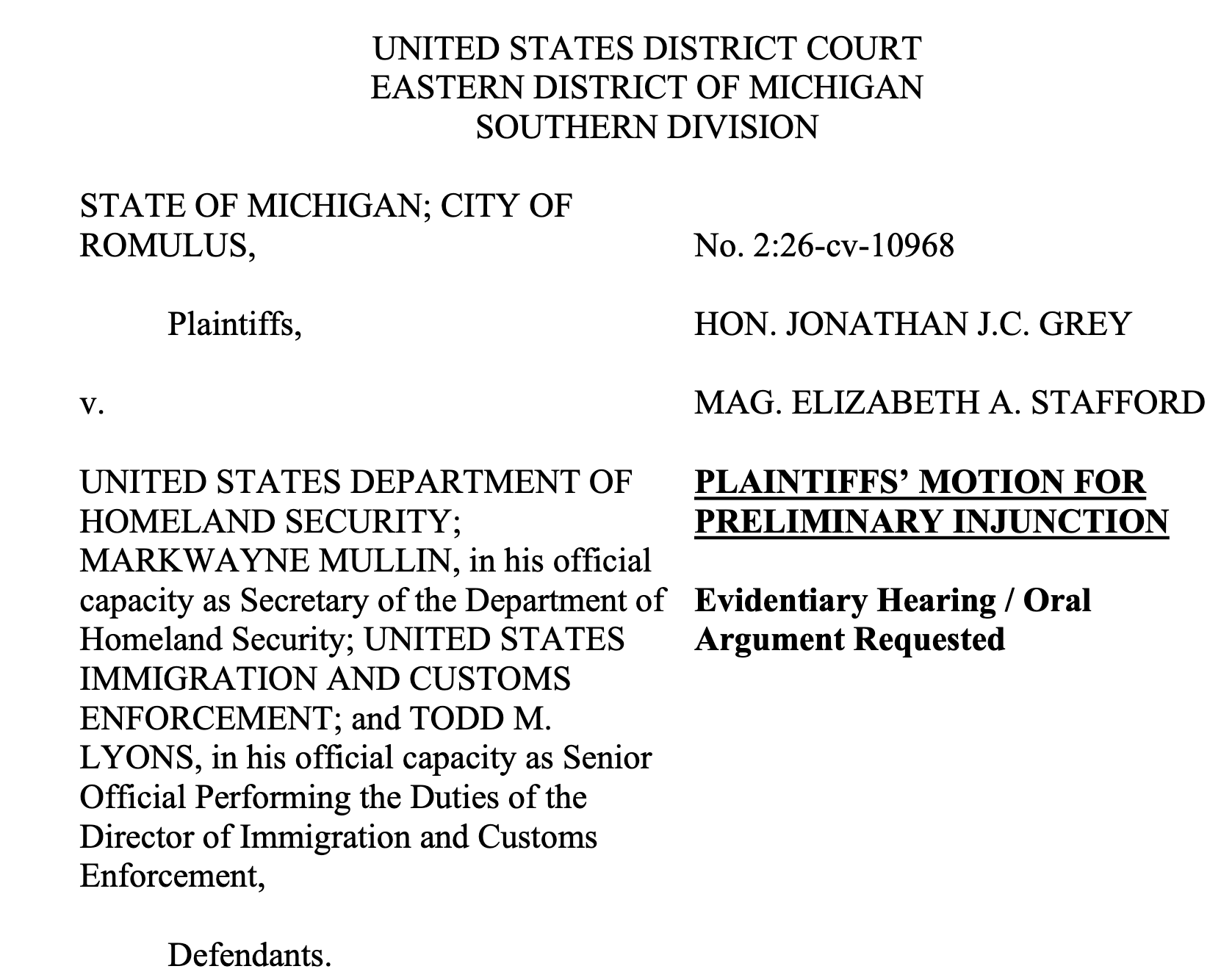
Michigan and the City of Romulus asked a federal judge on Tuesday to immediately freeze construction and detention operations at a suburban Detroit warehouse the Trump administration is converting into an immigration detention center, escalating a lawsuit filed one week ago into the most consequential test yet of the state’s effort to block the project.
The motion for a preliminary injunction, filed in the U.S. District Court for the Eastern District of Michigan, asks Judge Jonathan J.C. Grey to halt all physical changes to the 249,000-square-foot facility on Cogswell Street in Romulus and prohibit the detention of any individuals there while the litigation proceeds. Plaintiffs also asked the court to require the government to file a status report within 48 hours of any order describing the steps it has taken to comply.
The filing came with an unusual procedural wrinkle: the Department of Justice has not yet assigned counsel to the case.
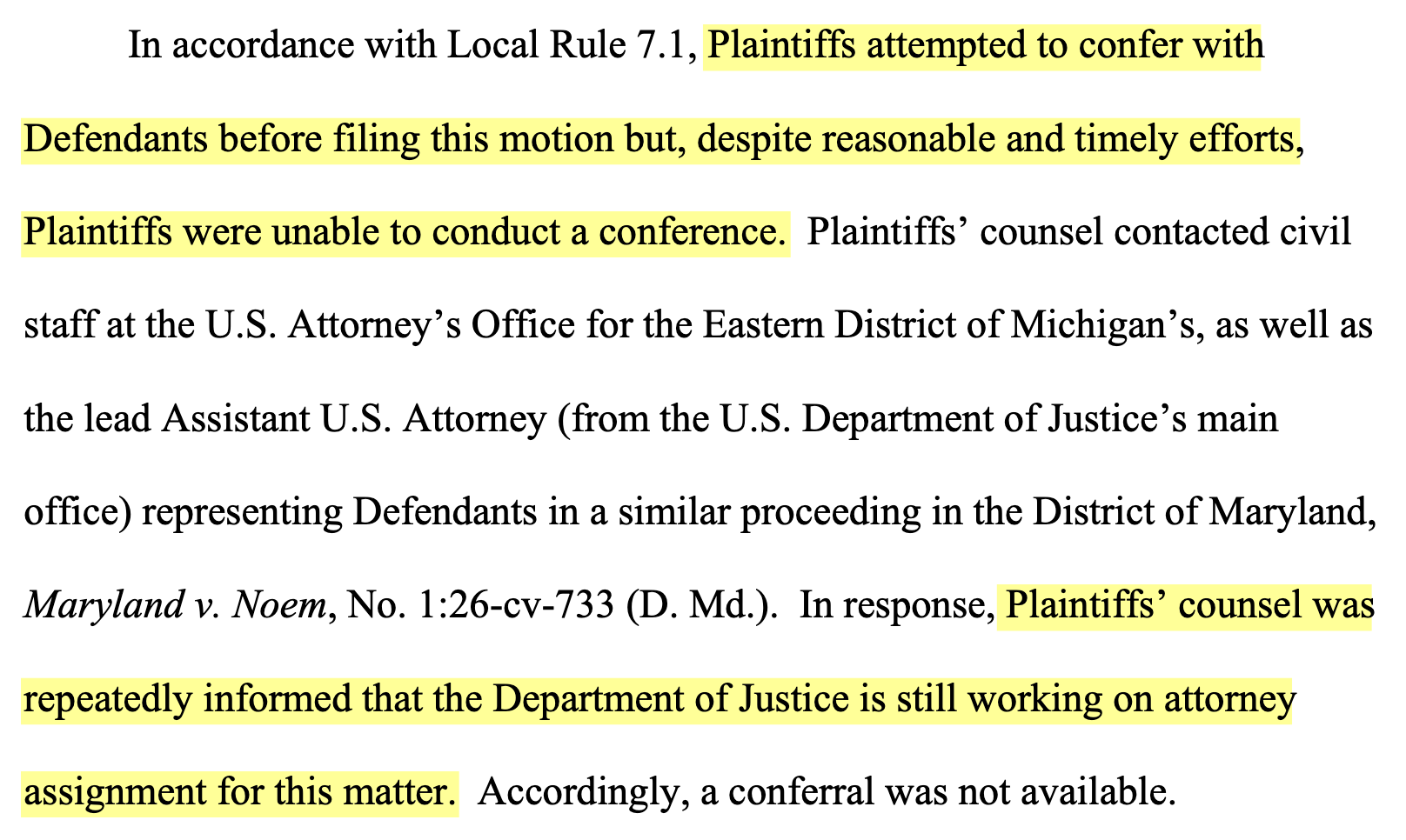
Michigan’s lawyers said they made reasonable efforts to confer with government attorneys before filing, as local rules require, but were repeatedly told that DOJ was still working on attorney assignment. They ultimately served the motion by certified mail to newly-appointed DHS Secretary Markwayne Mullin, ICE Acting Director Todd M. Lyons, Attorney General Pam Bondi, and the U.S. Attorney for the Eastern District of Michigan.
The failure to assign counsel may be indicative of a strain that runs deeper than just this case. The Justice Department has lost an estimated 5,500 employees since the start of the Trump administration — attorneys, agents, immigration judges — and has refilled a fraction of those positions, with top law school graduates largely no longer applying, according to reporting by the ABA Journal.
To redirect resources toward immigration enforcement, the department quietly closed more than 23,000 criminal cases in its first six months under Attorney General Pam Bondi — including more than 900 cases of federal program and procurement fraud, and three times as many environmental crimes cases as the prior administration, according to a ProPublica analysis published Tuesday.
The resulting shortage has been measurable in near-real-time. For example, Trump-appointed US attorneys in Texas, Louisiana, and Massachusetts filed court declarations warning that immigration habeas petitions had created a “tsunami’ of new litigation overwhelming their offices — in the Western District of Texas, such cases made up more than 75 percent of all new civil filings in January. The strain spilled into public view in a Minneapolis courtroom in February, when a Justice Department attorney told a federal judge that ICE officials simply don't respond when prosecutors try to get them to comply with court orders. “The system sucks. This job sucks,” she said, according to a transcript obtained by Politico. She was removed from her post shortly after.
“If they're having a hard time staffing Minnesota, and they try this in other jurisdictions, where are the prosecutors going to come from?” Laurie Levenson, a former federal prosecutor and Loyola Law School professor, asked Bloomberg Law in February.
To be sure, the warehouse cases likely involves a different bench of lawyers in a different part of the Justice Department. But the underlying condition is the same: aggressive federal expansion that has outpaced and overwhelmed the lawyers meant to answer for it in court.
Infrastructure Lacking at Romulus Warehouse
The motion’s most detailed arguments concern the physical limits of the Romulus site — constraints that state and city officials say make the project not merely unlawful but unworkable.
The department purchased the Romulus warehouse on or around February 4 for $34.7 million as part of its Detention Reengineering Initiative, a program backed by roughly $45 billion in congressional appropriations aimed at converting industrial facilities into immigration detention centers nationwide. Federal officials have said the site would house up to 500 people in immigration custody awaiting processing.
The warehouse is connected to the city’s sewer system by a six-inch line designed for low-volume industrial use, capable of handling 0.26 cubic feet per second of wastewater. A detention center for 500 people and staff would generate flows as high as 2.30 cubic feet per second — nearly nine times the line’s design capacity, according to a declaration from the city’s public works director. The 15-inch city main under Cogswell Street, which also serves surrounding residential neighborhoods, has a total capacity of 3.0 cubic feet per second. Overflows, the motion argues, would reach a 118-acre wetland conservation easement held by the Michigan Department of Environment, Great Lakes, and Energy on land adjacent to the property.
The traffic situation is similarly constrained. Cogswell Street is a three-lane road — two travel lanes and a center turn lane — that the city owns and maintains. The warehouse has a single point of entry from a major road, with no associated turning lanes. City officials say the roadway cannot support the volume of staff, contractors, transport vehicles, and emergency services a facility of this size would generate.
The government’s own public notice, issued in late February, disclosed plans to install 3,800 linear feet of perimeter security fencing. Michigan’s environmental officials say that fencing, if placed across the regulated floodway that crosses the property, would require a state permit — one that has not been applied for — and a hydraulic model demonstrating it would not increase flooding on upstream properties. The site flooded last year. Portions of the property lie within a 100-year floodplain, a 500-year floodplain, and a regulated floodway.
A Third Front In Procedural Suits
The Michigan filing is the third legal challenge to the administration’s warehouse detention program, and the first to combine floodplain and wetland concerns with the procedural arguments that have anchored the earlier cases.
In Maryland, U.S. District Judge Brendan A. Hurson has frozen construction on a planned 1,500-bed facility in Williamsport since early March, and extended that freeze last week through at least April 16. A hearing on a longer-lasting injunction is scheduled for the week of April 13 — the first time the government will be required to substantively defend the program in open court. Michigan’s lawyers cited Judge Hurson’s preliminary findings repeatedly in Tuesday’s brief, treating them as a roadmap.
New Jersey and the Township of Roxbury filed their own suit last week, challenging a 470,000-square-foot warehouse in Roxbury that the government purchased for $129.3 million. That complaint goes further than Maryland’s on the law, arguing not only that DHS violated the National Environmental Policy Act and the Intergovernmental Cooperation Act, but that the site itself is unsuitable for detention under the Immigration and Nationality Act — a claim Michigan also makes. New Jersey’s brief noted the warehouse currently has four toilets. State jail standards for a 1,500-person facility would require at least 94 showers, 125 toilets, and 125 wash basins.
Michigan’s case tracks the New Jersey theory closely. The state argues that before acquiring the Romulus warehouse, ICE was required by the INA to first consider whether existing correctional facilities — including several closed Michigan prisons under state control — could meet its needs. According to a declaration from a Michigan Department of Corrections official, federal officials never made contact.
What Happens Next
No hearing date has been set. Judge Grey will need to schedule one, and the government will first need to get lawyers on the case. That timeline is uncertain — a fact that may itself inform how quickly the court acts on Michigan’s request for emergency relief.
The April 13 Maryland hearing now carries significant weight beyond that case alone. If Judge Hurson issues a preliminary injunction, the administration will face a choice between initiating the environmental review process the court has said was likely required or seeking a stay from the Fourth Circuit.
A ruling either way could arrive just as the Michigan and New Jersey cases are finding their footing — and as the legal infrastructure of the entire detention expansion program is being stress-tested for the first time.
good, good good!!
Do not wait for resolution from the lawsuits. County and state officials must refuse all permits for proposed construction until the feds submit plans that can pass all local and state environmental, utility, and architectural regulations.