

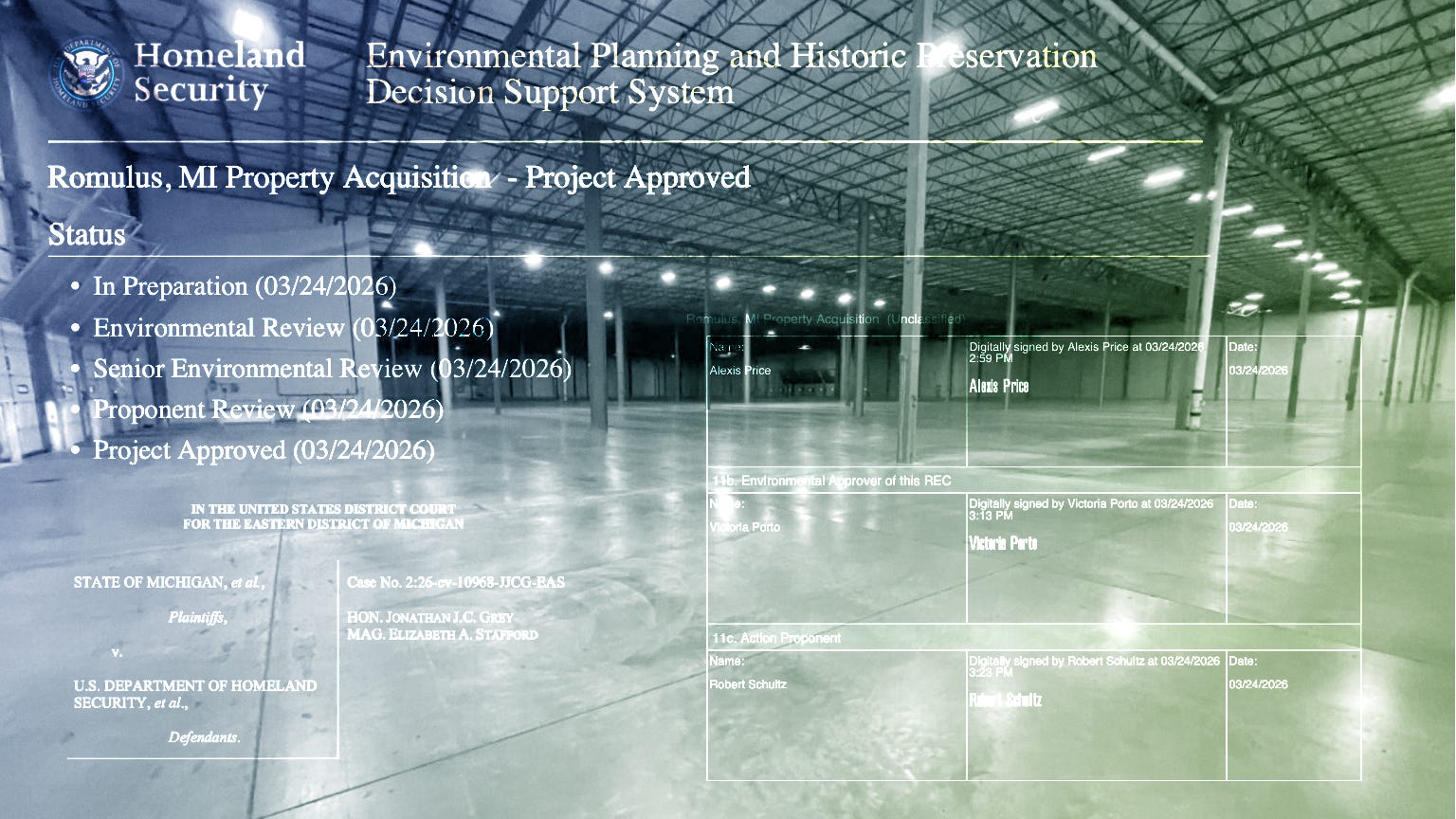
Federal officials defended a plan to convert a suburban Detroit warehouse into an immigration detention facility in a late-night court filing, as records show the project’s environmental review was completed in a single day — just hours after Michigan filed suit.
In its response, filed minutes before a court deadline, the Department of Homeland Security argued that the selection of detention sites falls within its “broad, discretionary authority” under federal immigration law and should not be subject to court review.

The filing also described opposition from some states as putting “U.S. citizens at risk” and pointed to Gov. Gretchen Whitmer’s prior opposition to ICE detention efforts, noting that she had blocked the sale of a state facility because it did not align with her “values,” framing the legal challenge as an effort to impede immigration enforcement.
Michigan officials argue that federal agencies moved ahead with the purchase and planning of the facility before completing the environmental review required under the National Environmental Policy Act.
ICE purchased the Romulus warehouse in early February. In its response, the government acknowledged the site could ultimately be scaled to accommodate as many as 2,000 detainees, though it said it does not currently expect to house more than 500.
State officials have cited concerns about wastewater capacity, traffic and the potential strain on local infrastructure if the facility is converted for detention use.
In its filing, the government said those harms were speculative, describing them as “contingent” on future decisions about how the facility would be used. It also argued that no final agency action had occurred and that plans for the site were still being developed.
Internal environmental review documents describe a more defined project.
A Record of Environmental Consideration, or REC, completed on March 24 — more than a month after the property was purchased and the same day Michigan filed its lawsuit — determined that the project qualified for a categorical exclusion, a streamlined form of review used for actions that “normally do not significantly affect the quality of the human environment.”
The document outlines a detention processing center with housing units, recreation areas and support facilities, while stating that the project would involve “no new building additions, footprint expansions, off site construction, or capacity related improvements.”
It also concludes that the facility would not exceed existing infrastructure capacity, even as it notes that the project “may require upsizing or modification of the existing sanitary sewer lateral” and references “possible sewer connection improvements,” with final capacity to be confirmed through later engineering and coordination with local authorities.
Digital signatures show the review was prepared and approved within roughly 30 minutes on the afternoon of March 24.
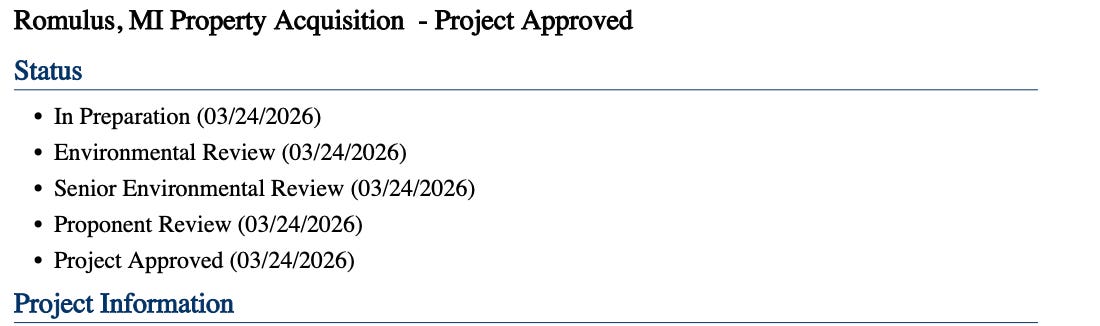
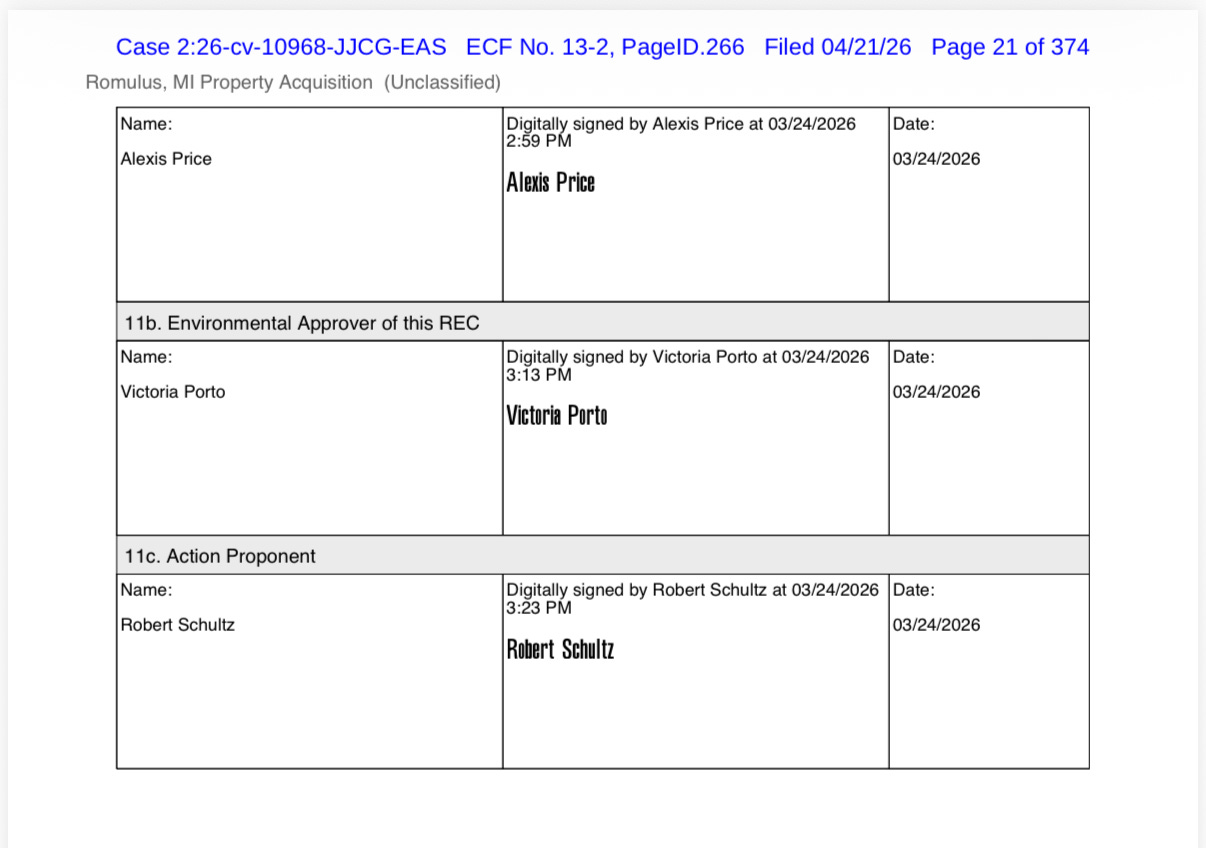
The environmental determination came nearly a month after the property purchase and within hours of the lawsuit, while the government’s court filing describes the project as still evolving and not yet final.
The REC also states that the proposed action is “not a piece of a larger action” and does not involve “extraordinary circumstances” that would require more detailed environmental review — findings used to support reliance on categorical exclusions.
In its court filing, the government emphasized that additional environmental review is forthcoming, stating that ICE will complete further analysis before undertaking construction or operating the facility.
That position follows an earlier internal determination that the project qualified for a categorical exclusion, a form of review used for actions not expected to have significant environmental effects.
In a separate case involving a warehouse conversion in Williamsport, Md., a federal judge rejected that approach, finding that DHS relied on categorical exclusions to evaluate a project that would substantially change how the facility functioned. The court wrote that the agency had attempted to “shoehorn” the conversion of a cargo warehouse into exclusions meant for minor renovations and real estate transactions, and that the review itself proceeded at a “rocket’s pace.”
In that case, DHS “stacked” multiple categorical exclusions simultaneously — including those for property acquisition and minor facility modifications — to justify bypassing more detailed environmental review. The court found that approach inconsistent with the scale of the project, where the conversion would introduce sustained human occupancy and strain existing infrastructure. Maryland’s request for a preliminary injunction was ultimately granted.
The same categories used in the Maryland case — covering real estate acquisition, minor renovations and limited construction — are also invoked in the Michigan review, where the agency determined that converting the Romulus warehouse into a detention facility would not constitute a meaningful change in use or require expanded environmental analysis.
Michigan is expected to file its reply by April 28.
Track this case and others at our updated Warehouse Litigation Tracker, live now at https://tracker.projectsaltbox.com.
Insanity. Very fitting.
Thanks so much for all of your investigative work. Every single bit of it helps make the struggle against these facilities stronger.