

ICE Turns to Private Industry to Track Down 100,000 Unaccompanied Children

Editor’s Note: This article has been updated to reflect the government’s responses to industry questions, posted on March 23, 2026.
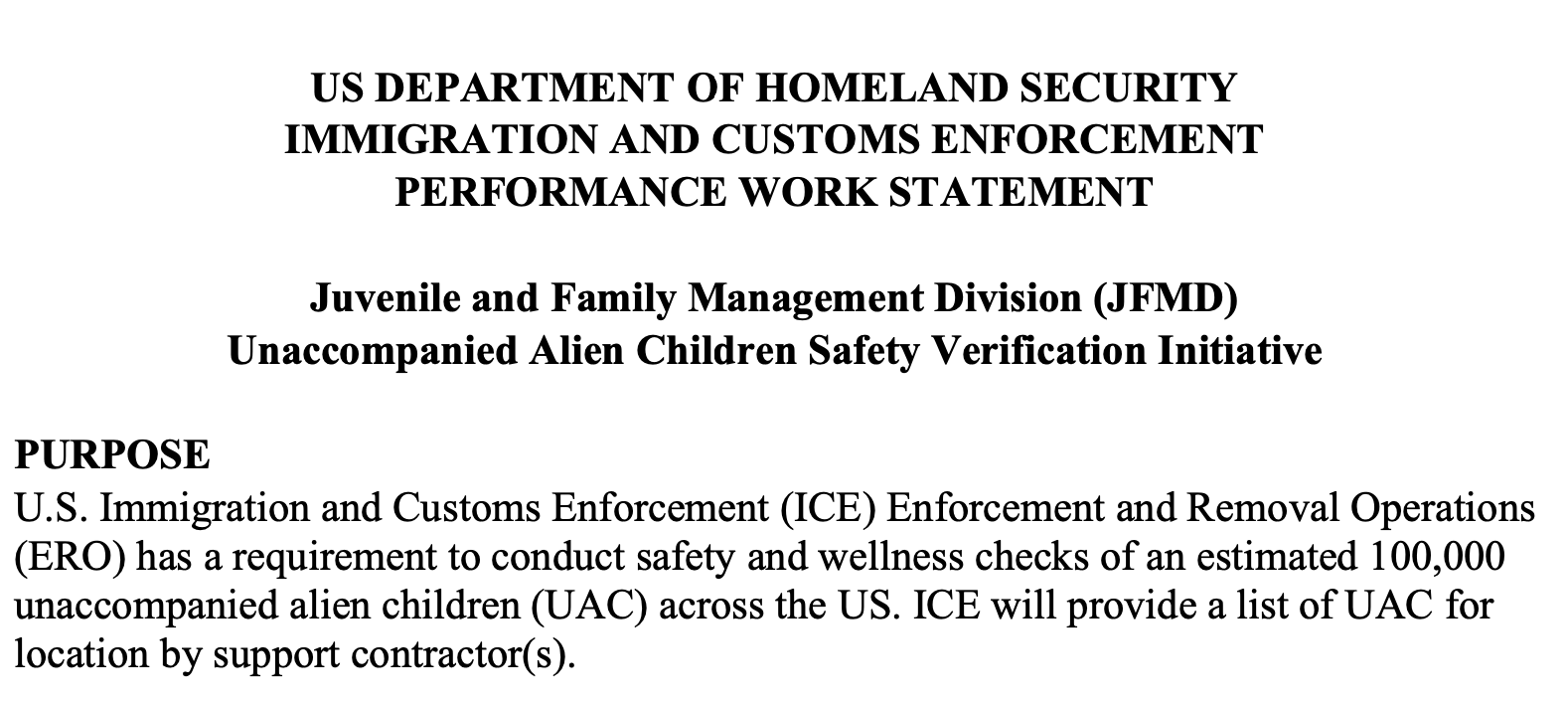
Yesterday afternoon, ICE ERO released a request for proposals (RFP) on SAM.gov requesting contractor support to “conduct safety and wellness checks of an estimated 100,000 unaccompanied alien children (UAC) across the US.” Labeled as the “Safety Verification Initiative,” this RFP is the latest development in a year’s long campaign by ICE to track down UAC who were encountered by DHS and subsequently released from the care and custody of the Department of Health and Human Services, Office of Refugee Resettlement.
While the initiative is framed as a way to ensure the safety and well-being of this subset of children by performing wellness checks, immigrant advocates warn that it functions as yet another loophole to reinstate backdoor family separation. ICE officials have already been carrying out so‑called welfare checks nationwide with the stated goal of protecting children, but reporters and advocates have documented that these operations are being used to locate children for deportation and to target their sponsors for immigration enforcement or criminal prosecution. In practice, this means visits that are presented as “safety” checks can end with children removed from their homes and returned to federal custody, or with parents and caregivers arrested while children are left behind.
The Timeline
In January 2025, ICE issued a memo titled, “Unaccompanied Alien Children Joint Initiative Field Implementation.” The stated purpose of the initiative was to establish a working relationship between Homeland Security Investigations (HSI) and Enforcement Removal Operations (ERO) to locate UAC, make sure their immigration obligations are being met, and to ensure children are not subjected to crimes of human trafficking or other exploitation.
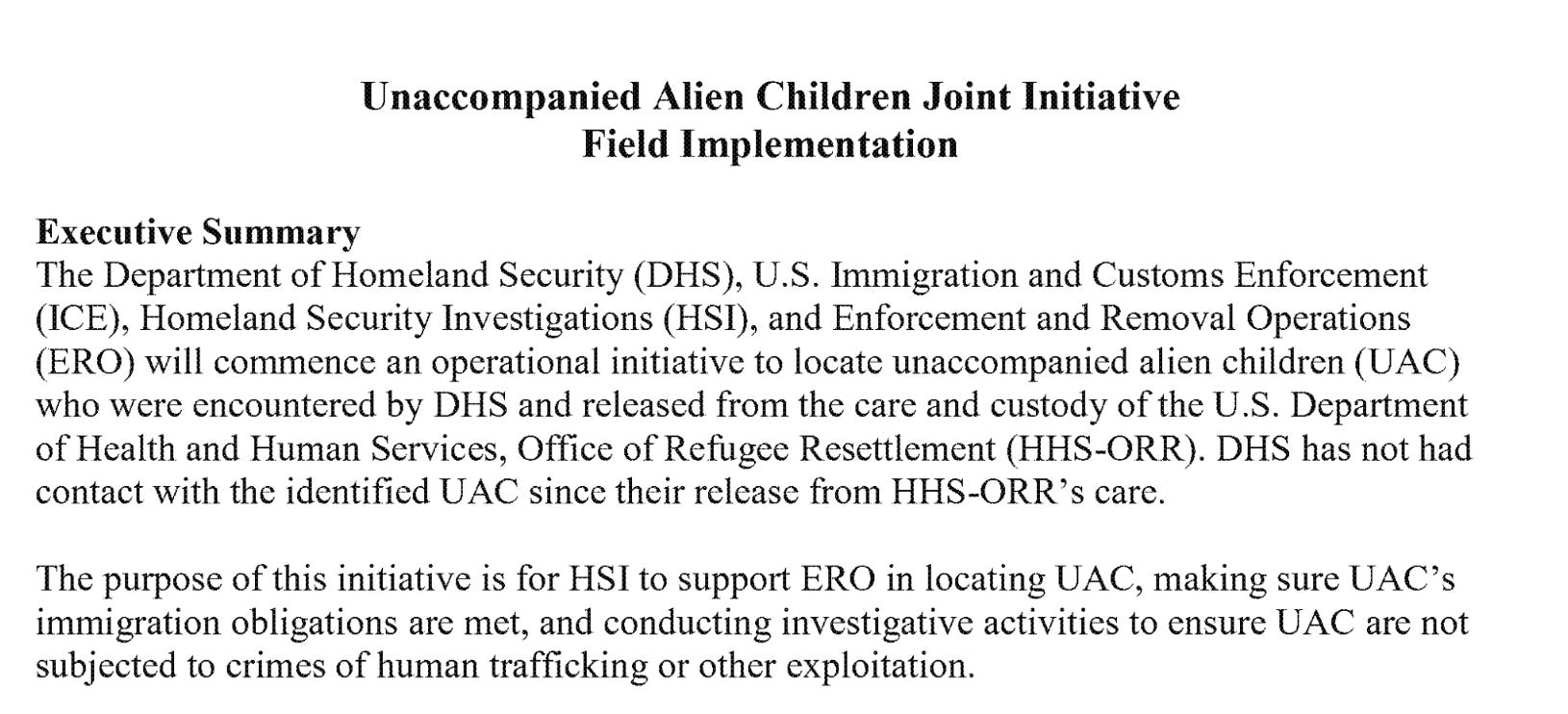
The memo laid out a four-phase implementation plan that started with categorizing over 400,000 children into three groups: flight risk, threat to public safety, and “border security” - UAC with orders of removal. Phases 2 and 3 of the initiative focused on planning activities including providing instructions to field offices and creating targeting packages. It appears that the initiative has now reached Phase 4: Commence Operations and Complete Reporting Requirements.
Following the release of this memo, immigrant communities felt the impacts of ICE’s efforts to track down unaccompanied children. According to the Immigration Policy Tracking Project, The Independent and AP News reported DHS showing up to schools and conducting door to door welfare checks. By June 2025, CNN reported that ICE had taken around 500 children into government custody following "so-called welfare checks . . . either because their situations were deemed unsafe or because of immigration enforcement actions against sponsors."
In late 2025, ICE announced two new initiatives to help locate unaccompanied children: the 287(g) National Call Center and a collaboration with local law enforcement under the 287(g) program dedicated to the UAC Safety Verification Initiative. The agency followed up in December with market research that led to the RFP released yesterday afternoon.
The Work Behind the Initiative
Yesterday’s RFP included a Performance Work Statement detailing the actions contractors must take to locate and verify the safety of unaccompanied children. The work will involve confirming each child’s location through government databases, conducting site visits and wellness checks, verifying school enrollment, and informing children and their sponsors of their legal responsibilities. During site visits, contractors will also be expected to document who resides with the child, their relationship to the minor, and any observable signs of abuse, neglect, or exploitation.
On paper, those tasks resemble traditional child-welfare visits, but there is no clear standard for what counts as an “unsafe environment,” and DHS has repeatedly used vague safety language to justify immigration enforcement. Advocates note that many sponsors are undocumented, lack stable income, or are losing access to work authorization because of higher fees and shorter validity periods, making them easy targets to label “unsafe” based on finances or immigration status rather than a child’s actual well-being.
Another central part of the contract will be data collection. In addition to providing the child’s current mailing address to ERO within 48 hours of receipt, contractors must gather more than ten additional data points, including detailed information about the child’s sponsor or sponsors. Paired with the March 2025 interim rule allowing ORR to share immigration information about sponsors with enforcement agencies, this kind of data collection raises serious concerns that information gathered under the guise of child safety will be used to detain or deport sponsors and to re-detain children.
Scenarios Shed Light on ICE Priorities
One notable aspect of the RFP released yesterday is that it includes four scenarios companies must address in their proposals. This common federal procurement practice helps the government evaluate how each bidder would handle potential future situations and assess their overall capabilities and approach. The four scenarios test a contractor’s ability to handle key operational and ethical challenges related to monitoring unaccompanied children: verifying their locations, responding to potential abuse or trafficking, scaling operations quickly while maintaining compliance, and managing staff misconduct to uphold program integrity.
Taken together, these scenarios show ICE is trying to build a fast-scaling monitoring apparatus for unaccompanied children while pushing much of the operational and ethical burden onto private contractors. Vendors are expected to rapidly expand into new regions, maintain high-volume case processing, and manage sensitive issues like suspected abuse, trafficking, and staff misconduct largely on their own, so long as they keep feeding data back to the agency.
The Bigger Picture
The UAC Safety Verification Initiative is part of the administration’s broader immigration enforcement push. Although it’s presented as a measure to protect unaccompanied minors, the program also functions as a tool for gathering data on immigrant communities and, in some cases, facilitating detention and deportation efforts.
UPDATE | Mar. 26, 2026
On Monday, ICE updated the SAM.gov record of this market research and included their responses to interested vendors’ questions. This is a typical part of the Federal procurement process, and while it is “business as usual,” it gives us additional insights into the government’s plans for the Safety Verification Initiative and the companies who may end up doing the work.

ICE plans to award contracts to multiple companies, though it does not specify how many. It confirms the program will cover 100,000 cases, with each company receiving an initial award of at least 1,000 cases. After that, additional 1,000‑case batches will go to vendors that have closed out 90% of their current batch.
This approach incentivizes companies to essentially compete for children’s files by closing cases fast. The faster a company closes each batch of cases, the more money they will receive.
Pricing Incentives for Speed
In addition to contractual incentives to close cases quickly, there are also pricing incentives. Contractors must propose incentive rates for cases closed within 7, 14, or 28 days, again implying that the faster a case is closed, the more money ICE will pay. The clock starts the day ICE sends over the first batch of cases and incentives apply across the board, regardless of how complex or risky individual cases are.
Clarification on “locate” and “wellness”
In their responses to questions, ICE clearly defines what “locate” and “wellness” mean in practice. A case only counts as “located” when a contractor has physically confirmed a child’s presence at an address through an in‑person visit and updated ICE systems with complete data. Phone or video contact alone doesn’t qualify.
“Conduct site visit” and “observe overall wellness” are treated as separate tasks, with “wellness” requiring interaction with the child and household to assess school enrollment and any signs of abuse, neglect, abandonment or trafficking. Any negative findings must be reported to ICE, which then decides what enforcement or “protective” actions to take.
These definitions were provided by ICE in response to several questions from interested vendors about what they would be able to bill for. In essence, contractors wanted reassurance from the government that they will still be paid for their time tracking down children, even if they are ultimately unable to locate them.
Companies Denied Access to ORR Systems
The Q&A makes clear that commercial data—not federal child‑welfare systems—will power the search for kids. ICE explicitly denies contractors access to ORR systems or other federal systems of record and says government databases are “not expected to add value”. Instead, vendors are instructed to use “all available databases, including open source and commercially available resources” to locate children and confirm addresses. Those findings will flow through an external portal that ICE already uses with vendors, which can accept both single‑record and batch uploads and is described as laying the groundwork for future expansion to “additional partners and use cases.”
Potential Bidders
The Q&A hints at a bidder pool made up of big, established players rather than small, community‑based groups. ICE is asking for a single prior project that already combines nationwide operations, locating and checking on missing or at‑risk children, and experience with UACs or similar foreign‑national child populations. It explicitly refuses to let companies stitch together multiple smaller contracts to meet that bar. That effectively favors large incumbents that already run UAC shelters, post‑release services, or national child‑welfare–style programs, as well as investigations and data firms that specialize in commercial databases and skip tracing, which the agency explicitly expects contractors to use to find children.
Outside this procurement, ICE has already started awarding work under the Safety Verification Initiative, including a $62 million contract to MVM to stand up operations to begin locating children. MVM’s long history as a major ICE vendor transporting and guarding migrants, fits squarely within the kind of large, well‑capitalized, security‑oriented firms the solicitation privileges, and underscores how this “welfare check” work is being routed through enforcement‑adjacent companies rather than community‑based child‑welfare providers.
ICE continues its sociopathic mission.
When your government is run by sociopaths, this is what you get.
Despicable