


The Department of Homeland Security plans to deploy 1,570 iris scanning devices to Immigration and Customs Enforcement locations across the country within 30 days of finalizing a no-bid contract with the Massachusetts technology company Bi2 Technologies, according to a Statement of Objectives posted to SAM.gov on May 8.

The proposed sole-source contract would give ICE agents the ability to scan a person’s iris using a smartphone and compare the result against a database containing more than five million criminal booking records. According to the procurement document, the system is designed to return matches in real time during field operations.
The May procurement appears to expand an existing ICE-Bi2 capability rather than create it from scratch. Federal spending records show DHS awarded Bi2 a $4.6 million contract in September 2025 for iris biometric recognition technology and access to a biometric information system. That earlier award required Bi2 to provide 200 biometric devices. The new Statement of Objectives calls for 1,570 devices, suggesting ICE is seeking to scale up the system’s physical deployment while maintaining nationwide access to Bi2’s IRIS and MORIS tools.
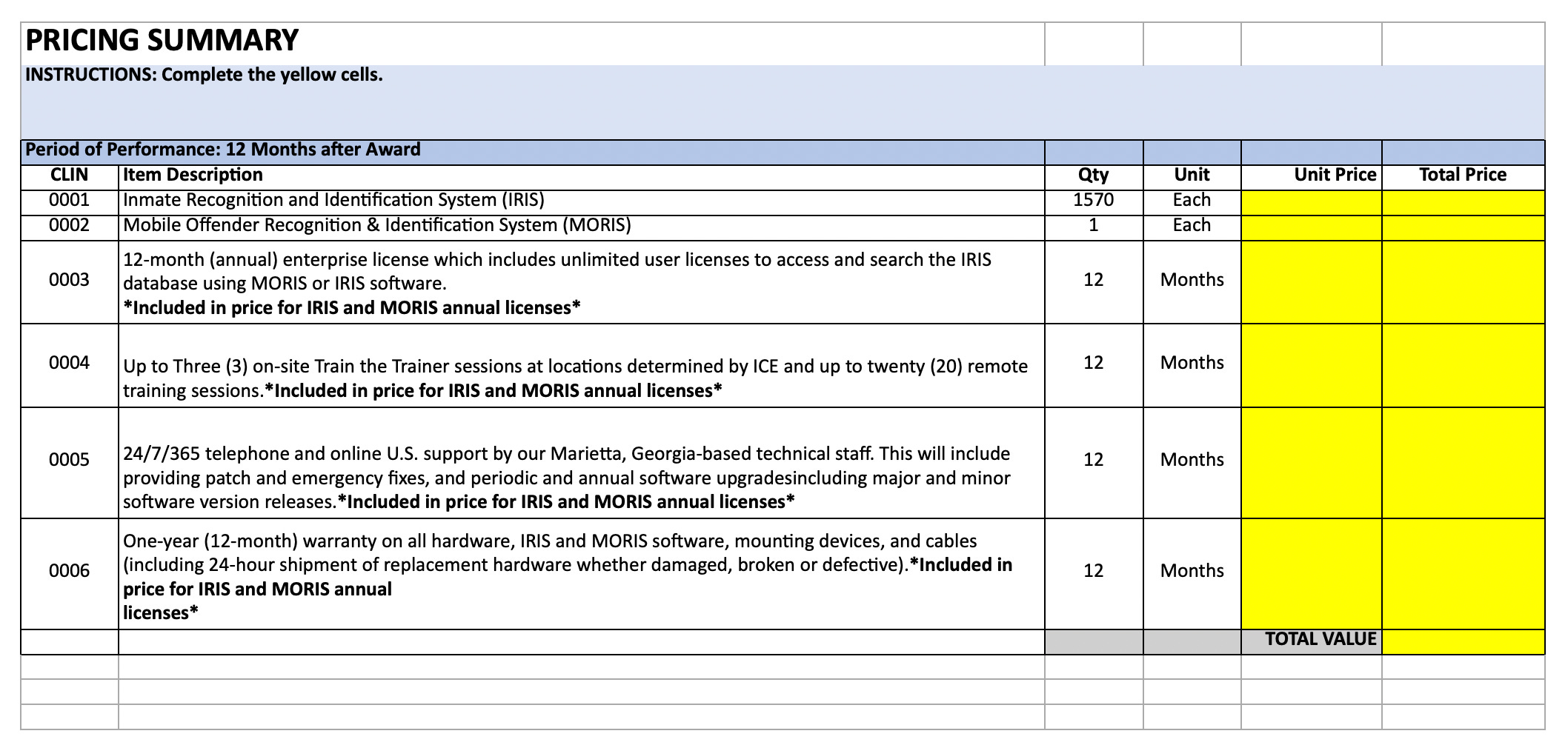
What Iris Scanning Is, and How It Works
Biometric identification uses a physical characteristic of the body to confirm a person’s identity. Fingerprints are the most familiar example. Facial recognition, which compares photographs against databases of known images, has become increasingly common in law enforcement over the past decade. Iris recognition works on the same principle, but analyzes the colored ring surrounding the pupil of the eye.
Bi2 Technologies describes the iris as “the most anatomically unique biometric visible on the human body” and says its IRIS system creates an algorithmic template from more than 265 unique characteristics in a person’s eye. The company says the system can return results in about eight seconds or less and can capture an image while the person is seated or standing 10 to 15 inches from the scanner, even if the person is wearing glasses or contact lenses.
Bi2 says IRIS was developed in 2006 with sheriffs for use in jails and correctional facilities, including intake, booking, release and identity authentication. The company also says the system is “not a surveillance technology” and is used only with an individual’s knowledge.
MORIS, the mobile system ICE is seeking to access, extends that capability outside a fixed booking environment. On its website, Bi2 describes MORIS as a handheld, wireless offender recognition system that allows law enforcement officers to authenticate a person’s identity and immediately retrieve information previously entered into the IRIS national database. The company says MORIS works on iOS, Android and Microsoft platforms and can be used on phones, tablets, laptops and other devices “on the street, in a vehicle or at the office.”
Bi2’s website says MORIS can provide arrest and incarceration history, including mugshots, state and federal identification numbers, offenses, aliases, charges and arrest details. It says the system can authenticate the identity of a person enrolled in IRIS and return arrest and incarceration history in less than a second from “virtually anywhere.”
How the Database Was Built
The IRIS database is not operated by the federal government. Instead, it is maintained by Bi2 Technologies through agreements with local law enforcement agencies that contribute booking records to the network.
According to reporting by Biometric Update, Bi2 offered free access to MORIS in 2023 to sheriffs in 31 counties near the southern border, expanding the company’s biometric repository through local jail booking records.
The procurement document states that the system now contains more than five million booking records associated with roughly 1.5 million unique individuals and data contributed by more than 247 agencies nationwide. ICE is not building an in-house biometric repository. Instead, it is purchasing access to an existing network assembled through local law enforcement agreements.
The procurement document calls for unlimited queries against the database, continuous access for ICE personnel and recurring real-time alerts based on predefined criteria. It also authorizes bulk downloads of records.
Why ICE Did Not Seek Competing Bids
Federal procurement rules generally require agencies to solicit competing bids before awarding contracts. Agencies may bypass that process when they determine that only one vendor can meet operational requirements.
ICE invoked that exception here. The procurement document states that Bi2 “has developed and maintains the only national, web-based iris biometric network and database” and that “no other organization, public or private, has developed or implemented a comparable capability.”
Because the database is proprietary, competing vendors would not have access to the same records even if ICE opened the contract to bids.
The procurement document cites President Trump’s border emergency proclamation and executive orders related to immigration enforcement.
The proposed procurement follows an earlier Bi2 award issued last year. Federal spending records show DHS awarded Bi2 Technologies a $4.6 million contract on Sept. 24, 2025, for “iris biometric recognition technology” and access to a biometric information system that would allow ICE agents to quickly authenticate subjects during field operations. The award, which runs through Sept. 23, 2026, appears to be the predecessor to the new Statement of Objectives, which expands the same IRIS and MORIS capability into a nationwide deployment of devices, licenses and database access.
What the Contract Requires, and What It Does Not
The Statement of Objectives includes several data protection requirements. Bi2 would be prohibited from using ICE query data for commercial purposes or sharing it with other clients. Images submitted for matching would be required to be deleted immediately after processing. The contractor would also be required to maintain audit logs and preserve monitoring data for at least 180 days.
The procurement document does not require the system to receive FedRAMP — short for the Federal Risk and Authorization Management Program — authorization before deployment. Instead, Bi2 is required only to submit a draft plan describing how it intends to pursue eventual certification under the federal cloud-security framework.
FedRAMP is the government’s standard process for evaluating the security of cloud-based systems used by federal agencies. The certification process is designed to test whether systems handling sensitive government information meet baseline requirements for encryption, access controls, logging, vulnerability management and continuous monitoring. Under the proposed contract, ICE would gain immediate nationwide access to a biometric system handling criminal booking records and personally identifiable information before that review process is complete.
The procurement document also does not describe any independent auditing requirement, congressional notification provision or external review mechanism governing use of the system.
Scale and Speed of Deployment
Under the terms of the proposed contract, Bi2 would be required to deliver 1,570 iris scanning devices to ICE locations nationwide within 30 days of the award, along with unlimited enterprise software licenses for a 12-month period.
Major federal technology deployments involving sensitive personal data often take months or years to move from award to operational use. The proposed rollout would place nationwide deployment on a significantly compressed timeline.
ICE’s Enforcement and Removal Operations division, which oversees arrests, detention and deportation operations nationwide, is identified in the procurement document as a primary operational user of the system.
ICE’s Expansion of Biometric Systems
The Bi2 contract is part of a sweeping expansion of biometric and data-analysis tools across federal law enforcement. Project Salt Box previously reported that DHS and the FBI have pursued or deployed systems involving mobile biometric collection, facial recognition, license plate tracking, social media analysis and large-scale case-management platforms. In that context, the Bi2 procurement would add mobile iris recognition to an enforcement infrastructure increasingly built around rapid identification, database matching and field-level data collection.
The proposed contract would last 12 months and provide ICE with nationwide access to the IRIS and MORIS systems.
Damn that George Orwell was way to accurate in his dystopian novel of “1984” when it was published in 1949 that depicts a totalitarian society under the constant surveillance of "Big Brother" and the Party, exploring themes of mass surveillance, censorship, and the manipulation of truth…
Several sheriff’s across Oklahoma are in commercials for Charles McCall-a super Trump sycophant with comm. running wild on every local channel. All sheriffs vowing to work with ICE including in my county. 11 trumpers are running wild out here & have spent millions. IMO-let them blow their wad…we’ll see if any Oklahomans are STILL ok with a fascist pedophile regime!