

The New Machinery of Political Surveillance
A leaked DOJ memo directs the FBI to investigate political beliefs. Public contracts show the surveillance tools are already deployed.

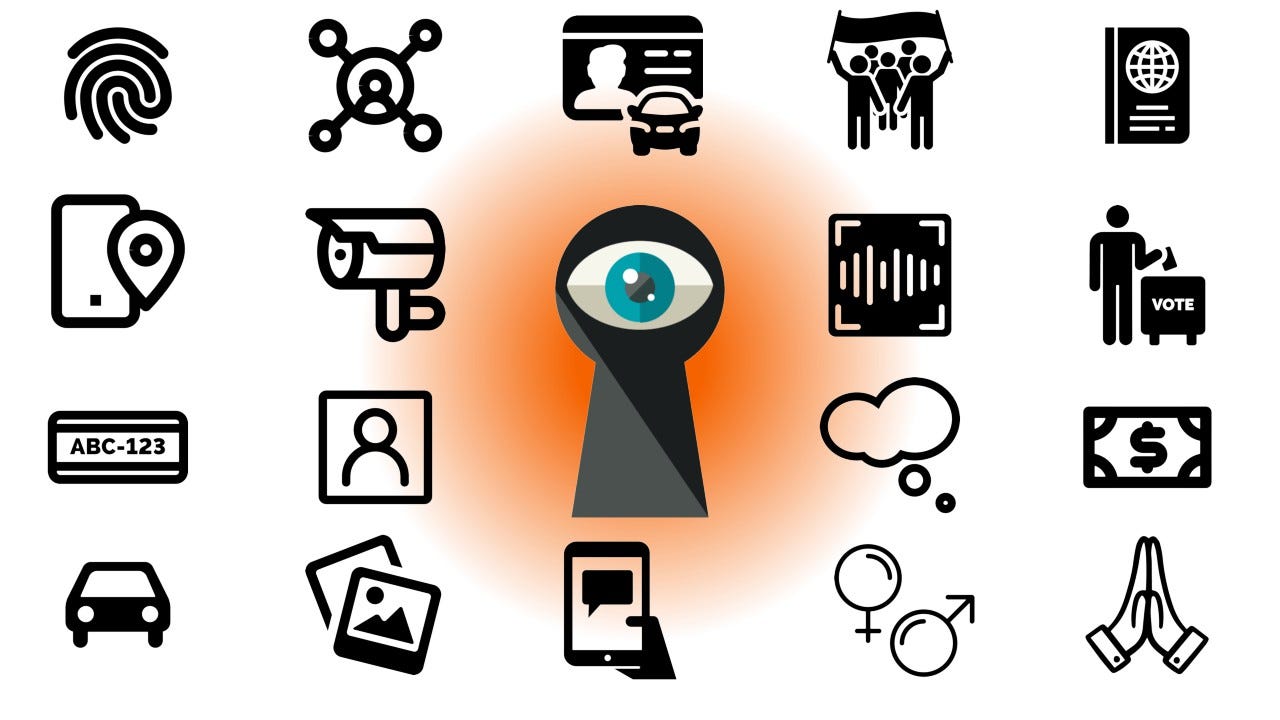
Yesterday, journalist Ken Klippenstein published a Department of Justice memo that lays out a sweeping plan to treat a wide range of political beliefs as potential domestic terrorism. The memo, signed by Attorney General Pam Bondi, directs the FBI to assemble lists of groups and individuals expressing “radical gender ideology,” “extreme views in favor of mass migration,” “anti-capitalism,” and other political or ideological positions. It instructs FBI Joint Terrorism Task Forces to “use all available investigative tools” and to map “the full network of culpable actors,” including retroactive investigations covering the last five years.
Ken’s scoop underscores exactly what the administration intends to do.
Public contracting documents, procurement filings, and system solicitations released across DOJ, DHS, ICE, and the FBI now help answer another: how they intend to do it.
Over the past year—and with accelerated pace since NSPM-7—federal law enforcement agencies have built or expanded a suite of tools capable of mass data ingestion, biometric capture, real-time surveillance, identity resolution, and automated case generation. Viewed together, these systems form the technical foundation that would allow DOJ to execute the mission described in the Bondi memo at significant scale.
This infrastructure spans far beyond these four federal agencies. Joint Terrorism Task Forces—partnerships that bring together FBI agents with officers from state police, county sheriffs, and city police departments—operate in every major metropolitan area. When DOJ procures surveillance technology or DHS deploys an investigative platform, those tools become accessible to this broader network of law enforcement. The contracts examined here represent a sample of the procurement activity across federal agencies, not an exhaustive catalog—they illustrate the types of capabilities being deployed, but the full technical arsenal available to JTTFs is significantly larger.
The Field Agent’s Toolkit
In February, the FBI posted a request for information for mobile biometric software designed to let agents collect fingerprints, iris scans, facial photos, and palmprints using Android phones or Windows laptops. This represents a fundamental shift in investigative capability—giving field agents what amounts to a full police booking kit on a smartphone, capable of capturing nearly every physical identifier that law enforcement uses to confirm identity.
The software does more than simply photograph suspects. It automatically validates that fingerprints are correctly aligned, that photos meet quality standards, and even documents partially missing fingers or eyes. Each capture can be geotagged to record where the data was collected and linked to driver’s licenses, passports, or DNA swabs. Perhaps most significantly, the application can store preloaded “watch lists,” allowing agents to identify individuals immediately, even without cell service. Every submission is standardized to flow seamlessly into national FBI databases.
These capabilities align directly with the Bondi memo’s call for identifying and tracking individuals associated with ideologically defined groups. What once required bringing someone to a police station can now happen at a protest, a traffic stop, or any field encounter.
The New Intelligence Engine
Earlier this year, DOJ released a Big Data Extraction request for information that sought software able to aggregate massive amounts of data from criminal databases, public records, and social media platforms, then make it all searchable within a unified system. The requested platform would deploy artificial intelligence to automatically highlight connections between individuals, flag potential risks, and generate concise reports for investigators.

To understand the scale: this tool could search hundreds of thousands of news articles, police reports, and social media posts in minutes rather than weeks, finding every reference to a person or group and mapping their associations. This becomes the backbone of a system capable of taking incoming tips, past investigations, and public data, then turning them into actionable intelligence for field agents.
The various data streams need coordination, and on September 30, DOJ awarded Palantir a $13.5 million contract for Case360 to serve exactly that function. The contract runs through January 2026 with a potential extension through September 2026. According to the contract justification, a three-month pilot demonstrated that Palantir’s platform “met and exceeded” the Office of the Attorney General’s ability to leverage departmental data for decision-making. The system enhances visibility into prosecutions, civil matters, and criminal cases while boosting workforce productivity through commercial data integration and artificial intelligence software.
The full deployment integrates two key business applications across all 94 federal district offices nationwide. Case360 operates as a central operations dashboard, linking incoming tips, biometric records, surveillance data, and social media analysis into a single investigative workflow. Agents can map networks of individuals, assign cases to field offices, and track follow-ups across jurisdictions. In effect, it’s the operating system that coordinates the multiple tools DOJ, DHS, and hundreds of federal, state, and local law enforcement agencies deploy through Joint Terrorism Task Forces, turning raw data into enforcement actions.
The Surveillance Layer
While the DOJ memo sets the overarching policy, Department of Homeland Security contracts reveal the breadth of technical reach feeding into this infrastructure. DHS maintains ElasticSearch subscriptions for Homeland Security Investigations that allow analysts to search, sort, and visualize huge volumes of investigative data rapidly. The agency has licensed PenLink’s Cobweb and Tangles products—tools designed to monitor public posts, extract information, and map social networks from open-source platforms. Meanwhile, a $364,000 Clearview AI contract procures facial recognition software for HSI, officially described as supporting investigations of child sexual exploitation and assaults against law enforcement officers, though the technology can identify individuals from images or video captured anywhere.
The US Secret Service operates cell tracking services that support location tracking for phones, feeding movement histories into case files. ICE maintains its own parallel infrastructure: a $72.9 million Palantir contract for its bespoke Investigative Case Management system, which will likely operate similarly to Case360 by pulling multi-source information to identify and track persons of interest. Together, these systems will generate a continuous stream of intelligence that flows into Case360 or similar dashboards, creating what amounts to a real-time investigation factory.
Vehicle surveillance extends the net further. In October, the FBI issued a solicitation for license plate readers to track vehicles across multiple locations. These systems pair cameras with software that automatically reads and logs license plates, creating detailed records of vehicle movement. In the context of the Bondi memo’s ideological targeting criteria, such data could trace the movements and associations of identified individuals across cities and states.
A Self-Replenishing System
The Bondi memo explicitly emphasizes tips from the public as a source for investigations. DHS has posted a forecast for expanded ICE HSI Tip Line staffing, calling for round-the-clock contractors to review tips submitted online or by phone. These tips feed directly into Case360, where they are triaged, analyzed using the tools described above, and assigned to field offices. Over time, this creates a self-replenishing intelligence stream, with each investigation potentially generating new leads and targets, ensuring the system continuously generates work for field enforcement.
What This Means
The Bondi memo directs the FBI to investigate Americans based on their political beliefs. These procurement documents show that federal agencies have already built the technological infrastructure that could enable them to do exactly that—and to do it at a scale previously impossible.
Here’s what makes this different from traditional law enforcement: the system appears designed not to investigate specific crimes, but to identify people based on what they believe, then map everyone they’re connected to. An agent can collect your biometric data in the field with a smartphone, feed it into a system that cross-references your social media posts, tracks your car’s movements, identifies you in photos using facial recognition, monitors your phone’s location, and maps your entire social network—all potentially coordinated through a single dashboard that’s now deployed across the country.
The scale matters because these tools don’t belong to a single agency pursuing a specific mandate. The FBI, DHS, ICE, and the Secret Service have built interlocking systems that share data through Joint Terrorism Task Forces. What begins as an ICE investigation using Palantir’s $72.9 million Investigative Case Management system could flow into the FBI’s Case360 platform. An anonymous tip called into the DHS or DOJ hotlines could trigger biometric collection in the field, facial recognition searches through Clearview AI, and license plate tracking—all before any actual “crime” has been committed. The agencies appear to be operating as a unified intelligence and enforcement apparatus.
This matters for anyone who has attended a protest, posted political opinions online, or associates with activist organizations. Bondi’s memo explicitly targets “radical gender ideology,” “extreme views in favor of mass migration,” and “anti-capitalism” as investigative priorities. The infrastructure to surveil, identify, and track people holding these views—and everyone in their networks—is operational right now. The system appears designed to be self-sustaining: tips generate investigations, investigations generate more tips, and the cycle continues.
The question isn’t whether the government could build a system to monitor Americans based on ideology. The procurement documents show they clearly already have. But the dizzying scale represents something new: previous surveillance required individualized suspicion of criminal activity.
This modern infrastructure enables mass categorization by belief, automated network mapping, and real-time tracking—all coordinated across agencies that historically operated in silos, and automated by proprietary AI systems that make consequential decisions at machine speed with no public accountability. When these platforms flag someone for ‘radical gender ideology’ or map their social network, there’s no algorithm to audit, no clear legal standard to challenge, and no framework for understanding how ideological categorization becomes grounds for surveillance. By the time the Bondi memo made the intent explicit, the capability had already been built.