

White House “Border Czar” Tom Homan was speaking Tuesday to a room of Homeland Security officials and immigration enforcement contractors in Phoenix when he offered a blunt assessment of the administration’s plans.
“You ain’t seen shit yet,” Mr. Homan said at the Border Security Expo. “This year will be a good year. Mass deportations are coming.”
The remarks, delivered at an industry conference rather than a press event and reported by CNN, underscored the administration’s intention to sharply escalate immigration enforcement in the months ahead. They also raised a practical question officials have not publicly answered: Where does the administration plan to hold the people it arrests?
The immigration detention system currently holds roughly 60,000 people against an estimated capacity of just over 70,000. The administration has pledged to expand that capacity to more than 100,000 beds using $38.3 billion appropriated through the One Big Beautiful Budget Act.
A review of federal budget records, law enforcement partnership data and corporate disclosures indicates that officials are pursuing at least three separate strategies to reach that target — including one effort whose status was brought into clearer focus on Tuesday during an investor call by a major private prison operator.
A Lower Public Profile
When Markwayne Mullin replaced Kristi Noem as secretary of homeland security earlier this year, the administration’s immigration operations became less publicly visible.
Ms. Noem’s tenure had been marked by large-scale enforcement actions in Chicago, Minneapolis and Los Angeles that drew protests and, in at least two cases, resulted in the deaths of American citizens during encounters with immigration officers. Under Mr. Mullin, such operations have largely receded from public view, or have at least evaded mainstream media attention.
Mr. Mullin said Tuesday that the change was intentional.
“We’re purposely trying to be a little more quiet,” he said on Newsmax.
Asked whether the administration remained committed to deporting all undocumented immigrants or had narrowed its focus to those with criminal records, Mr. Mullin said it had not changed course.
“No,” he said. “We’re staying focused on all illegals, without question.”
That message differs from guidance the administration has provided some political allies. CNN has reported that James Blair, the White House deputy chief of staff, urged Republican lawmakers to emphasize the removal of criminals rather than mass deportations in public messaging.
Mr. Homan struck a similar note in Phoenix, saying criminal and public safety threats “have to be the priority” before adding that everyone else remained “on the table.” He said that 35 to 40 percent of those arrested by Immigration and Customs Enforcement during President Trump’s second term have had no criminal record.
But ICE’s own detention population does not fully match that public-safety framing. According to TRAC, 42,722 of the 60,311 people held in ICE detention as of April 4 — about 71 percent — had no criminal conviction. Many of those with convictions had committed minor offenses, including traffic violations.
The data points to a capacity problem that already extends beyond people convicted of crimes. As the administration promises a broader enforcement surge, it is preparing to hold a detention population that is already largely made up of civil immigration detainees with no criminal convictions.
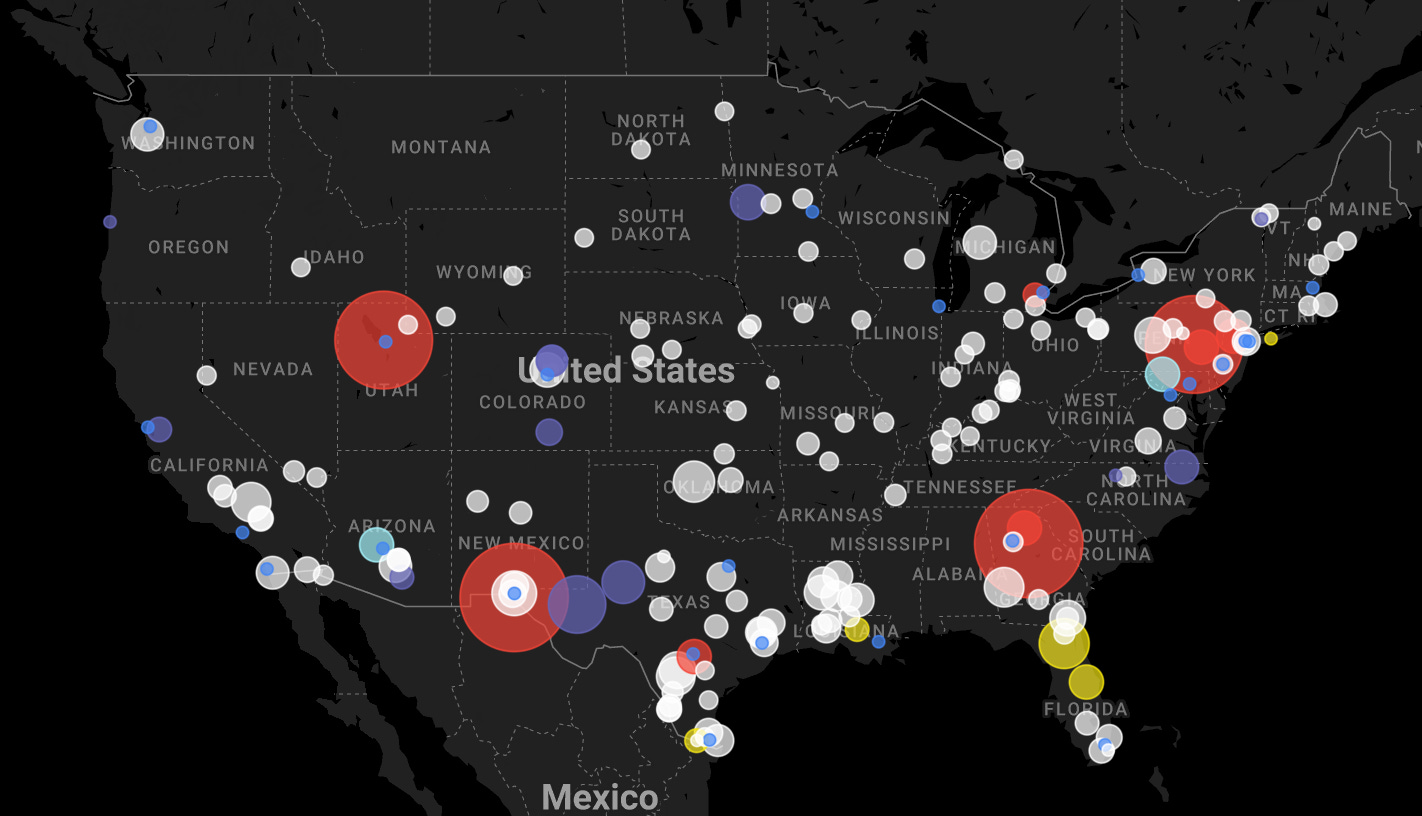
Federal records, corporate disclosures and law enforcement partnership data indicate that the administration is pursuing at least three parallel efforts to expand detention capacity: converting industrial warehouses into detention centers, purchasing existing private detention facilities from prison contractors, and rapidly expanding agreements that allow local jails to house immigration detainees.
The Warehouses
The administration’s most visible effort is the Detention Reengineering Initiative, under which ICE has purchased industrial warehouses for conversion into detention centers.
ICE has acquired 11 such properties in the first quarter of this year. But the initiative has run into legal resistance. A planned facility in Maryland has been halted by federal court order. A second, in Arizona, was voluntarily paused before the state’s attorney general filed suit. Two others face active litigation, with no retrofit contracts yet awarded. The remaining seven have neither pending lawsuits nor awarded construction contracts. If all 11 progress to completion, they will add 38,000 beds to ICE’s total detention capacity — and pushing it over its 100,000-bed goal.
A person familiar with the matter, speaking on condition of anonymity because they were not authorized to discuss internal deliberations, said the initiative had not been abandoned. Rather, officials are reassessing how to proceed while purchases and retrofit contracts remain on hold.
Buying Turnkey Prison Facilities
A second effort has not received as much fanfare or attention as the warehouse plan.
ICE has been in discussions with GEO Group, one of the nation’s largest private prison operators, about purchasing approximately 10 of the company’s detention facilities outright, according to remarks made Wednesday by the company’s chief executive, George Zoley, during GEO’s quarterly earnings call.
ICE had previously alluded to buying turnkey detention sites in Detention Reengineering Initiative materials provided earlier this year to Gov. Kelly Ayotte of New Hampshire.
“I can respectfully acknowledge that we have been in discussions with ICE regarding the potential sale of multiple facilities,” Mr. Zoley said.
A second individual, speaking to Project Salt Box on condition of anonymity for fear of reprisal, identified eight privately-operated detention facilities that federal officials have examined as potential acquisition targets. These include:
Northwest ICE Processing Center in Tacoma, Wash.
California City Detention Center in California City, Calif.
Otay Mesa Detention Center in San Diego
Mesa Verde ICE Processing Center in Bakersfield, Calif.
Montgomery Processing Center in Conroe, Texas
Central Louisiana Processing Center in Jena, La.
the Aurora ICE Processing Center in Aurora, Colo.
the Winn Processing Center in Winnfield, La.
The potential GEO purchases also differ from the warehouse conversions in a crucial way: the facilities are already detention centers. Local opposition to the warehouse sites has focused heavily on environmental review, land-use changes, infrastructure limits and whether ICE can convert ordinary industrial buildings into detention facilities. Buying existing detention centers would avoid many of those concerns, and make them substantially harder to fight.
Mr. Zoley told investors that federal ownership could also provide legal advantages over privately operated detention sites, arguing that the federal government would have broader constitutional protections against state oversight efforts.
Several of the facilities identified as potential acquisition targets are in states — including California, Washington and Colorado — where officials have sought to impose stricter oversight on immigration detention operations.
California, Washington, Colorado, Illinois, Maryland, New Jersey and New Mexico have passed or considered measures aimed at limiting immigration detention contracts, private detention facilities or warehouse-style detention conversions. In Illinois, the House recently passed a bill that would bar new immigration detention centers from operating within 1,500 feet of homes, schools, parks, day care centers or houses of worship. Maryland lawmakers have advanced bills to regulate private custodial facilities and detention conditions. And in New Jersey, state officials have passed measures restricting local jail contracts with ICE.
Mr. Zoley said federal officials appeared to be weighing the relative cost and complexity of purchasing existing detention facilities against converting warehouses, particularly as the warehouse initiative had become, in his words, “politically problematic.”
GEO Group houses more than one-third of all ICE detainees nationwide. The company reported first-quarter revenue of $705.2 million, up 17 percent from a year earlier.
Leaning on Local Jails
The third strategy is less centralized and would not require ICE to build or buy detention facilities — rather, the agency could use its growing network of local police department partnerships.
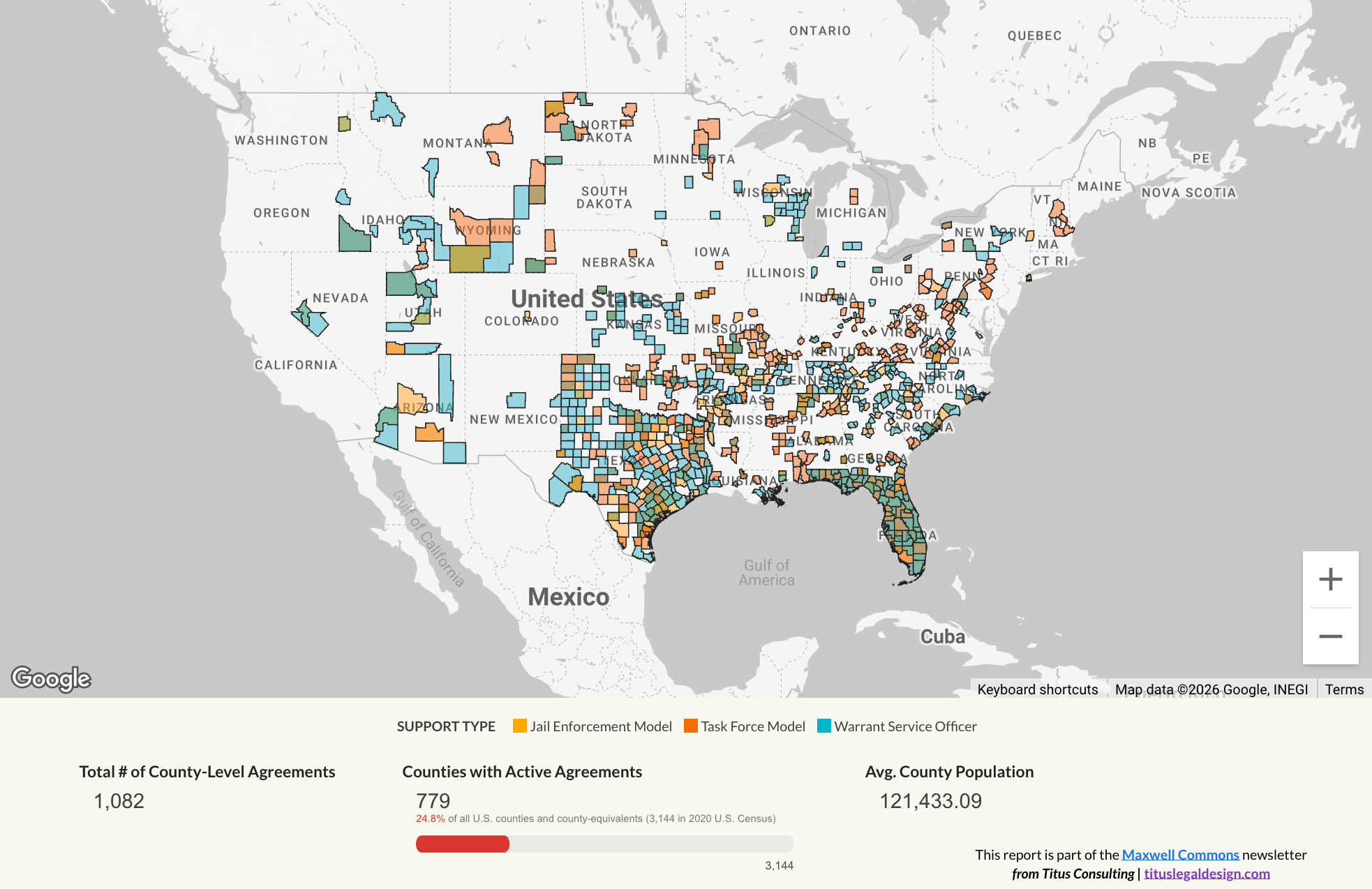
Under the federal 287(g) program, ICE can delegate some immigration enforcement powers to state and local law enforcement agencies. Depending on the model, local officers can question people in jails about immigration status, issue immigration detainers, execute administrative warrants or assist with enforcement outside jail settings. ICE describes the program as a collaboration tool; critics describe it as a way to extend the deportation system through local police and jail networks.
The program matters for detention capacity because it lets ICE use existing local infrastructure. A person arrested by local police can be identified for immigration enforcement while already inside a jail, held on a detainer and transferred into ICE custody without requiring ICE to first send federal officers into the community or open new detention space.
That expansion has accelerated under President Donald Trump’s second term. A dashboard maintained by Andrew Thrasher and sourced from primary ICE data, shows 1,786 active 287(g) agreements with 1,506 agencies across 39 states as of May 5. In the previous 30 days, 160 new agreements were signed, a 19.4 percent increase over the prior period. In the previous 90 days, 429 were added, a 78 percent increase. Texas leads all states with 380 agreements across 309 agencies; Florida has 346 agreements across 282.
The Trump administration has also added a financial incentive. In September, the Department of Homeland Security announced that ICE would reimburse participating agencies for the annual salary and benefits of eligible trained 287(g) officers, including overtime. That gives local agencies a fiscal reason to join the program while giving ICE a broader enforcement network without immediately adding federal detention beds.
This approach does not solve ICE’s long-term capacity problem. But it can expand the pipeline of arrests and transfers while officials weigh slower options, including warehouse conversions and facility purchases.
The detention planning has unfolded alongside a sharp increase in enforcement-related spending.
White House apportionment records reviewed by Project Salt Box show that ICE’s allocation for its 287(g) law enforcement officer pay under the One Big Beautiful Budget Act increased from $185 million in October 2025 to just over $1 billion by mid-April 2026.
The rise suggests that ICE is scaling enforcement capacity at the same time it is searching for places to hold people arrested in that effort.
A Shift Toward Interior Enforcement
ICE’s own detainee records show that the administration’s enforcement posture has shifted toward arrests inside the United States.
In July 2025, 73 percent of people in ICE custody had been arrested by ICE officers in interior enforcement operations, while 27 percent had been transferred from Customs and Border Protection following border encounters. By January 2026, those figures had shifted to 84 percent and 16 percent, respectively.
The detained population peaked at 70,766 in late January, near the system’s estimated capacity, before declining to 60,311 as of April 4. The administration has not publicly explained the decline.
Sanctuary-State Tensions
Mr. Homan reserved some of his sharpest remarks Tuesday for jurisdictions that limit cooperation with federal immigration enforcement.
“We’re going to flood the zone,” he said. “You’re going to see more ICE agents than you ever seen before.”
He added that people encountered during enforcement operations who were not the intended targets — known within ICE as “collaterals” — would increasingly be taken into custody.
“You will see collateral arrests increase in these areas,” he said.
Gov. Kathy Hochul of New York responded by recalling what she said was a commitment made directly to her by Mr. Trump.
“Donald Trump himself said he would not send a surge of ICE agents to the state of New York unless I ask,” she said. “I’m not asking.”
The administration has not publicly detailed the detention-facility acquisition discussions, the pace of 287(g) expansion or the increase in enforcement-related spending. Each has emerged through earnings calls, budget documents, government records or remarks delivered outside the administration’s regular public messaging.
On Tuesday’s earnings call, Mr. Zoley offered a summary of where the planning stood.
“All of the plans, I think, are being reviewed, assessed,” he said. “And I’m sure they’ll come up with some reasonable conclusions.”
Thanks for broadening the focus beyond just the warehouse acquisitions and conversions to include the commercial turn-key concentration camp profiteers, PSB! ✊
Does anyone have information about efforts to persuade the government to speed up legalization efforts instead of deportations?