

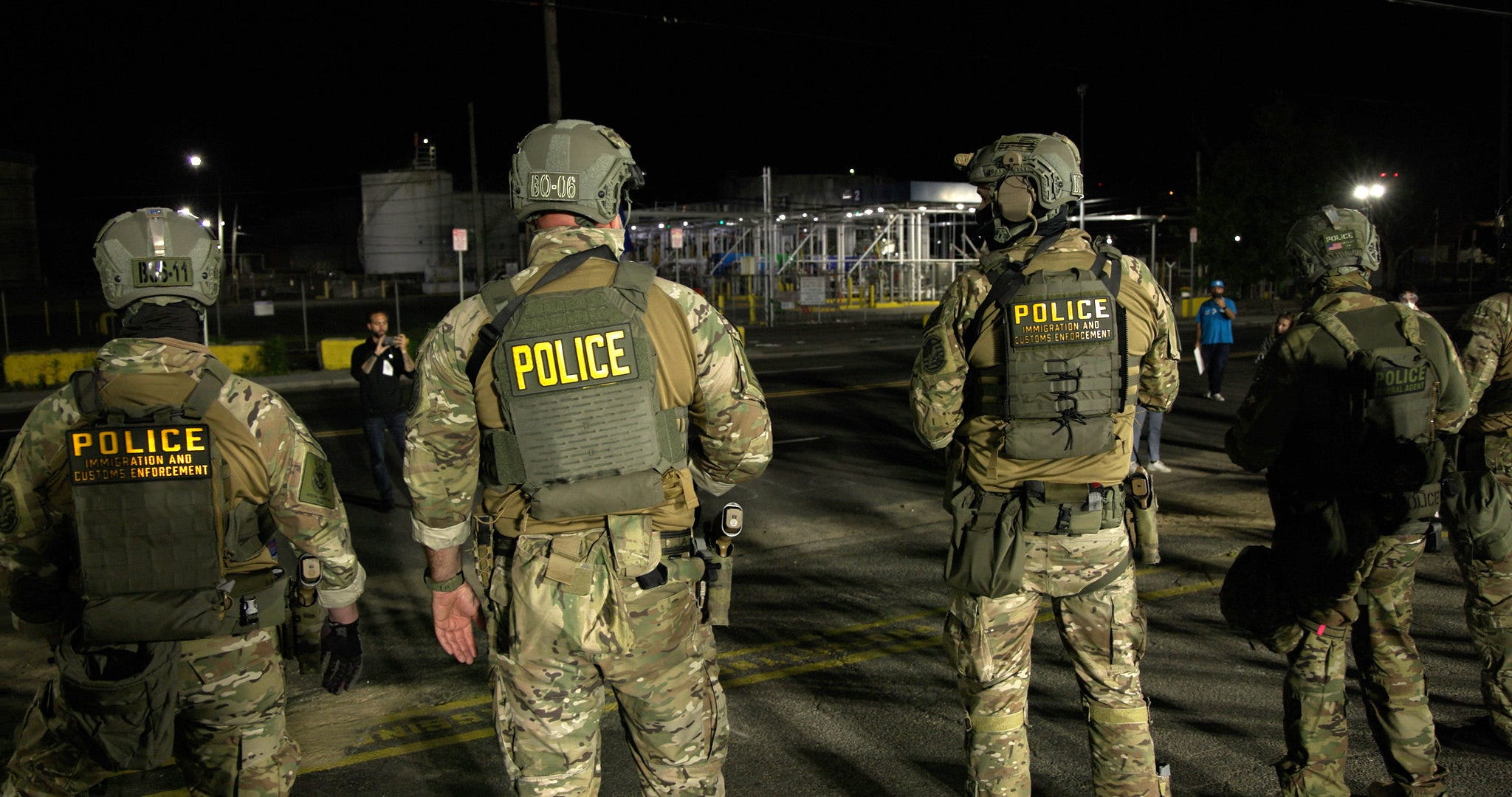
A coalition of New Jersey community groups has asked the state attorney general to bring the federal government back before a judge, claiming immigration agents used a court-restricted Morris County warehouse as a holding and transfer point for people arrested in a raid seven miles away.
The warehouse at 1879 Route 46 in Roxbury, N.J., has been the subject of a federal lawsuit since March, and a court order signed in May limits what the government may do there while an environmental review is pending. The coalition, Project NINJA — short for No ICE North Jersey Alliance — contends that holding people inside the building on Sept. 4 broke that order. Its letter to the attorney general’s office asks the state to seek a contempt finding and to demand the right to inspect the property.
ICE is using the property as “a de facto detention and transfer facility” to support its raids across northern New Jersey, David Broderick, the coalition’s legal adviser, said in a statement accompanying the letter.
The request to New Jersey Attorney General Jennifer Davenport arrives days before a status report deadline in the case. Under a May 19 scheduling order, Justice Department attorneys must file that report on or before Sept. 18.
Project Salt Box reviewed the letter, which the coalition has not released in full. It has published a summary of the letter’s claims alongside a public letter-writing campaign directed at state officials, which had drawn about 2,600 signatures by Monday.
WHAT HAPPENED?
The coalition’s account comes from a Dover councilwoman, who relayed what the daughter of one man apprehended by ICE told her by phone that day, and from a log volunteers kept at a nearby observation point.
Dover is a small city of roughly 18,000 in Morris County, about seven miles east of the warehouse along Route 46. The warehouse sits in the Ledgewood section of Roxbury Township, roughly 35 miles west of New York City.
Agents arrested about seven people in downtown Dover in the early morning of Sept. 4, according to the account the coalition gave the attorney general’s office. One of them called his daughter at 8:52 a.m. He told her he had been driven west from Dover with others picked up that morning, that he thought he might be in Pennsylvania, and that he was being held inside what he described as a jail or prison.
He called again that evening and said he had since been moved to the Elizabeth Detention Center, a privately operated ICE facility about 40 miles east in Union County.
The volunteers, parked at a public lot across Route 46 from the warehouse’s driveway, logged a set of vehicles entering the property between 8:15 and 8:25 a.m., arriving from the direction of Dover, shortly before the detainee's 8:52 a.m. call to his daughter.
The vehicles stayed roughly an hour. A black SUV with tinted windows left the warehouse at 9:23 a.m., they reported. Vehicles they had photographed earlier that morning in Dover left at 9:30 a.m., and a gray sedan with tinted windows left at 9:34 a.m.
The coalition says the two accounts line up and asserts that the man was inside the warehouse when he called his daughter. It asked the attorney general’s office to seek cell site records from his carrier to pinpoint where the call originated and to subpoena footage from an automated license plate reader the group believes is mounted at the property. The coalition said it does not know whether the camera belongs to Rockaway Township police, ICE, or a third party.
A security guard approached the volunteers around 11:32 a.m. and told them to leave, they reported. After they returned to the lot, guards circled the property repeatedly in their vehicles, passing the volunteers each time, they said. At 12:28 p.m., a Dodge Durango with tinted windows pulled into the lot and the driver began filming them, according to the volunteers.
The coalition told Davenport's office that it has photographs and video of the vehicles it describes and offered to turn over the material.
WHAT THE MAY ORDER ALLOWS AT ROXBURY WAREHOUSE
New Jersey and Roxbury Township sued Immigration and Customs Enforcement, the Department of Homeland Security, Secretary Markwayne Mullin and acting ICE director Todd M. Lyons in March, arguing the government bought and began converting the warehouse without the environmental review and intergovernmental consultation federal law requires.
U.S. District Judge Jamel K. Semper signed a joint stipulation on May 12, days before a hearing on the state's request for a preliminary injunction. The order put that request on hold and limited the government to security and maintenance work at the site until it finishes an environmental assessment.
The stipulation allows the government to install temporary fencing that does not disturb the ground, perimeter cameras, shielded lighting, security signage and an alarm system with closed-circuit cameras mounted on trailers. It also permits lock changes, heating and electrical work, plumbing and backflow testing, fire alarm inspections, cleaning and trash removal, lawn care outside the conservation easement, and repairs to keep out leaks and pests.
That list does not mention detainees. Bringing arrested people onto the property and holding them there amounts to operating it as a detention facility whether or not construction has begun, the coalition told the attorney general's office.
ICE’S HISTORY OF USING “HOLD SITES”
The coalition also argued that federal detention standards classify what it says happened at the warehouse as detention.
ICE lists processing facilities among the detention facilities it operates. The agency’s 2026 National Detention Standards define a hold room as a secured area used for temporary confinement before in-processing, transfer or removal, and require such rooms to be well-ventilated and well-lit, furnished with seating for a posted capacity, stocked with soap and potable water, and compliant with federal accessibility standards. A detainee may not be held in one for more than 12 hours except in exigent circumstances.
A vacant warehouse meets none of those requirements, the coalition said. The state’s complaint describes the building as having four toilets. No state or township official has inspected it since the stipulation was entered, according to the letter.
ICE has defended similar temporary holding at other sites. The Colorado Times Recorder reported in March that detainees were being kept in nine unmarked ICE suboffices around that state. The agency said the locations were not secret, describing them in a statement to CBS News as offices where personnel “process arrests and may temporarily hold detainees before transferring them to a detention center.” The holding cells meet national detention standards and are inspected regularly, ICE said, comparing them to a sheriff’s office or police substation.
Colorado’s Democratic congressional delegation challenged that account in a letter to Todd M. Lyons, the acting ICE director who is also a defendant in the Roxbury case. Internal agency policy had capped stays in hold rooms at 12 hours until a June 2025 memo raised the limit to 72 hours. Citing records obtained under the Freedom of Information Act by the Deportation Data Project, the lawmakers said more than 3,000 people were held in such rooms between January and October 2025, including one man held for 39 days.
The delegation posed six questions to Lyons and gave a March 27 deadline. It asked how many people had been held longer than 12 hours and where, what records ICE keeps of food, water and medical care provided in those rooms, how the agency tracks a detainee’s location, and how lawyers reach clients held there.
The fifth question resembles the allegations in Roxbury most closely. It asked whether anyone in ICE custody in Colorado had been held anywhere other than the Aurora detention facility or a Colorado field office, and, if so, demanded the number of people held, copies of the relevant contracts, and “the locations of the warehouses where individuals were held.”
Project Salt Box asked the Department of Homeland Security whether ICE had brought anyone to 1879 Route 46 on Sept. 4, whether the property had been used for staging or temporary custody at any point since May, whether the security cameras the stipulation permits are operating, and who holds the guard contract at the site. The department responded by asking for the names and dates of birth or alien registration numbers of the people described in this account.
Told that the reporter did not have them, and asked again about the property, the department declined to comment, citing ongoing litigation.
A spokesperson for the attorney general's office said the office is reviewing the allegations. “If ICE tries to convert the Roxbury warehouse site into a detention facility, it would violate a court order," the spokesperson said in a statement. "We are carefully reviewing reports of ICE activity at the warehouse and will take all necessary steps to address any non-compliance with a court order.”
SEVEN MONTHS OF REVERSALS
The warehouse has been contested since Christmas Eve, when The Washington Post reported that the Trump administration had put Roxbury on a list of industrial buildings it planned to convert into detention space. Homeland Security bought the 470,000-square-foot building in February for $129.3 million, roughly twice its assessed value according to research conducted by Project Salt Box, from an entity tied to Dalfen Industrial and a Goldman Sachs fund. It was one of 11 warehouses the department acquired nationwide for about $1 billion.
Roxbury’s mayor and council, all Republicans, opposed the plan, and the township joined the state’s lawsuit in March. The May stipulation paused construction. The government’s position then shifted twice.
The first shift followed a June 18 report from The New York Times that ICE documents showed the agency intended to sell or transfer seven of the 11 warehouses it had bought nationwide, including Roxbury. Eleven days later, on June 29, the parties told the court that Homeland Security no longer intended to convert the building and planned to sell it instead. Semper entered that representation as an order the next day, making it part of the court record rather than just a statement in a filing.
That decision did not survive the day. New Jersey Gov. Mikie Sherrill posted on X that evening that DHS had “confirmed” it was backing down and called it a victory for the state and for Roxbury.
Homeland Security Secretary Markwayne Mullin replied minutes later on the same platform. “DHS will NEVER back down. We will be keeping this site for a detention center,” he wrote, adding that people without legal status should leave or be found, arrested and deported.


The formal reversal followed on July 10, when Justice Department attorneys filed a notice saying the agency would proceed with plans to consider retrofitting the warehouse after all, citing decisions by unnamed officials. The notice states that the June 29 representation had itself been authorized by DHS officials before it reached the court. Neither the notice nor Mullin's post addressed the representation entered as an order 11 days prior.
Project Salt Box asked the department what prompted the reversal and received no response. This organization filed a Freedom of Information Act request in July seeking records that would explain it.
In a joint status report filed July 17, both sides told the court the government was still weighing whether to proceed and that no timeline existed for a decision. The government’s most recent report, filed July 20, says only that the assessment continues.
A neighboring property owner has since moved to join the case. Netcong Heights LLC, which owns a nearby residential complex, filed a motion to intervene on Aug. 13, arguing that converting the warehouse into a 1,500-bed detention facility would push wastewater flow through its sewer easement to about 187,500 gallons a day, more than 15 times the 11,700-gallon limit set in the agreement governing that line. The company said it is not taking a position on the detention plan itself, only seeking to protect its property and roughly 700 residents from the risk of sewage backup.
Broderick said the coalition’s volunteers have made observations over the past several months that point to a pattern, and that Sept. 4 was not an isolated occasion. The letter asks the state to inspect the property to determine whether other violations have occurred.
This is a developing story and will be updated.
This story was updated at 1:27 pm E.T. on Sept. 15 to include a statement from the New Jersey attorney general's office.
This story was updated at 1:42 pm E.T. on Sept. 16 to include a statement from the Department of Homeland Security.
Thank you for the in-depth reporting on this warehouse detention facility. Kudos to the community involvement and the response from the NJ Governor. As Americans, we must continue to hold ICE accountable for their continued reckless disregard for the law.
Thank you so much for shining a light on this.