

In the months before the federal government purchased a large warehouse outside Hagerstown, Md., for more than $100 million, the property was still being marketed to private tenants — including a “household name” Fortune 500 company considering a move from Pennsylvania.
Emails released this week through a Maryland Public Information Act request show the site at 16220 Wright Road remained in active commercial use planning shortly before its transition into a project now tied to federal immigration enforcement.

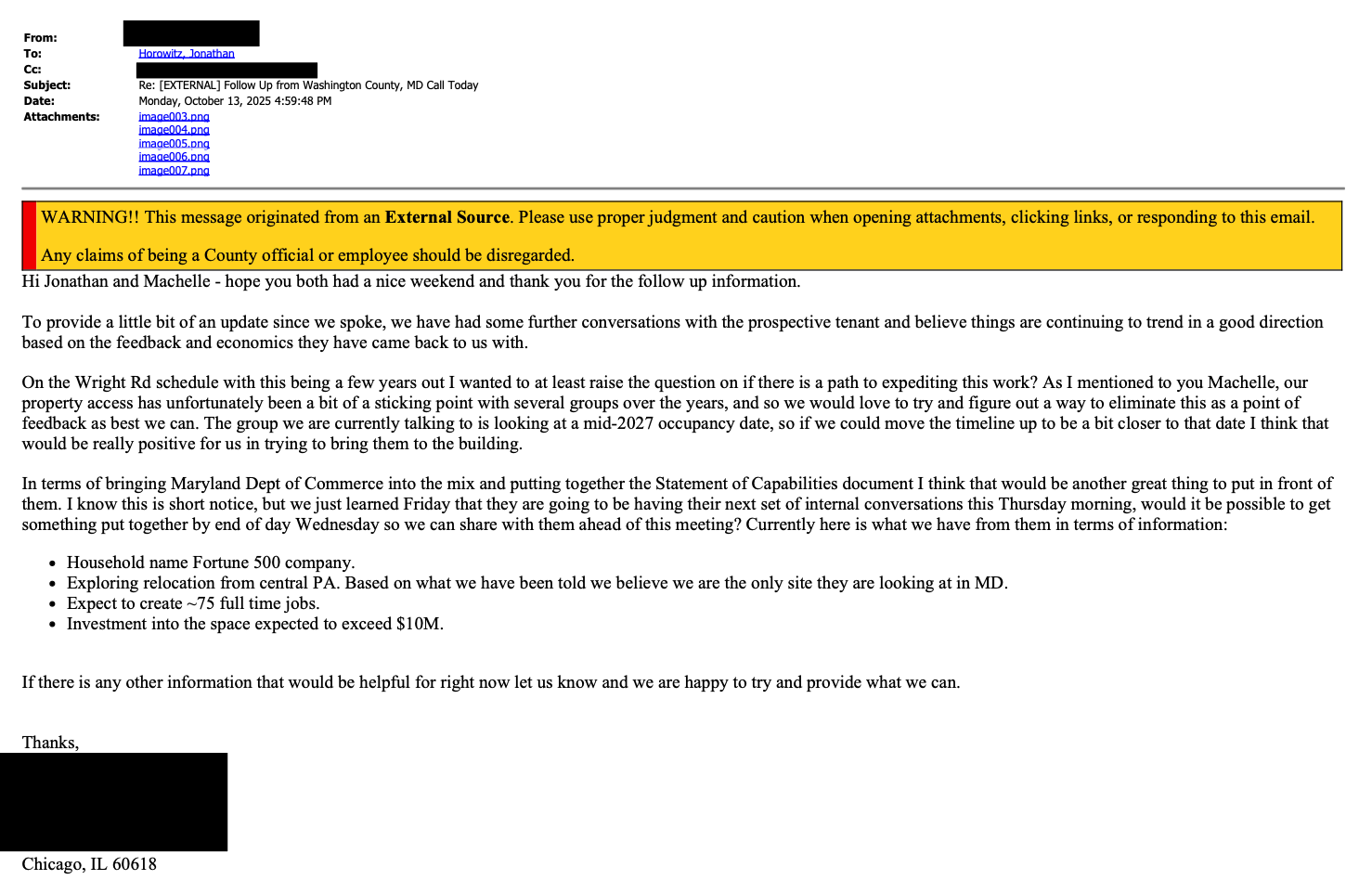
The records do not identify the prospective tenant. But according to emails, the company was exploring a relocation from central Pennsylvania that could have brought about 75 jobs and more than $10 million in investment.
For several years, emails show, officials in Washington County’s business and economic development office worked with the building’s owner — a real estate arm of the investment platform Fundrise — to attract tenants.
In June 2022, shortly after the purchase, Jonathan Horowitz, a business development official for the county, told a representative of the firm that the county had worked with the previous developer and was seeking to establish “a connection from the building owners to the local government.”
By March 2023, that relationship had deepened. After a meeting with Fundrise representatives, Horowitz sent materials outlining local and state incentive programs and wrote, “I’m looking forward to filling your building up asap!”
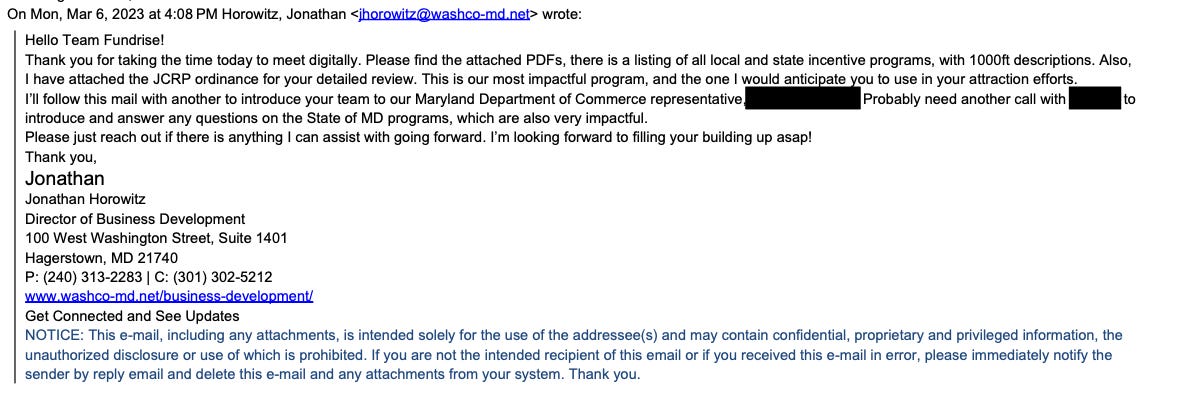
Emails show the county also offered to connect the company with officials at the Maryland Department of Commerce and assist in assembling incentive packages to attract tenants.
At the same time, emails show, both the county and the property’s owner were grappling with constraints at the site. Access to the warehouse was a recurring issue, with a planned extension of Wright Road not expected to be completed until 2027 or later. Representatives of the owner pressed county officials about whether the project could be accelerated, describing access as a sticking point in discussions with prospective tenants.
In a January 2024 exchange, a Fundrise asset manager described a potential tenant with four or five employees operating forklifts and asked whether existing restroom facilities would meet code. Gregory E. Cartrette, Washington County’s director of permits and inspections, replied that no additional restrooms would be required.
That exchange reflects the building’s original intended use: a large industrial facility designed for limited on-site staffing.
As late as October 2025, the property remained in active leasing discussions with private tenants. Within six months, it had been acquired by the federal government and then — at least for now — stopped by a federal court.
Fundrise told investors it was not actively marketing the property for sale when it received the unsolicited offer, according to investor communications previously reviewed and reported by Project Salt Box, and said it accepted the bid based on its fiduciary obligations and the buyer’s terms. The account suggests the federal purchase did not emerge from a planned sale process but instead overtook an ongoing effort to lease the building to private tenants.
As Project Salt Box previously reported, on Jan. 12, 2026, the Department of Homeland Security formally initiated a consultation process with local officials, stating that U.S. Immigration and Customs Enforcement was proposing to purchase and convert the warehouse into a processing facility. Plans outlined in the letter included interior construction of holding and processing spaces, medical areas and visitor facilities.
Four days later, on Jan. 16, Michelle Gordon, the Washington County administrator, circulated the notice internally to county commissioners, describing it as part of the federal government’s due diligence process. She wrote that, to the county’s knowledge, ICE had not yet completed a purchase or made an offer. State land records indicate the federal government executed purchase documents that same day.
Even as the proposal took shape, Gordon reiterated the county’s legal position, writing that federal actions were outside local control and noting that detention facilities were permitted under the property’s industrial zoning designation.
The transition from commercial leasing to federal use unfolded over the following weeks.
By Feb. 10, amid mounting local opposition, the Washington County Board of County Commissioners adopted a resolution expressing “full, unwavering support” for the Department of Homeland Security and Immigration and Customs Enforcement.
The following day, Gordon wrote to federal officials acknowledging that the department had purchased the property and outlining a series of infrastructure needs tied to the project, including sewer capacity upgrades, water supply considerations and transportation improvements. The county also requested federal assistance for projects ranging from pump station upgrades to a proposed widening of Interstate 81.
Those same infrastructure constraints had been raised months earlier in communications between county officials and the property’s owner during efforts to attract commercial tenants.
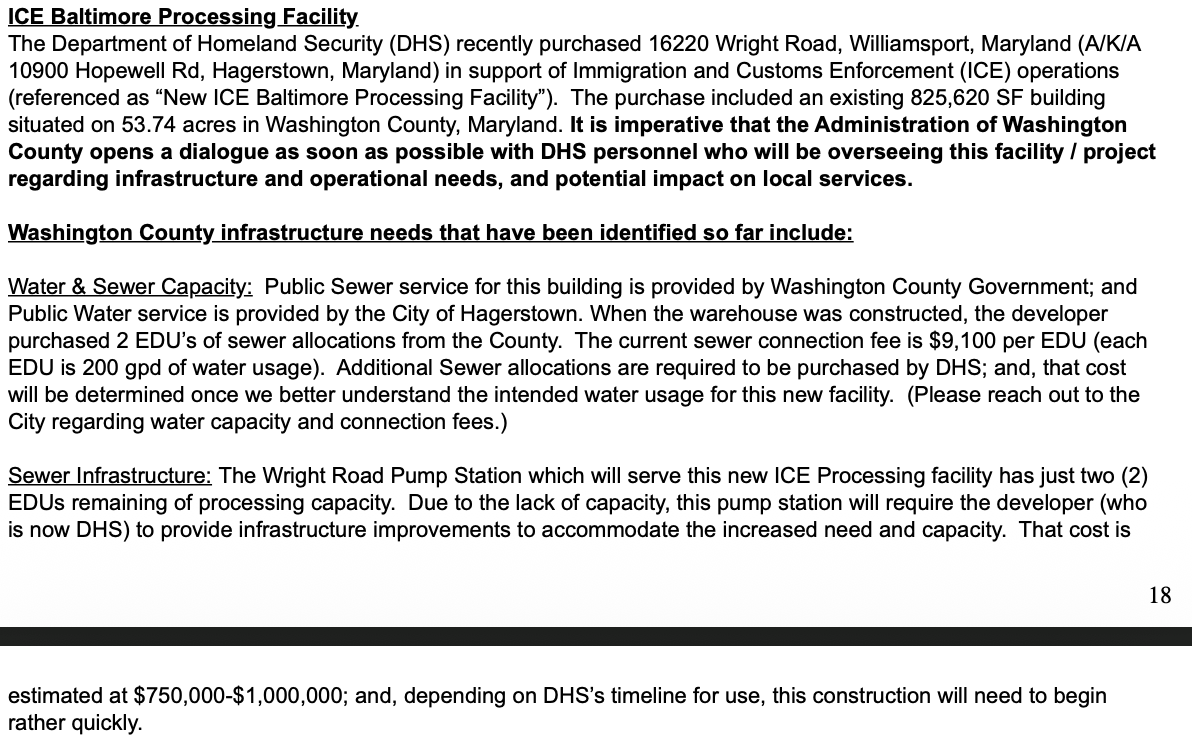
The emails do not show direct coordination between county officials and federal agencies prior to the purchase. But they document a compressed timeline in which the warehouse shifted from an actively marketed commercial asset — one facing known infrastructure constraints — to a federal project expected to accommodate far higher levels of occupancy.
The same infrastructure constraints the county had identified in earlier communications — first as barriers to commercial use and later in requests for federal assistance — now underpin the state’s case against the warehouse’s use as a detention center. A federal judge this week issued an injunction halting further work at the site pending environmental review, while Maryland officials have ordered Washington County to revise its sewerage plan — a step that could determine whether the project can move forward at all.
Thank you so much for your work and transparency on this issue
Soulless money laundering.