


Federal immigration authorities included a detainee labor program in contracts for two warehouse detention facilities in December 2025 — a month before the government had completed purchasing either property.
The task orders — executed procurement records covering sites in Williamsport, Md., and Surprise, Ariz. — were issued on December 22, 2025, under the U.S. Navy’s WEXMAC TITUS contracting vehicle. Both were made effective March 6, 2026. Among the operational line items in each: an “Alien Volunteer Work Program,” reimbursable at a per-detainee, per-day rate, governed by contract terms that Immigration and Customs Enforcement redacted from the public records request that produced these documents.
The Maryland warehouse, a roughly 825,000-square-foot facility near Williamsport, Md., was purchased by the federal government in January 2026 for approximately $102.4 million. In Arizona, the purchase of a 418,000-square-foot warehouse followed a similar timeline, selling days later for $70 million.

The Work Program
The Volunteer Work Program is a standard feature of established detention facilities, where detained immigrants may perform jobs — kitchen work, laundry, sanitation, facility maintenance — in exchange for wages that amount to as little as a dollar a day. Under ICE’s own detention standards, last codified in 2011, participation is voluntary except for basic housekeeping duties, and detainees must be paid at least one dollar per day — a rate far below the federal minimum wage of $7.25 an hour that applies to most workers in the United States.
It is not a feature typically associated with intake and transfer processing. That’s the function ICE has repeatedly described as the primary purpose of these sites.
ICE’s internal planning documents for the Detention Reengineering Initiative, a previously reported program to overhaul and expand the agency’s detention network, describe regional processing centers as staging locations where detainees stay an average of three to seven days before being transferred or removed. That overview, dated February 13, 2026, was shared publicly by New Hampshire Gov. Kelly Ayotte after ICE sought to convert a warehouse in Merrimack, N.H., into a similar facility. The purchase was ultimately abandoned. Nowhere does it describe processing sites as places where detained immigrants would hold jobs.
Yet both task orders include the work program, billed per detainee per day, capped at an undisclosed amount, with governing terms in Section 27.9 of each contract’s Performance Work Statement. Those sections were withheld and the rate itself was redacted.
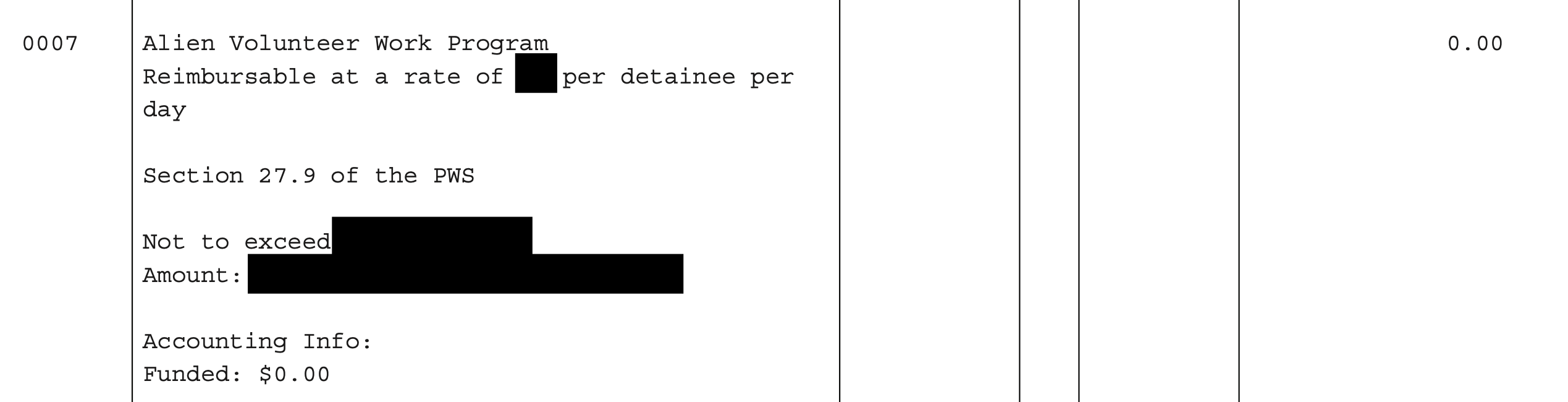
Identical language appears in both documents, which were awarded to different companies in different states: KVG LLC in Maryland and GardaWorld Federal Services LLC in Arizona. The identical language points to a standardized ICE contracting template under WEXMAC and not language specific to either facility or operator.
The DRI describes processing sites as staging locations. It does not describe them as places where detained immigrants would hold jobs.
What the Task Orders Add
Before these task orders became public, what was known about ICE’s warehouse plans rested on two sources: internal agency documents reported by The Washington Post on December 24, 2025, which indicated ICE planned for up to 1,500 detainees at each facility, and the agency’s own representations across four separate federal lawsuits, where it has consistently put the planned capacity at 542.
These procurement records add a third layer. Unlike a leaked planning document or a court filing, a task order is an executed contract specifying what a vendor is being paid to deliver, in what sequence, and over what period. The blueprint that emerges maps onto neither the 542-bed processing center ICE described in court nor the short-term staging mission the agency has offered publicly.
Under the base period of each order, the first 60 days are reserved for contractor transition and facility retrofitting. A six-week ramp-up follows, during which beds come online in incremental stages. The remaining roughly eight and a half months are structured around full-capacity detention operations — guards, transportation, per-detainee billing, and the work program running in parallel. Should the government exercise its options, each contract envisions two additional 12-month periods of uninterrupted operations. Fully exercised, both would extend well past the two-year mark.
The mileage structure of the Arizona contract contain details not included in the Maryland document. Transportation line items in the GardaWorld records distinguish between “Processing Sites,” estimated at 5,000 miles per year — consistent with short local transfer runs — and “Megacenters,” estimated at 100,000 miles per year, a figure that implies a regional hub moving large numbers of people across significant distances. The DRI overview confirms the underlying model previously described generically by ICE. Processing centers shuttle detainees into large-scale facilities capable of housing 7,000 to 10,000 people for 60 days at a time, or more.
Both task orders describe their sites as “processing and detention facilities.” Guard services at each are capped at 20,000 hours per year, roughly 55 hours a day, enough to sustain continuous around-the-clock coverage. Invoice requirements for detention services mandate detainee names, identification information, bed-day rates, and check-in and check-out dates. Among line items listed under other direct charges: “volunteer detainee wages.”
Both documents also bar the contractor and any subcontractors from making public disclosures about the agreement without ICE’s prior review and approval.
The Williamsport facility remains blocked. A federal judge issued a preliminary injunction halting conversion work there pending a full environmental review — a process an ICE attorney said in a recent hearing could take years. This week, ICE reached a settlement with challengers in New Jersey, agreeing to pause operations at a similar warehouse site under the same condition.
GardaWorld, meanwhile, is hiring. The company posted a listing on LinkedIn on Tuesday for an unarmed security guard at the Surprise facility, describing the role as securing the perimeter of an “immigration processing and custodial facility.” The posting noted the company was “building a pipeline” for the position, with an anticipated start date of later this year.
A federal lawsuit challenging the Surprise conversion remains pending in the District of Arizona, filed against a facility whose operator is already recruiting staff and under a contract that was ready before the government even owned the building.
Concentration camps. Like we said.
So slave labor