

UPDATE: DHS Purchases Hagerstown Warehouse for $102.4 Million
As federal authorities finalize the purchase of an 825,000-square-foot site for an immigration center, local leaders concede that county law stops at the property line.

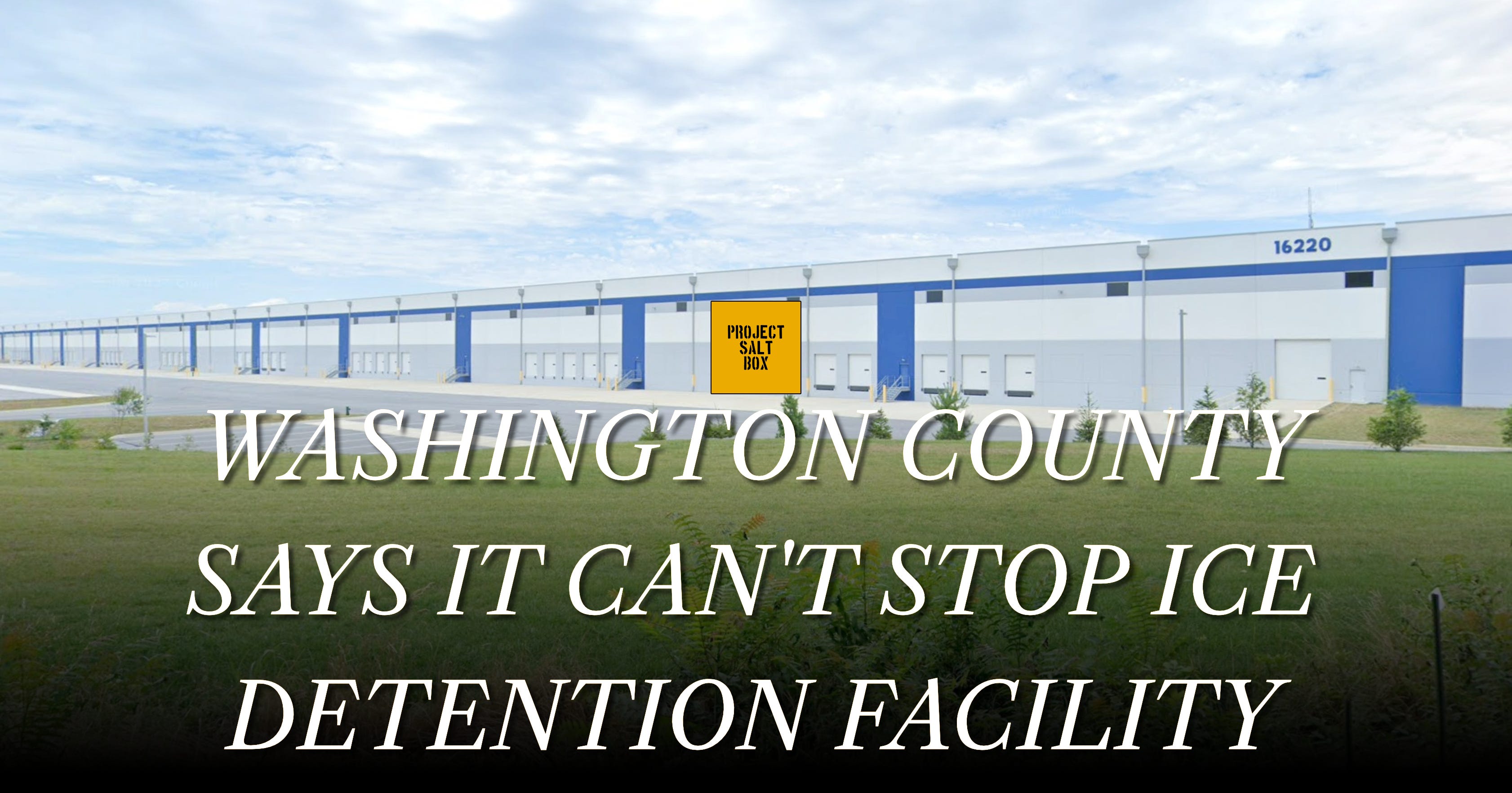
Washington County officials said Wednesday they are powerless to stop the federal government from converting a local warehouse into an immigration detention processing center, citing constitutional limits on local authority.
In a statement posted to Facebook, the Washington County Board of Commissioners confirmed it had been notified by the Department of Homeland Security about a “potential purchase” of property at 10900 Hopewell Road, also known as 16220 Wright Road. But property records filed this week show the $102.4 million sale to U.S. Immigration and Customs Enforcement has already closed.
The board said federal supremacy doctrine prevents the county from enforcing zoning laws that would normally govern such a conversion.
“Generally, the federal government does not need to respect local zoning regulations that conflict with federal mandates,” the statement said, citing the Constitution’s Supremacy Clause. “Washington County is not able to legally restrict the federal government’s ability to proceed.”
The statement offered the most detailed public description yet of federal plans for the 825,000-square-foot facility, which DHS characterized as a “new ICE Baltimore Processing Facility.” Plans include holding and processing areas, medical suites, and “public-facing visitor space,” according to the county. Proposed improvements include upgraded fencing, specialized lighting, and the possible installation of “tentage and guard shacks.”
Federal authorities also sidestepped local historic preservation review. DHS informed the county’s Planning and Zoning Department that its internal assessment found “No Historic Properties Affected” — a determination the county says it has no authority to challenge under federal law.
The commissioners’ statement reflects a collision between local land-use authority and federal immigration enforcement. While the board said “decisions about land use are best made locally,” it offered no recourse, noting that federal agencies historically do not seek county approval for such projects.
As of Wednesday, the county said federal officials had not formally notified them that the purchase was complete, despite the deed being publicly recorded.
Neither the Washington County Board of Commissioners nor Governor Wes Moore’s office responded to requests for comment.
UPDATE | Jan. 28, 2026 - 3:50 PM
Washington County officials’ acknowledgment that they cannot block a federal immigration detention facility appears to have borrowed heavily from a statement issued weeks earlier by Oklahoma City — including nearly word-for-word passages about local control and constitutional limits.
Both statements were released after the Department of Homeland Security notified local governments of plans to convert warehouses into ICE processing centers. The language tracks closely, but the responses reach starkly different conclusions.
Oklahoma City, in a statement issued in late December, wrote:
“It is the City of Oklahoma City’s longstanding position that decisions about land use are best made locally.”
Washington County’s statement, posted Wednesday, read:
“It is Washington County’s position that decisions about land use are best made locally.”
Both statements followed that assertion with similar framing about legal constraints.
Oklahoma City:
“Though we recognize the legal reality...”
Washington County:
“However, the legal reality when property is owned by the Federal Government is clear.”
The parallels extend to explanations of federal supremacy doctrine. Oklahoma City noted that federal entities “historically have not sought the zoning approval of the City of Oklahoma City for projects.” Washington County used nearly identical phrasing: federal entities “historically have not sought the zoning approval of Washington County Government for projects.”
Both statements also cite the Supremacy Clause and describe DHS correspondence about historic property determinations in similar terms.
But the conclusions diverge sharply.
Oklahoma City outlined concrete next steps: preparing a formal response to DHS, requesting the agency pursue a special permit, and sending letters to congressional representatives “requesting their support of a local public approval process.”
“The placement of a detention facility is an issue of local interest that would benefit from a public process involving residents, especially the neighbors of such a facility,” Oklahoma City officials wrote.
Washington County’s statement offers no comparable recourse. After stating the county “is not able to legally restrict the federal government’s ability to proceed,” it ends with a phone number for additional information.
The similarities suggest Washington County may have used Oklahoma City’s statement as a template — a common practice among local governments facing similar federal actions.
But the decision to adopt the legal language while removing provisions for local resistance reflects a fundamentally different posture toward federal authority.
Oklahoma City acknowledged legal limits while committing to exhaust every available avenue for local input. Washington County presented those same limits as final.
A deal on the Oklahoma City facility has not been finalized based on a review of land records performed by Project Salt Box. Washington County's sale to ICE, valued at $102.4 million, closed earlier this month according to publicly available property records, though county officials said they had not been formally notified of the purchase.
While federal law may limit zoning authority, Washington County is not powerless and should not present this issue as settled. The County still has a responsibility to actively oppose projects that are harmful to residents.
This proposed ICE detention and processing facility will impact community safety, local infrastructure, emergency services, public health resources, and quality of life. The County can and should formally object, demand full environmental and community impact reviews, engage state and federal representatives, and publicly advocate against this facility.
Saying “we can’t stop it” is not the same as doing everything possible to protect residents. Washington County should be fighting this — not standing aside.
Any information on which companies have been awarded contracts for building out and running this facility? Assume a private for profit company. Strong incentives being created to avoid speedy and humane “processing”. Would also be interested to know more details about who sold the warehouse originally. Everyone making money in this travesty should be held to account.