

To locate targets, ICE turns to the industry tracking Americans' phones
Immigration enforcement agents want to tap the mobile advertising industry for surveillance tools that constitutional scholars say circumvent Fourth Amendment protections.

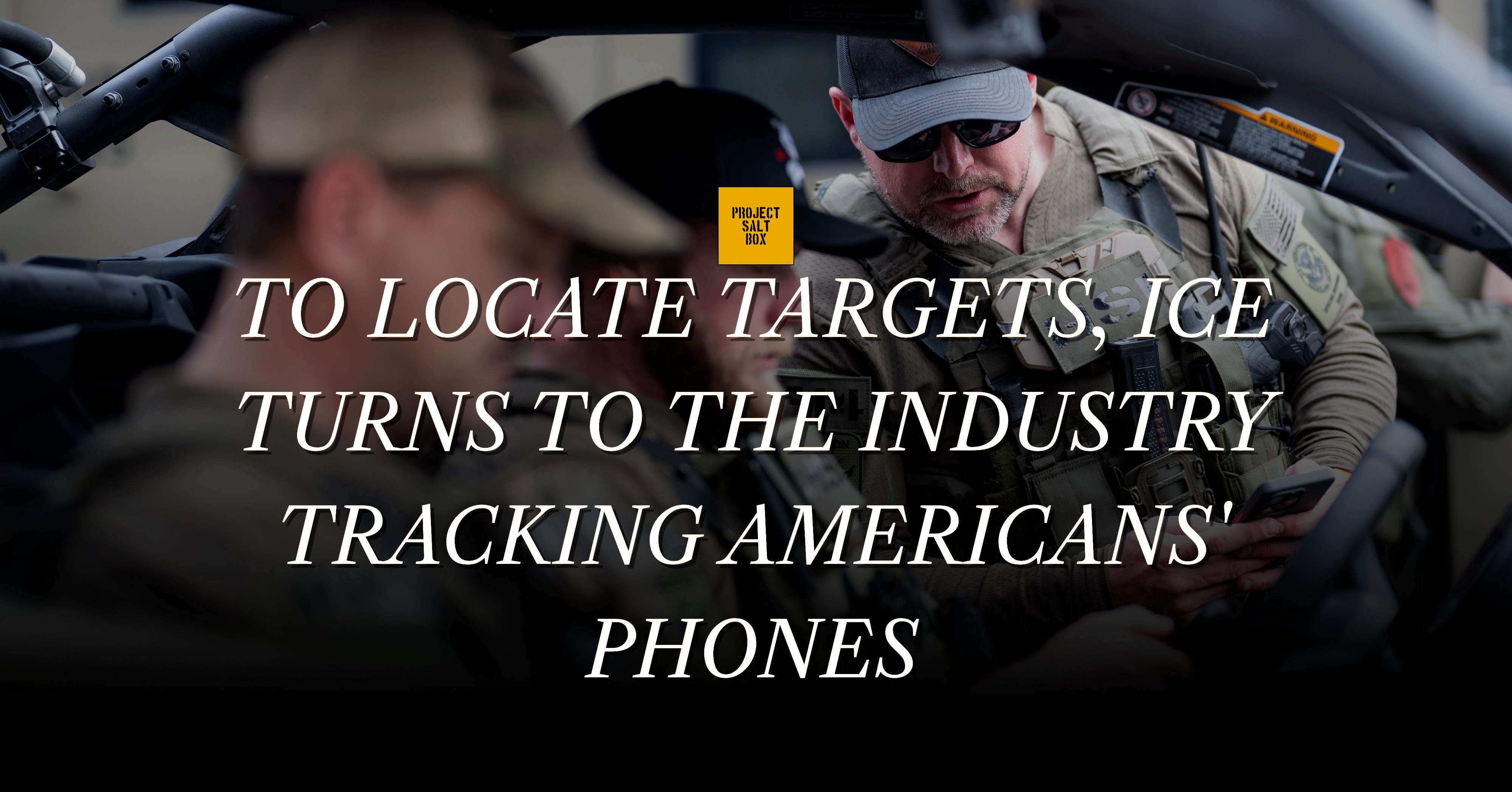
The Department of Homeland Security is moving to acquire commercial surveillance tools that would allow immigration enforcement agents to track the movements of millions of Americans without a warrant, according to a federal procurement document issued last week.
The Request for Information, published on behalf of Immigration and Customs Enforcement, solicits demonstrations from vendors who can provide access to location data harvested from the mobile advertising industry — the same technological infrastructure that follows consumers across the internet to serve targeted advertisements.
But ICE wants to repurpose that system for immigration investigations, identifying “patterns of life” by monitoring where people go, when they arrive and how long they stay — all without judicial oversight.
How Ad Tech Became a Surveillance Tool
The moment a user opens an app with advertising, it triggers what's called real-time bidding — an automated auction that happens in less than 100 milliseconds. In that fraction of a second, information about the user flows to potentially thousands of advertisers and data brokers.
The technology ICE is seeking to acquire operates on a system that most Americans interact with dozens of times daily, often without realizing it.
Every time someone opens a mobile app — whether checking the weather, playing a game or reading news — the app may request their location and assign them a unique identifier called a Mobile Advertising ID. Apple calls its version the Identifier for Advertisers, while Google’s is the Google Advertising ID. These identifiers were designed to help advertisers target consumers without exposing their names or email addresses. But when combined with location data, they create what privacy researchers describe as a powerful tracking infrastructure.
The moment a user opens an app with advertising, it triggers what’s called real-time bidding — an automated auction that happens in less than 100 milliseconds. In that fraction of a second, information about the user flows to potentially thousands of advertisers and data brokers, according to the Electronic Frontier Foundation, a digital rights organization.
The system broadcasts details like device type, location and browsing history to help advertisers decide how much to bid for the chance to show that user an advertisement. Only one advertiser wins the auction and serves the ad. But all the participants in the bidding process receive the data — meaning anyone posing as an ad buyer can harvest a continuous stream of information about billions of people.
That vulnerability has been exploited repeatedly. In 2024, the Federal Trade Commission accused data broker Mobilewalla of collecting personal information from real-time bidding auctions without ever placing ads. The company amassed data on more than a billion people — with an estimated 60 percent coming directly from the bidding system — and sold it to clients seeking to track union organizers, monitor Black Lives Matter protests and compile home addresses of health care workers.
Another firm, Patternz, built a surveillance tool explicitly for security agencies worldwide using bidstream data. The company’s chief executive boasted it could track people through “virtually any app that has ads,” according to reporting by 404 Media.
The California Privacy Protection Agency notes that because phones are typically used by a single person, the advertising identifiers effectively function as personal tracking devices. Data brokers use them to monitor habits and locations, then sell that intelligence to other businesses — or, as ICE’s request suggests, to government agencies.
An End Run Around the Courts
By purchasing location data from commercial brokers rather than demanding it from carriers, agencies contend they can bypass Fourth Amendment protections entirely.
The move exploits what privacy researchers call the data broker loophole. In 2018, the Supreme Court ruled in Carpenter v. United States that the government generally must obtain a warrant before compelling telecommunications companies to hand over historical location records, finding that such data reveals intimate details about a person’s life.
Yet federal agencies have increasingly turned to a parallel market. By purchasing location data from commercial brokers rather than demanding it from carriers, agencies contend they can bypass Fourth Amendment protections entirely. Legal scholars remain divided on whether that interpretation will withstand judicial scrutiny.
Aaron X. Sobel, an associate at Arnold & Porter who practices foreign relations and international law, wrote in the Yale Law & Policy Review that location tracking reveals profound invasions of privacy:
“Location data can reveal some of the most intimate details of people's lives. Location data can reveal whether someone is visiting an abortion clinic; what faith they practice and how frequently they attend religious gatherings; what their political associations and beliefs are; what their immigration status is; and much more.”
The ICE solicitation specifies that Homeland Security Investigations, the agency’s investigative arm, seeks platforms capable of ingesting massive volumes of location pings and employing “geofencing” technology to identify every mobile device within a defined geographic boundary — say, a city block or a building — then tracing those devices to residential and workplace addresses.
Part of a Broader Pattern
ICE is joining a growing roster of federal agencies that have normalized the acquisition of commercially available information, or CAI, a bureaucratic term for data purchased on the open market.
FBI Director Christopher Wray disclosed in 2023 that his agency had conducted a pilot program purchasing American phone geolocation data. Customs and Border Protection has contracted with location data firms including Venntel to monitor remote stretches of the southern border. And Secret Service procurement records show the agency has spent millions on what vendors call “location intelligence” for protective operations and investigations.
The technical ambitions outlined in the ICE request are significant. To make operational use of the billions of location signals generated daily by American phones, the agency is seeking capabilities modeled on systems already deployed by U.S. Citizenship and Immigration Services. The platforms must be able to cross-reference commercial advertising identifiers with government databases, converting anonymous data points into names, addresses and movement histories within seconds.
A Legislative Showdown Looms
Previous efforts to close the data broker loophole have failed despite bipartisan support in the House: the Fourth Amendment Is Not For Sale Act passed 219-199 in April 2024 but the Senate declined to act before the congressional session ended.
The timing of the ICE request could hardly be more fraught. As the agency moves to expand its surveillance reach, a funding crisis threatens to shut down portions of the federal government at the end of this week — and the political fallout from two fatal shootings has put every aspect of ICE operations under intense scrutiny.
Federal funding expires at 12:01 a.m. on Jan. 31, and Senate Democrats have vowed to block the Department of Homeland Security appropriations bill unless Republicans agree to sweeping reforms of immigration enforcement. The standoff follows the fatal shootings of two U.S. citizens by federal agents in Minneapolis this month.
On Jan. 7, ICE officer Jonathan Ross shot and killed Renée Good, 37, in her car after she briefly reversed away from agents who had surrounded her vehicle. Eyewitness videos contradicted federal officials’ claims that she had run over the agent.
Then on Saturday, Border Patrol agents fatally shot Alex Pretti, a 37-year-old intensive care nurse. Video from the scene shows Mr. Pretti holding up his phone before agents doused him with pepper spray and wrestled him to the ground. While Mr. Pretti was pinned, agents removed a legally carried handgun from his holster; they then shot him. The Department of Homeland Security later said that Mr. Pretti had violently resisted and posed a threat to the agents’ safety, though the footage captured by bystanders has raised questions about that account.
The deaths have sharpened opposition to the agency beyond progressive activists, drawing concern from an expanding cohort of civil liberties organizations that say its tactics have grown increasingly aggressive. More striking, however, is the emerging unease among some Republicans, a handful of whom have begun to question the agency’s conduct — an unusual fissure in a party that has long offered near-uniform backing for federal immigration enforcement.
While ICE operations would likely continue even through a partial government shutdown — Republicans allocated $75 billion to ICE over four years in what President Trump called his “One Big Beautiful Bill” — procurement processes are more vulnerable to political pressure. Congressional Democrats could use appropriations riders to restrict specific surveillance acquisitions, or the administration could pause controversial purchases to avoid further inflaming tensions.
Previous efforts to close the data broker loophole have failed despite bipartisan support in the House: the Fourth Amendment Is Not For Sale Act passed 219-199 in April 2024 but the Senate declined to act before the congressional session ended.
Privacy advocates note that the practice raises not only constitutional questions but also practical ones about accuracy and accountability. Academic studies have found that data broker inferences can be "wildly inaccurate," with some third-party audience segments performing "barely better than finding the right customers by random chance." Meanwhile, government purchases of such data lack meaningful oversight, with agencies keeping transactions secret and providing little public disclosure of how the information is used or whether it has led to wrongful targeting.
The Department of Homeland Security has not responded to requests for comment.
Vendors have until Feb. 2 to respond to the request. Until then — or until Congress acts — the location data generated by millions of American phones remains available for purchase by federal agencies, no judicial approval required.