

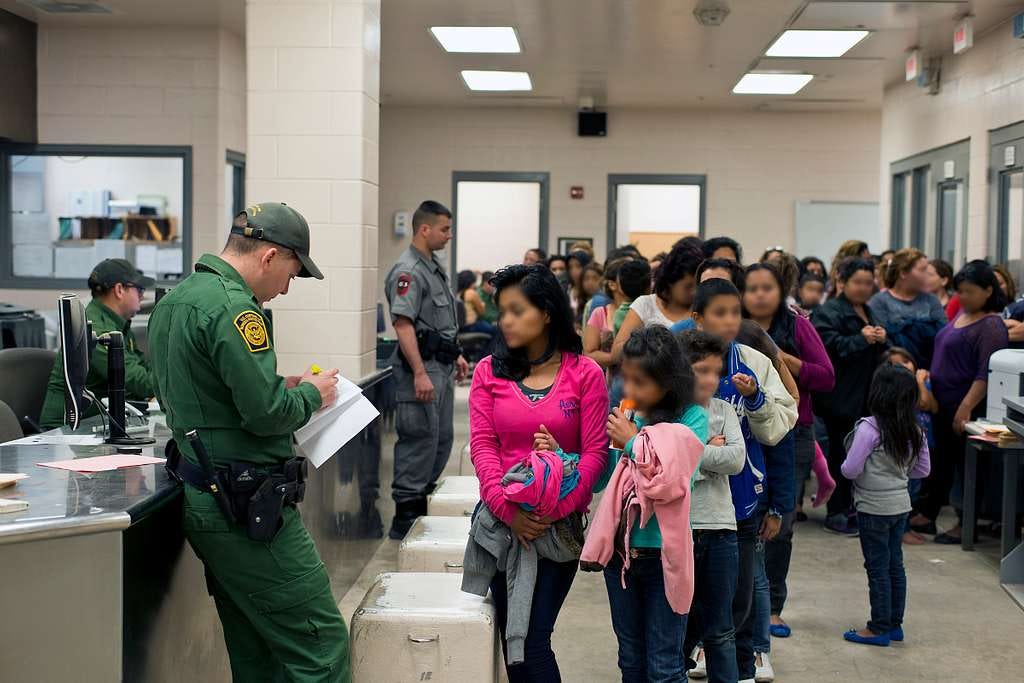
About 150 companies joined an open call with the Office of Refugee Resettlement, or ORR, on Aug. 18 to hear whether they could support a federal request for emergency housing for a potential influx of migrant children.
The office is searching for companies to open and operate what it calls emergency intake facilities. Each site would hold as many as 3,000 unaccompanied children, and a contractor would have to be ready to house 400 within 30 days of receiving an order, according to a notice posted to SAM.gov, the federal government’s contracting website.
The agency plans to award the contract by Dec. 31, officials said on the call.
For much of the call, companies asked what a contractor would be expected to ask. How many beds would they need to provide? What would the staff-to-child ratio be? Which state licenses would a facility need? How tall does the perimeter fence have to be, and how close to a hospital does the site have to be?
Then they asked how they would be paid, and what would happen if the influx of children never came.
In that case, companies would be paid a flat fee while a site is being prepared, according to ORR officials on the call. They would be paid at set rates for keeping a site idle or partly staffed. Only once a facility opens does payment shift to a per-child rate. Any vendor approved for the contract would also be paid a fee even if they never receive an order at all. An official could not say how much.
The new emergency intake notice sets a 90-day deadline for a potential site to reach full operation.
The government has paid for empty beds before. Homestead was an influx facility in Florida, the same category of temporary site ORR is now planning, run under contract by a private company and holding as many as 1,200 unaccompanied children. After the last child left in August 2019, ORR kept it staffed at a cost of about $600 per bed per day, roughly $720,000 a day, the agency's director at the time, Jonathan Hayes, told a House Appropriations subcommittee that September, according to CBS News. That came to more than $33 million over about seven weeks. Hayes said reactivating the facility would take at least 90 to 120 days, and that he was not willing to give up the capacity given uncertainty about how many children might arrive.
The contract would work like a standing purchase account. Once companies are approved, the agency can place as many orders as it wants, with as many companies as it wants, without a new competition each time.
Beds would be contracted in blocks of 50. No site has been chosen, and the Department of Health and Human Services has so far said it has no immediate plans to open one.
The Independent, which first reported on the project last month, quoted an agency spokesperson who said the roundtable was standard market research and called it journalistic malpractice to describe it otherwise.
The notice on SAM.gov is a special notice, a posting agencies use to gauge industry interest before a formal solicitation.
Who attended the call?
Many of the companies who attended the open call hold or have held federal immigration contracts, and several have access to the same Navy contract vehicle ICE has used since February to buy detention services without competitive bidding.
GEO Group, the private prison company that operates 19 ICE detention facilities and provides armed guard and transportation services to the agency, was on the call. Its subsidiary BI Incorporated runs ICE's alternatives-to-detention program, which supervises people the agency has released rather than detained, and has taken in roughly $768 million on that work under task orders since 2023. BI also holds two smaller ICE task orders for skip tracing, the practice of locating people for arrest and deportation.
Deployed Resources, which has supplied Customs and Border Protection with soft-sided facilities since 2016, earned hundreds of millions of dollars running emergency shelters for unaccompanied children during the Biden administration, according to ProPublica.
The Baptiste Group was also on the line. Tennessee suspended the license of a Baptiste Group-operated shelter for migrant children in Chattanooga in 2021 after allegations of abuse. Federal records show the same company, identified by its unique entity identifier, received an HHS grant for residential shelter services for unaccompanied migrant children during the same fiscal years it ran that shelter.
So was Response AI Solutions, who holds an ICE task order for safety verification and wellness checks on unaccompanied children, issued to meet a minimum requirement of 1,000 cases. The government has committed $3.7 million so far against a maximum of $243.4 million. The company was also paid $2.6 million under a separate ICE task order for urgent services and supplies supporting surge law enforcement in the St. Paul area.
Last month, U.S. Customs and Border Protection hired both Response AI Solutions and the Baptiste Group, among four companies, to collect immigration fines from people the United States has deported.
A representative for Anovaeon LLC also appeared on the attendee list. The San Antonio company was founded in 2024, operates from a residential address, and describes itself on its website as a humanitarian response partner without mentioning immigration detention. Project Salt Box reported in March that it had begun recruiting staff for a planned 1,500-bed detention facility at a western Maryland warehouse the government bought in January for $102.4 million, despite having never been awarded a federal contract.
Eric Fritz, the chief executive of Anovaeon, previously worked at Endeavors, which also appeared on the attendee list. He was deputy director for operations and contracts there from March 2021 to April 2022, according to his LinkedIn profile, where he says he led the rapid stand-up of a 3,000-bed shelter for unaccompanied minors and oversaw federal and subcontracting agreements worth more than $800 million in his first year. Mr. Fritz was not on the Aug. 18 roundtable.
Other participants handle pieces of the same system. SOS International holds nine ICE contracts through the agency's Detention Compliance and Removals office, with combined ceilings of roughly $874 million. The largest, awarded June 1 and worth up to $559.6 million, falls under the category ICE uses for skip tracing. The company also holds a security guard contract worth up to $145.6 million and has done translation and interpretation work for the agency.
Loyal Source, Ingenesis and AMI Expeditionary Healthcare staff medical services at immigration facilities. Endeavors received the $86.9 million no-bid ICE contract in 2021 that the Department of Homeland Security's inspector general later found was not adequately justified.
Attending a market research call does not mean a company will bid, and bidding does not mean it will win. No formal solicitation has yet been posted, and no contract has been awarded.
Sites could open 30 days after contract award
On the call, officials described three levels of clearance for workers. Fully cleared staff may work alone with children. Staff who pass a preliminary check must stay within sight of a cleared employee. Staff whose checks are still pending may work at a site but cannot have contact with children. Officials said the tiers are what allow a facility to open on the 30-day timeline.
ORR has explored and awarded this kind of procurement in the past. A sources sought notice was posted in November 2020, in the final months of the first Trump administration, seeking contractors to staff temporary influx shelters for at least 1,000 children, with sites ideally capped at 1,500. Performance was to begin in May 2021, by which time Biden was in office and ORR had already opened its emergency intake sites. That contract ran through May 2026.
ORR opened 14 emergency intake sites in 2021, in the first months of the Biden administration. At the largest, on the Fort Bliss Army post in El Paso, the agency hired nearly 300 case managers within a month, according to a September 2022 report from the Health Department's Office of Inspector General. Many had no background in child welfare. ORR waived its own training requirements for 60 days, meaning hundreds of workers began handling children's cases untrained.

Ultimately, the agency’s own inspector general found that speed came at a cost.
Supervisors told investigators that some release recommendations failed to account for a child’s history of abuse, or whether a sex offender lived in the household of the proposed sponsor. One ORR leader said the children are inherently vulnerable, that bad actors target programs serving them, and that bringing on inexperienced case managers quickly is something that should never occur.
The report also found that ORR issued guidance in March 2021 that stripped steps out of sponsor screening to speed releases, including background checks and identity verification for other adults living in a sponsor’s home. Investigators concluded that removing those safeguards may have increased children’s risk of being released to unsafe sponsors. Some staff who raised concerns said they were reassigned or dismissed.
The inspector general made five recommendations. ORR agreed with all of them.
Two of the five are fixes this notice could address. A draft requirements document, dated May 14 and posted alongside the special notice in July, sets minimum qualifications for case managers, which the 2021 sites lacked.
A case manager must hold a bachelor’s degree in behavioral sciences, human services or social services and have at least a year of experience with child welfare standards, best practices, quality assurance or compliance. The document sets a ratio of one case manager for every eight children. It also says child welfare or case management experience is strongly encouraged, but does not require it.
On the second recommendation, that case managers be trained before they begin, the draft is virtually silent. It requires the contractor to ensure staff complete necessary training and to retrain them as policies change. It sets no deadline and does not say training must come before a worker takes a case.
The remaining three recommendations concern ORR’s own systems and internal review processes, which a contract document would not cover.
The draft also gives the agency room to move faster than its own rules. ORR may waive or modify background check requirements facility by facility, at its sole discretion.
The agency commits to receiving background checks within 30 days of a facility opening, not before it opens. The section of the document that would govern supervision of uncleared staff has not been written. In its place the draft carries a note that the section is to be determined.
The draft’s background check standard is drawn from a guidance document ORR published on April 30, 2021, a month after the first emergency intake sites had already opened.
Licensing
Facilities in Texas are not expected to need a state license, officials said. A company representative asked whether sites there could open without one and was told the government does not expect Texas to license this type of facility.
A representative of a Maryland company on the open call said licensing in that state would likely take longer than 90 days, the deadline the contract sets for a site to reach full operation. ORR officials said the agency is holding to the 90-day timeline and would weigh exceptions individually. What would take the place of state licensing at unlicensed sites was not addressed.
Homestead operated without a Florida license because it sat on federal property, which also kept it outside the local school system. The superintendent of Miami-Dade County Public Schools said at the time that he was not allowed to inspect its classrooms. Rep. Rosa DeLauro, who chaired the appropriations subcommittee that oversaw the program, described influx facilities in 2019 as unlicensed shelters that adhere to neither state nor federal standards of care.
Where the children would come from
The administration has reported that border crossings are at historic lows. More than 150 shelters already house unaccompanied children, according to the Independent.
Asked where the expected influx of unaccompanied migrant children would come from, the Department of Homeland Security did not respond. A spokesperson told Project Salt Box that the agency would not discuss law enforcement operations, then listed more than a dozen arrests of sponsors accused of crimes including rape, human trafficking and attempted murder.
Asked whether the projected increase was tied to interior enforcement against parents, the spokesperson said ICE does not separate families, and that parents are asked whether they want their children removed with them or placed with someone the parent designates.
Homeland Security Secretary Markwayne Mullin said much the same on Sept. 1, telling a reporter that the agency targets parents rather than children, and that a parent facing removal could take a child along or leave the child with what he called a “trusted, vetted individual.”
Asked for the data behind the size of the contract, the spokesperson said ICE has located more than 146,000 of the 450,000 children who entered under the previous administration.
Those figures come from a Department of Homeland Security inspector general report published in August 2024, covering fiscal years 2019 through 2023 under both administrations. The report found ICE transferred 448,000 unaccompanied children to the Health Department, had not served 291,000 of them with a notice to appear in immigration court, and that more than 32,000 did not appear for hearings. It did not describe the children as missing.
Advocates who work with unaccompanied children told PolitiFact in March that a child who never received a court notice is not the same as a child who cannot be found, and that the paperwork often fails because a family moved or an address was incomplete. DHS gave PolitiFact the same list of sponsor arrests it later sent Project Salt Box, without saying whether those sponsors’ children were among the ones it counts.
Then-Secretary Kristi Noem said on March 3 that the department had located more than 145,000 children. Six months later, the figure DHS gave Project Salt Box was about a thousand higher.
ORR did not respond to questions Project Salt Box submitted on Tuesday, Sept. 2. Among them: what projection supports capacity of up to 3,000 beds per site, what the standby fee for approved companies would be worth, which states the agency expects will not require licensing, and how it would keep staff without completed background checks separate from children.
What happens next
On the call, officials said a revised version of the requirements document would be issued Sept. 1 and would include detailed staffing ratio tables.
As of Sept. 2, nothing new has been posted. The only version available to bidders remains the draft from May, posted in July.
No date has been set to release the formal solicitation. An ORR official said in the August roundtable that the first order could be solicited once the contract is awarded, depending on ORR's needs.
This post has been updated to correct the count of companies who attended the Aug. 18 roundtable. We originally reported 40. The number is actually 150.
this is a nightmare......what groups...... et al ......are protesting against these professional jailers and concentration camp entrepreneurs. What can I do? I always want the Names of these organizations and activist-thugs to be illuminated on the sides of building and put on billboards.
NO NO NO ! NOT AGAIN! DO NOT TAKE THE CHILDREN! 😭😭like the first term……..they just DISAPPEAR! I believe Sold,Black Market,..first term DeVoss was a cab head,her “ Christian” childrens adoption agency ,I believe Took Many of them and SOLD” adopted” them out.💔. We CANNOT ALLOW THIS! These ICE THUGS ARE THE CRIMINALS! Deviants,Felons for many things ……sick sick administration! Dear gawd help us! They CANNOT BE TRUSTED! WHY did DeVoss just disappear…..I wait for a deep dive into her hidden life!