

Surge Signs Mount as Federal Contracts Reveal Major Expansion of ICE Detentions in Baltimore Region
Procurement records, staged vehicles, and firsthand accounts from inside the agency's field office suggest a surge in detention operations is imminent.



UPDATE: 10:07 PM, Feb. 23, 2026
In a statement provided to Project Salt Box, U.S. Senator Chris Van Hollen said he had serious concerns about the federal buildup.
“Given the lawless actions undertaken by Trump's ICE operations in Maryland, Minneapolis, and beyond, I have serious concerns with their buildup of resources in our state, the lack of transparency around their taxpayer-funded purchases, and what it all means for our communities,” he said. “I will continue to stand with my fellow Marylanders to stop Trump's ICE from terrorizing our communities.”
Inside the Fallon Building at 31 Hopkins Plaza in downtown Baltimore, where ICE operates its regional field office, attorneys and their clients say something has changed. Agents who previously went without visible weapons have begun appearing in tactical vests and holsters. Multiple people with direct experience at the building, speaking to this publication on condition of anonymity, described family separation occurring inside and recounted instances in which detainees were told they faced imminent deportation, only to be released hours later. Those who experienced it, they said, were left traumatized. One attorney — who represents clients held at the building and accompanies others to routine check-ins there, and who spoke anonymously for fear of retribution against their clients — said they had overheard ICE employees discussing plans to expand the agency’s presence in the Fallon Building onto additional floors.
And now, a solicitation posted Feb. 20 on the federal contracting database SAM.gov reveals that ICE is planning to nearly triple its detainee meal capacity in the Baltimore region — a concrete logistical measure of an enforcement expansion that local officials, state legislators, and the sheriffs once tasked with assisting the agency all say is underway.
Meals By the Numbers
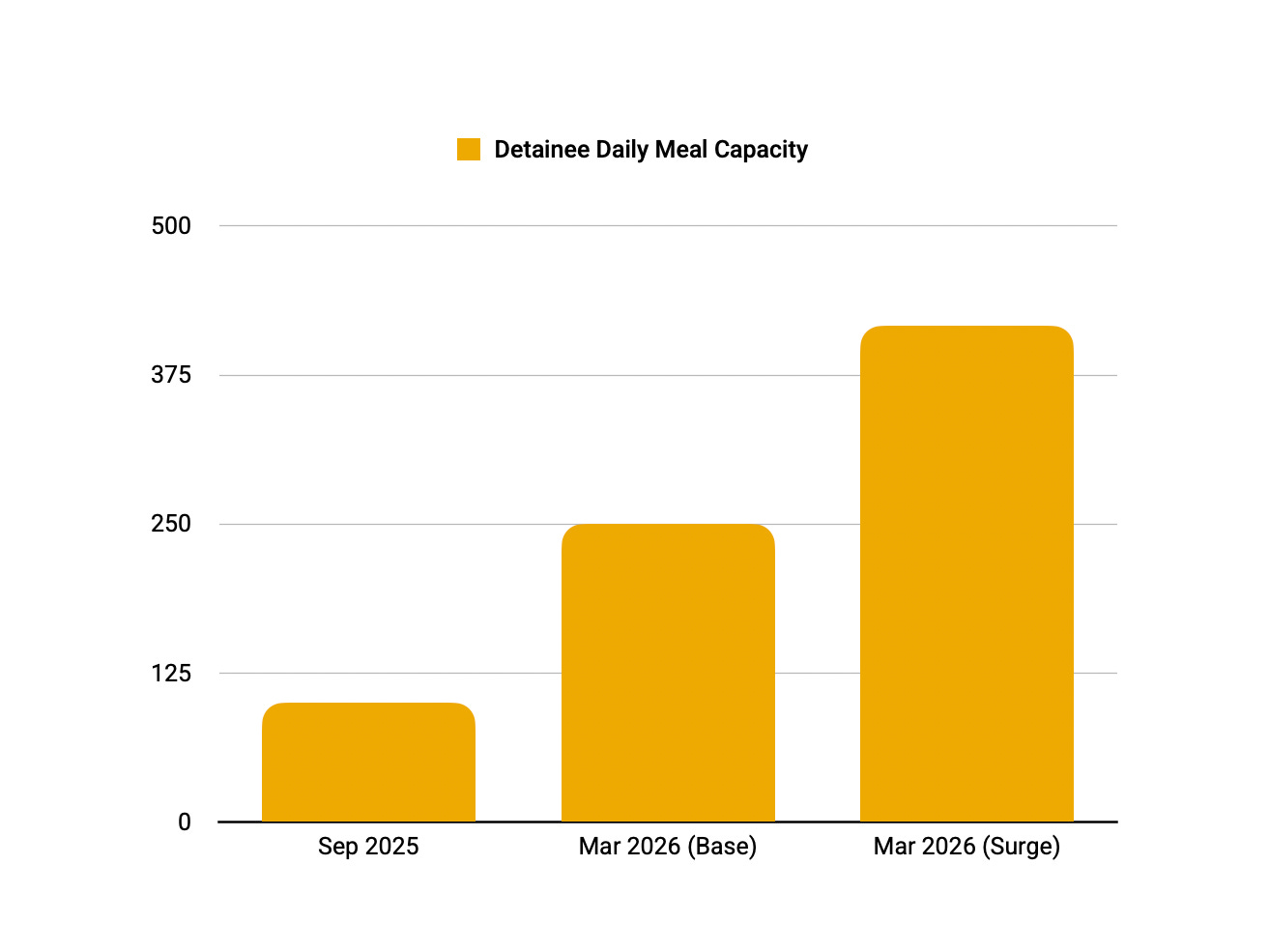
In September 2025, ICE awarded a contract specifically for "Baltimore AOR detainees" — meaning all detainees within the agency's Baltimore area of responsibility — supplying 18,000 shelf-stable meals every 90 days, enough to feed roughly 100 people per day. The solicitation posted this month seeks 45,000 meals for the same period, a 150 percent increase in base volume. Surge provisions allow the agency to request up to 10,000 additional meals per month on 30 days' notice, pushing maximum daily capacity to approximately 416 detainees — a 316 percent increase over the prior contract's ceiling. The previous contract ran for six months. The new one runs for up to five years.
Nearly all of the volume increase is concentrated in the Baltimore suboffice, where base meal orders jump from 15,000 to 42,000 per 90-day cycle — a 180 percent increase. The Salisbury sub-office, which covers the Eastern Shore, holds at 3,000 meals per cycle, unchanged from the prior contract.
The procurement documents identify not just how many detainees ICE expects to process, but where. The primary delivery address in the new contract is 6522 Meadowridge Road in Elkridge — identified in the statement of work as the future home of the Baltimore Field Office, with a planned move date of May 2026.
That building, a 29,000-square-foot commercial property in an office park less than a mile from an elementary school, was being covertly retrofitted to include detention space and detainee processing areas. Local officials discovered what it was becoming before the federal government formally announced it.
Howard County moved swiftly to block it — the county revoked the building permit in early February after determining the contractor had failed to meet state public notice requirements, then passed emergency legislation barring any non-government entity from obtaining a detention permit in the county. The federal meal solicitation listing the Elkridge address was posted two weeks after that legislation was signed into law.
A Buildup in the Making
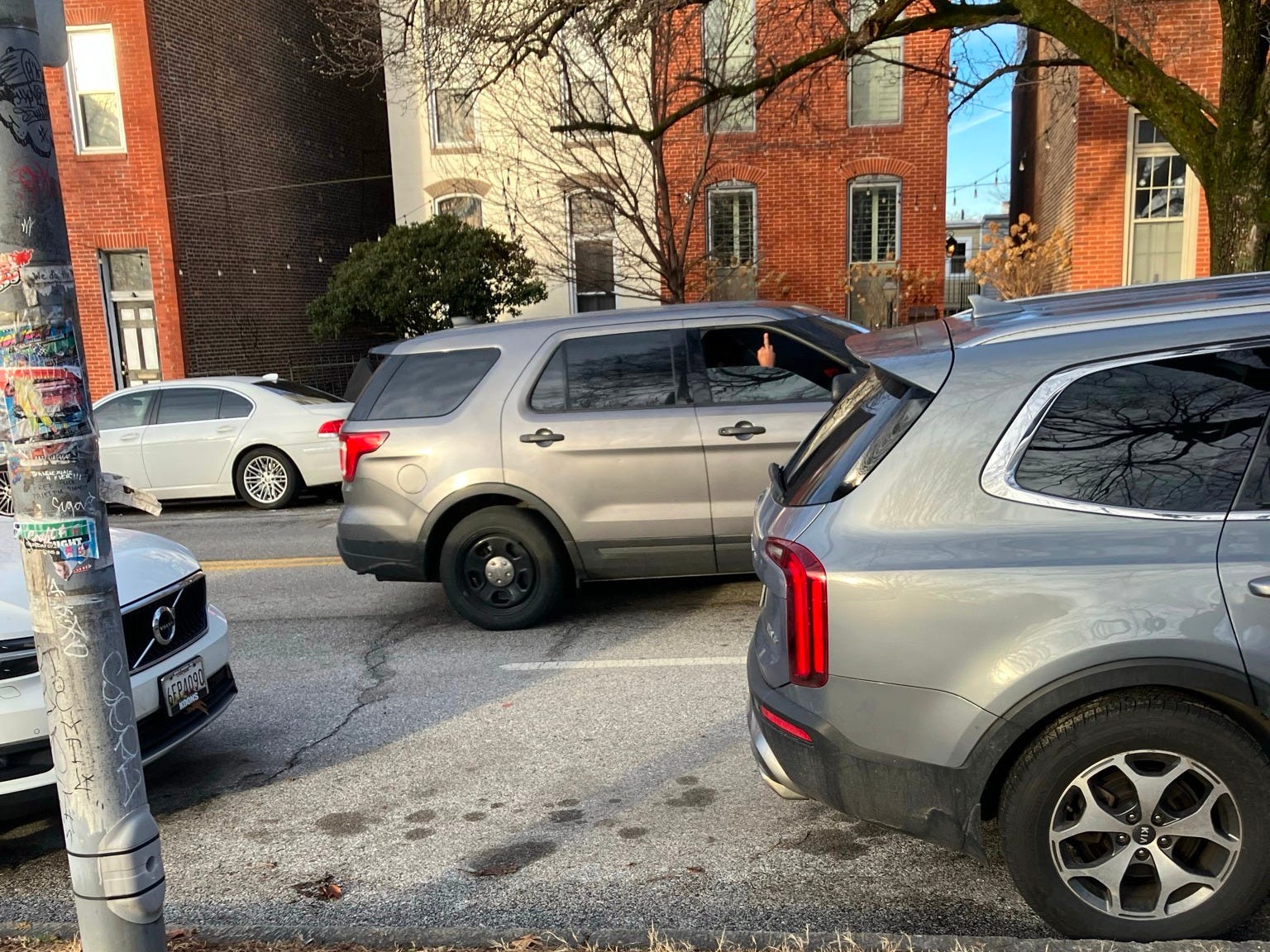
The meal contract is just one piece of a broader regional buildup. In recent weeks, dozens of new law enforcement vehicles have appeared at sites around Baltimore — among them a fleet of approximately 50 staged in the Symphony Center garage at 1030 Park Avenue in the city’s Midtown-Belvedere neighborhood, several bearing ICE placards.

Federal leasing records show the General Services Administration occupies the adjacent building at 1010 Park Avenue. The lease on that property, along with two others in the complex, is held by 901 L.L.C., an affiliate of David S. Brown Enterprises, under a master agreement with the Maryland Transit Administration. Whether GSA subleases directly from 901 L.L.C. could not be independently confirmed based on available records, but no other lessor exists in the chain. Senator Chris Van Hollen, whose Baltimore regional office is in the same complex at 1040 Park Avenue, told the Baltimore Banner that inquiries to both ICE and building management had gone unanswered.
ICE spokesperson Casey Latimer confirmed the vehicles are tied to workforce expansion. “With the ICE workforce growing exponentially, fleet vehicles are a necessary piece of equipment for onboarding officers and agents,” Latimer said, adding that the agency has more than doubled its officers and agents nationally.
In Western Maryland, the Department of Homeland Security has purchased an 825,000-square-foot warehouse near Hagerstown with plans to convert it into a detention facility capable of holding up to 1,500 people. ICE has also opened a new attorneys’ office in Hunt Valley, in Baltimore County.
Why Now?
The buildup tracks closely with the collapse of the formal cooperation structure that had defined ICE’s relationship with Maryland law enforcement for years.
On Feb. 17, Gov. Wes Moore signed emergency legislation — House Bill 444 and Senate Bill 245 — immediately terminating 287(g) cooperative agreements between ICE and nine Maryland county sheriffs’ offices. The program had allowed local jails to screen detainees for immigration status and transfer them to federal custody; a separate provision had deputized local officers to help execute ICE warrants. Both ended with the governor’s signature.
The 287(g) model — sometimes called the “jail model” — allows ICE to intercept people already in local custody. Without that access, agents must locate people in the community. More street-level arrests mean more people in federal custody — and more detainees to house and feed.
Not everyone believes the ban will hold. Speaking at a Politico Governors Summit the day after Moore signed the bill, former Maryland Gov. Larry Hogan predicted it would be disregarded. “All the local law enforcement are saying, ‘We're going to ignore that because we're required to work with them,’” Hogan said.
Just one day after Gov. Moore signed the bill, Maryland sheriffs held their monthly meeting with Vernon Liggins, the acting director of the Baltimore ICE field office. As The Baltimore Banner first reported, several sheriffs left that meeting convinced the ban would do little to reduce ICE’s presence in the state.
“They’re going nowhere,” Wicomico County Sheriff Mike Lewis said of ICE. “In fact, they’re going to intensify their effort. Mark my word: You will see a dramatic increase in the presence of ICE in this state.”
Wicomico was the latest county to join the 287(g) program, and while the ban ends that official agreement, counties are not prohibited from coordinating with federal agencies in their pursuits of individuals convicted of violent crimes.
Local Impact
Local advocates, organizations and government officials say they have already seen an increase in ICE activity and have been preparing for a larger surge. Among those feeling it most acutely are asylum seekers who entered the country legally and have been complying with ICE’s check-in requirements — requirements that have themselves grown sharply more demanding. Where check-in appointments were once annual, several advocates said, they are now occurring as frequently as every two weeks. Agents who previously required asylum seekers to report to the field office have begun showing up at their homes instead.
“These are people who left everything behind and came to the United States seeking safety,” said a Baltimore-area advocate who works with asylum seekers and spoke on condition of anonymity. “They have complied with every aspect of the immigration process, no matter how demanding or invasive. No criminal record, total compliance with the law, doing everything they can to contribute to their new community — and this administration comfortably disregards all of that. They are criminalizing and punishing immigrants for merely daring to exist in this country.”
Enrollment in ICE's Intensive Supervision Appearance Program, known as I.S.A.P., has also increased significantly. Those enrolled report receiving random phone calls and live self-portrait requests through the BI Incorporated app, both of which can be logged as noncompliance if unanswered — even accidentally, or due to a system or network error. The consequences for an immigration case, the advocate said, can be "devastating."
In local schools, students and teachers are feeling the strain. One teacher, who spoke to this publication on condition of anonymity, said some students had stopped coming to school as families grew fearful of the increased federal presence in the area. The anxiety, she said, had become visceral. When her car alarm went off accidentally during afternoon pickup, cars in the line began honking and students started running toward their vehicles.
“It became clear that people believed it was a warning that ICE was here,” she said. “That moment captured the level of anxiety our community is carrying.”
A second teacher, who also spoke on condition of anonymity, described similar anxiety among her high school students. Where there should be talk of graduation, she said, students are instead preoccupied with more urgent questions: whether their parents will be home when they arrive after school, or whether they themselves could be stopped on the street. At least one of her students has not returned to school since her parents were taken by ICE.
Schools have begun responding where they can. Informational packets are going home with students, including know-your-rights cards intended to ensure families understand their legal protections. Amid the fear, the teacher said, she has also witnessed something else.
“In the middle of all this fear and heartbreak, I’ve watched students and staff wrap themselves around one another in support,” she said. “I’ve seen kindness, courage, and compassion. And that, more than anything, is what gives me hope.”
Project Salt excellent details, way to report, yes that's the way it's done!
Let’s hope they don’t replicate Minneapolis