

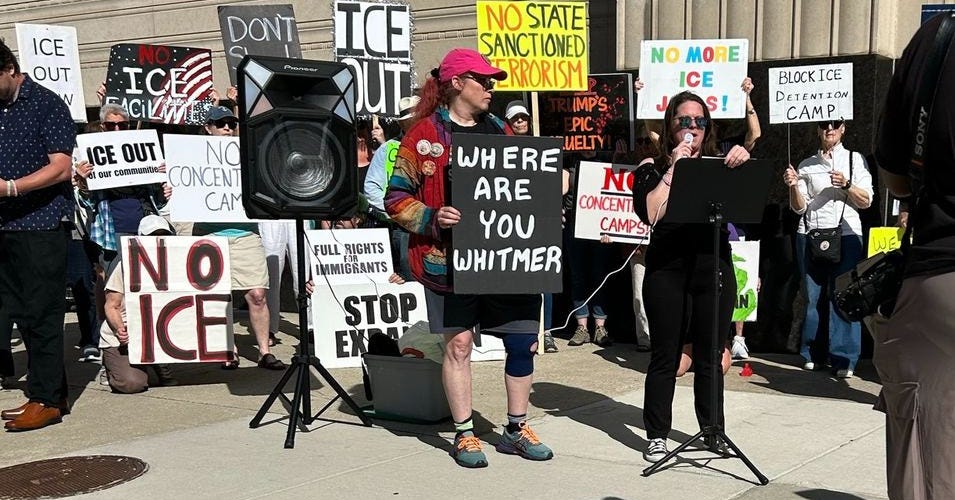
A motion hearing in Michigan’s federal lawsuit against a proposed immigration detention center in Romulus was canceled last Friday and rescheduled as a virtual proceeding for Wednesday, court records show — a development that did not stop a coalition of advocacy organizations from gathering Monday outside the Theodore Levin U.S. Courthouse in Detroit to press state and local officials to use regulatory and infrastructure authority to halt the project.
The coalition’s rally, organized by the Coalition to Shut the Camps alongside more than thirty partner organizations, came as State of Michigan, et al. v. DHS entered its third month in the Eastern District of Michigan.
The lawsuit, filed March 24 by Attorney General Dana Nessel and the City of Romulus, challenges the Department of Homeland Security’s $34.7 million acquisition of a 249,000-square-foot warehouse at 7525 Cogswell Street, contending that DHS purchased the site without conducting required environmental reviews or notifying state and local authorities in advance.
Federal environmental law generally requires agencies to assess the impact of a major action — purchasing a site, converting it, operating it — before they act, a step the state alleges DHS skipped entirely.
Instead, after buying the warehouse in February, the agency reached back into its own regulatory rulebook and stitched together three narrow internal exemptions covering routine property acquisition, minor facility upgrades, and limited operational changes, then declared that their combination absolved it of any review requirement. Nessel's reply brief calls this maneuver “Frankenstein's Exclusion.”
Federal courts have generally looked unfavorably on that approach. The Ninth Circuit Court of Appeals has held that stacking exemptions in this way would “swallow the protections of NEPA,” and a federal district court in Maryland, ruling on granting a preliminary injunction on a nearly identical DHS warehouse detention case, held that an agency cannot invoke an exemption after the fact — or during litigation — to paper over a review it never conducted.
DHS produced its environmental analysis on March 24, the same day Michigan filed suit. The agency had completed its acquisition seven weeks earlier.
In an April 21 sworn declaration filed as part of DHS’s defense of the lawsuit, Andrew J. DeGregorio, an Environmental Protection Specialist with ICE’s Office of Asset and Facilities Management, testified that the agency’s renovation plan called for housing up to 500 to 1,000 detainees at the site, with scalability to accommodate 2,000 — four times the 500-person figure the agency has repeated publicly. The declaration also confirms that any increase in utilities infrastructure, including water supply and wastewater capacity, would require coordination with local authorities.
“DHS cannot operate this facility by itself,” said Melody Simmons of the Coalition to Shut the Camps. “They put it in writing in their own court filings.”
The declaration further confirms that the categorical exclusion DHS used to exempt the warehouse purchase itself from environmental review is, in the agency’s own words, “a non-documented CATEX” — meaning no written analysis was required or produced to support it.
The central legal justification DHS offered for bypassing environmental review on a $34.7 million acquisition is one for which the agency kept no records.
Coalition speakers on Monday called on Governor Gretchen Whitmer, Wayne County Executive Warren Evans, the Great Lakes Water Authority Board, the Michigan Department of Environment, Great Lakes and Energy, and the City of Romulus to withhold the permits, water service, sewer connections, and infrastructure approvals the facility requires to open.
Organizers cited actions in Pennsylvania, where the governor directed his Department of Environmental Protection to block water and sewer service to ICE warehouse facilities, and Maryland, where the governor signed legislation and joined the state attorney general in obtaining a federal injunction halting construction, as examples of states that have used executive authority the coalition argues Whitmer has not.
“The federal lawsuit is a vital tool, advancing novel legal theories that buy this community time,” Simmons said. “It is not, by itself, sufficient to stop a determined federal agency from building a warehouse concentration camp in Romulus.”
On May 11, the ACLU of Michigan, the Michigan Immigrant Rights Center, and the Detroit Justice Center filed to join the case, expanding the legal coalition beyond the state and the city. Wednesday’s virtual hearing will be the first at which all three organizations appear as parties.
Ale Rojas of No Detention Centers in Michigan used Monday’s rally to connect the Romulus fight to conditions at an existing Michigan facility. Hundreds of people held at the GEO Group’s North Lake Processing Center in Baldwin recently undertook a multi-unit hunger strike, Rojas said, to protest inadequate medical care, insufficient food, and prolonged isolation — actions detainees took at risk to their own health despite threats of transfer to other facilities.
“They hoped we would listen to the message they sent — we are in pain, suffering, being killed, underfed, untreated, isolated, and our humanity is being ignored,” Rojas said. “Please do not look away.”
Keep track of the latest developments in the warehouse lawsuits in one convenient place at our Warehouse Litigation Tracker.
WAY TO GO “Coalition to Shut the Camps”….one of the strongest, most effective organizations on the planet!!!
Thank you, as usual, for your excellent reporting!