

Maryland House Passes Trio of Immigration Bills in Response to Federal Detention Push
Three emergency measures would set new limits on immigration detention in Maryland — and give residents the right to sue federal officers in state court.

Updated Feb. 27, 2026, 1:33 p.m. E.T.
This article was updated to include comments from Delegate Vaughn Stewart and Delegate Melissa Wells.
Responding to the Department of Homeland Security's move to establish a major immigration detention center in western Maryland, the state's House of Delegates passed three emergency bills Thursday that would restrict where detention facilities can operate, set mandatory standards for conditions inside them, and create a new legal avenue for holding federal officers accountable for civil rights violations.
The action came as a fourth bill in the package — one that would have barred the conversion of buildings not originally designed for detention — faced a scheduling delay that pushed its committee hearing to March 11, leaving little time before the legislature’s crossover deadline, after which bills that have not cleared their chamber of origin are effectively dead for the year.
But the setback proved less consequential than it might have been. When two of the bills emerged from committee, they had been substantially rewritten to absorb much of what the delayed measure was designed to accomplish.
The Backdrop
All three bills are a response to DHS’s $102 million purchase in January of an industrial warehouse in Washington County, just outside Hagerstown, which the agency intends to convert into a 1,500-bed immigration processing and detention center. The purchase was made with little public notice; local officials learned of it after the fact.
Washington County is part of Maryland’s 6th Congressional District. The county’s all-Republican Board of County Commissioners expressed support for the project while acknowledging it had no legal mechanism to stop it.
The Maryland facility is only one piece of a broader national expansion. As of mid-February, ICE was holding roughly 73,000 people in detention — an 84 percent increase from a year earlier and the highest level ever recorded by the agency.
The bills target private entities rather than the federal government directly. The federal government is generally not required to comply with local zoning law on property it owns outright — a constraint the bills’ sponsors acknowledged openly during committee hearings. What the state can do, they argued, is raise the floor: require zoning approval, set minimum standards for conditions and create legal accountability for what happens inside.
The Zoning and Standards Bills
HB 1017, sponsored by Del. Melissa Wells, a Baltimore Democrat who chairs the House’s Government, Labor and Elections Committee, would bar private entities from operating immigration detention facilities in Maryland without explicit zoning approval. The bill defines what counts as such a facility broadly enough to foreclose the most obvious workarounds: a facility qualifies regardless of how its use is described in any permit application, so long as it involves involuntary custody or physical features consistent with secure confinement, including perimeter security, controlled access points or locked holding areas. A general zoning classification for government or institutional uses, the bill specifies, does not constitute authorization.
That language does much of the work that HB 0630 was written to do. A retroactivity provision extends the bill’s reach further still, applying to agreements already entered into and explicitly overriding prior permits and prior investment — meaning private entities that have already begun construction toward a detention facility cannot use that work as a legal shield.
In a statement provided to Project Salt Box this morning, Ms. Wells said the bill reinforced principles already embedded in Maryland law. “House Bill 1017 reinforces longstanding zoning principles by making clear that private immigration detention facilities must comply with local land use requirements and public approval processes,” she said. “This legislation strengthens accountability while respecting the role of local governments in decisions that directly impact their communities.”
HB 1018 governs what happens once a facility is operating. It would require the Secretary of Public Safety and Correctional Services to adopt minimum mandatory standards for the care, custody and conditions of civil detainees, and empower the Maryland Commission on Correctional Standards to inspect facilities, receive anonymous violation reports and order closures.
An amendment toughened the closure provision significantly. Where the original bill said the commission “may” order the immediate cessation of operations upon finding a life-threatening or health-endangering condition, the final version says it “shall” — converting a discretionary power into a legal obligation. Emergency regulations must be adopted by June 1.
Both bills were passed as emergency measures, requiring a three-fifths supermajority. If passed in the senate, they would take effect immediately upon the governor’s signature. HB 1017 passed 98 to 36; HB 1018 passed 98 to 37.
“Our Community Cannot Handle the Burden”
The floor debate that preceded those votes cut across the usual partisan lines — and at times sounded less like an argument about immigration than about roads, water mains and hospital beds.
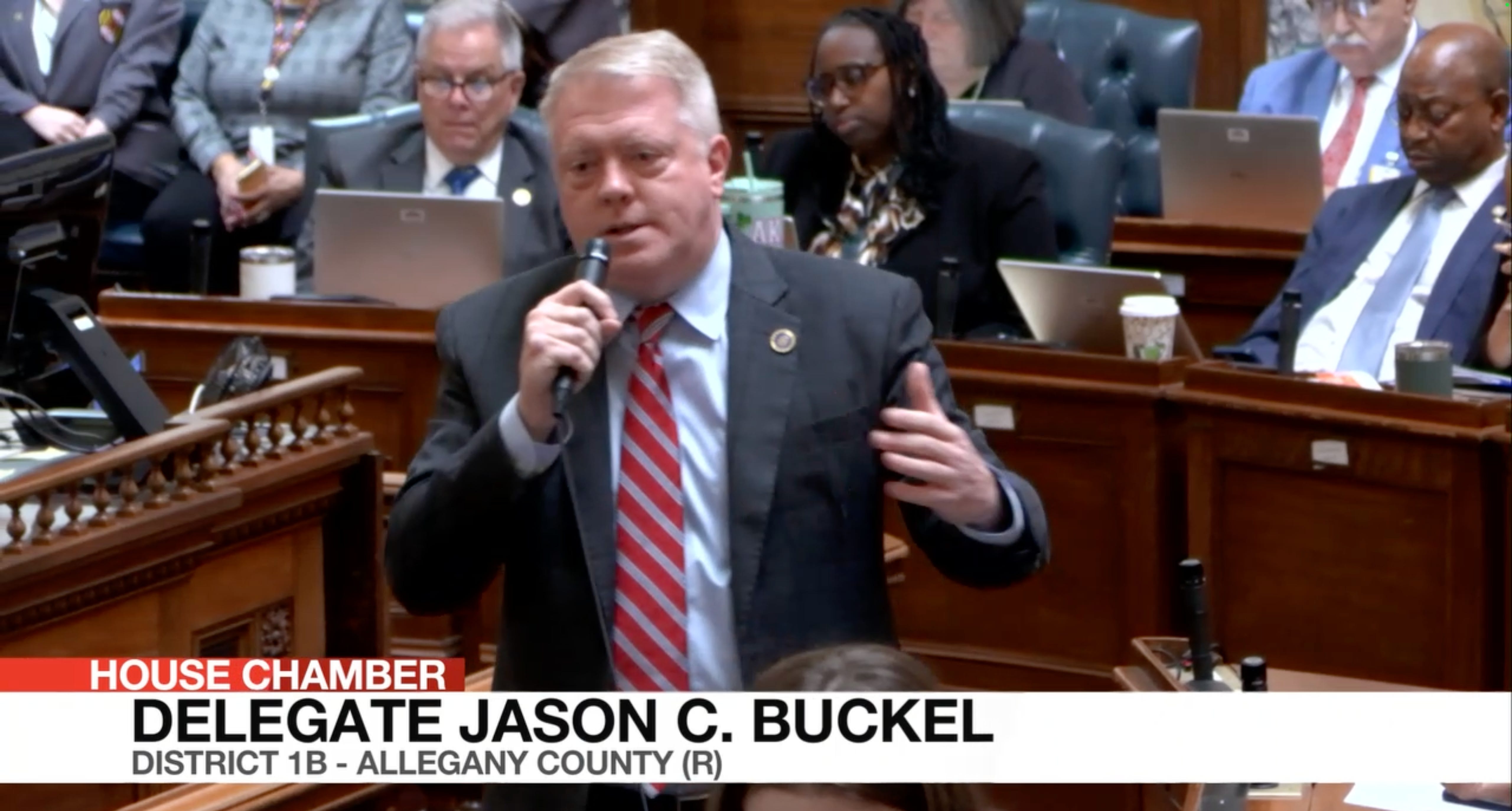
Del. Jason Buckel, a Republican from Allegany County, opposed HB 1017 on the grounds that a Maryland detention facility would benefit detainees by keeping them close to their families and lawyers. “We’ll construct a facility — a modern facility, a large facility — that’s not overcrowded, in Maryland, an hour or two away from individuals who may be swept up in immigration enforcement in Maryland,” Mr. Buckel said. “And what is the response of our General Assembly? ‘No.’”
Del. Vaughn Stewart, a Montgomery County Democrat who co-sponsored HB 1017 and separately sponsored HB 1018, sought to reframe the debate in fiscal rather than ideological terms. “This is a pocketbook bill,” Mr. Stewart said. “We’re protecting Marylanders’ pocketbooks because we’re ensuring failures inside a detention center don’t leave the fence line and become a problem for taxpayers and ratepayers.” He cited a recent letter from Senator Roger Wicker, Republican of Mississippi, to Homeland Security Secretary Kristi Noem, warning that detention facilities impose substantial infrastructure demands. “When facilities fail to meet certain standards,” Mr. Stewart said, “the consequences don’t end in the jail. They show up in our local ERs, our EMS response times, our utility bills, and in our county budgets.”
In an emailed statement provided to Project Salt Box after the vote, Mr. Stewart elaborated on the scope of HB 1018. “HB 1018 is a concrete response rooted in public safety and transparency,” he said. “It ensures that any facility physically operating within Maryland — whether local, private, or federal — is held to clear, enforceable health and safety standards so that taxpayers, first responders, and communities aren't left to shoulder the costs of unregulated operations. This legislation is not about immigration policy; it's about accountability, readiness, and preventing unsafe conditions from becoming public emergencies.”
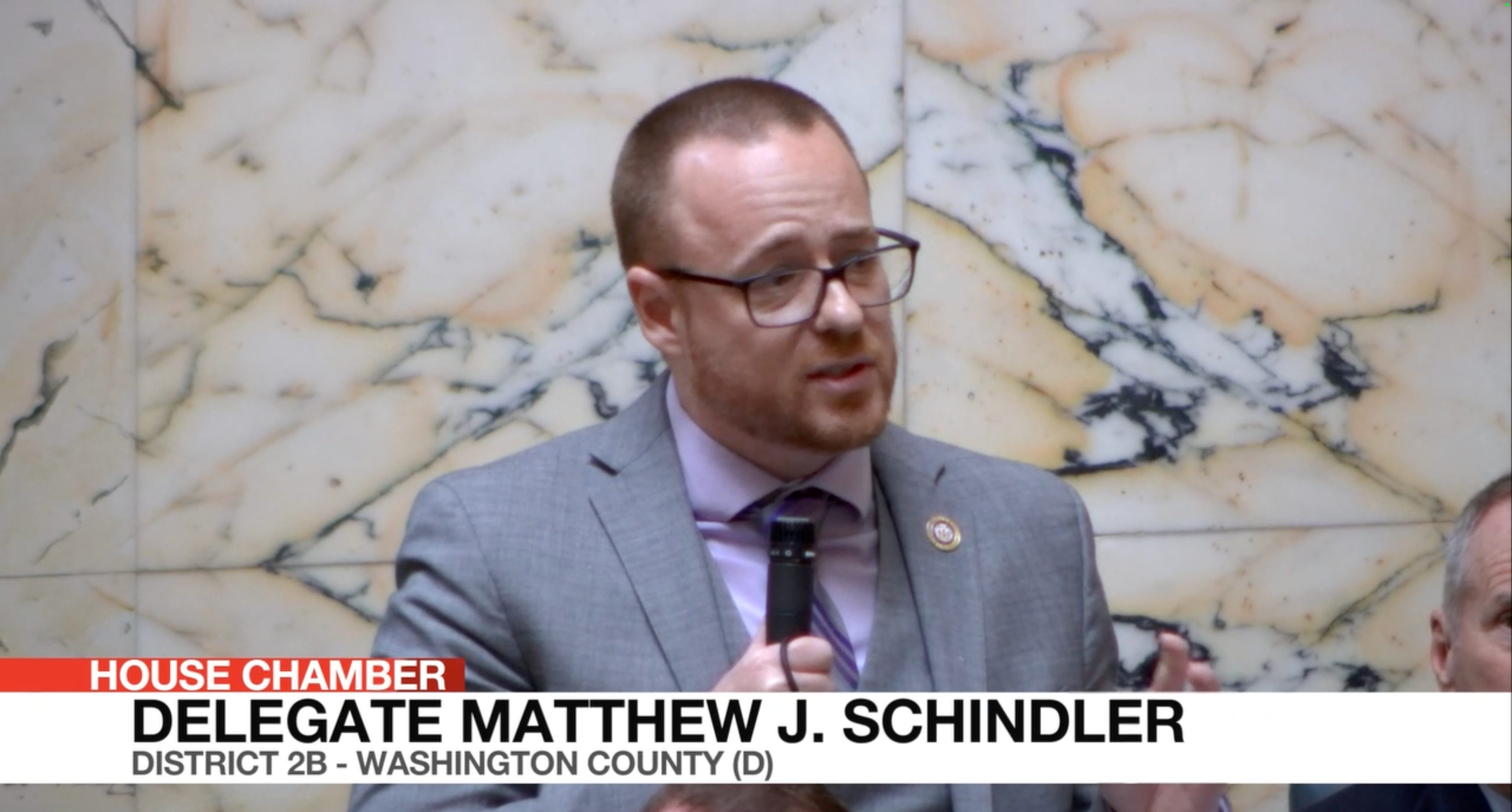
The most precise case came from Del. Matthew Schindler, a Democrat who represents Washington County, where the Williamsport facility is planned. Speaking during debate on HB 1018, Mr. Schindler offered a figure-by-figure accounting of what a 1,500-bed detention center would mean for a county whose infrastructure was built for nothing like it.
“This facility is expected to hold up to 1,500 people,” Mr. Schindler said. “The town of Williamsport, Maryland, has a population of 2,000 people.” He noted that Wright Road, where the warehouse was built, is a two-lane road that county officials estimate will require $1.5 million in improvements to handle the additional traffic.
Water presented an even starker gap: the warehouse is currently allocated the equivalent of roughly 800 to 900 gallons per day; the conservative estimate for the detention facility, he said, is 93,000 gallons a day.
He then turned to emergency services. Williamsport has no municipal fire, police or emergency medical services, relying instead on the county. The Washington County Sheriff’s Office has roughly 110 field officers covering the entire county around the clock. The nearest fire and EMS company — a volunteer unit — has eight EMTs and paramedics.
Meritus Medical Center, the county’s only hospital, has about 300 beds and operates at between 90 and 100 percent capacity, with emergency room wait times exceeding four hours.
“We have three state prisons in Washington County,” Mr. Schindler said, “and it sounds like we’ve got another one coming. Our community cannot handle the burden if we have a safety failure at one of these detention centers.”
A New Legal Tool for “Digital Unmasking”
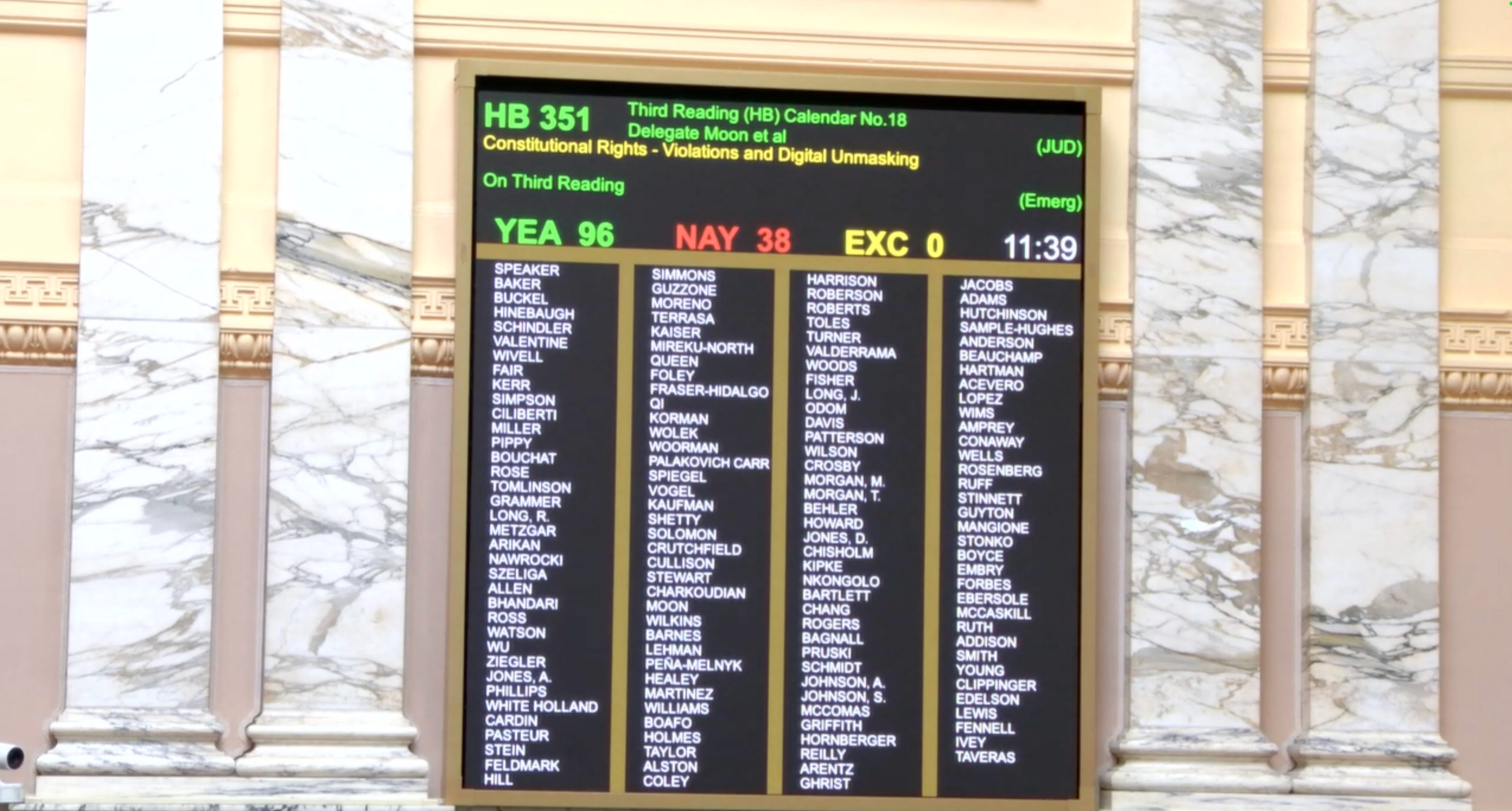
The third bill, HB 351, received less public attention than the other two but may prove the most legally significant of the three.
The legislation was drafted against a backdrop of documented civil rights complaints arising from federal immigration operations across the country. In Minneapolis, ICE agents shot and killed two American citizens within weeks of each other in January — Renee Nicole Good on Jan. 7 and Alex Pretti, a 37-year-old VA nurse, on Jan. 24 — in encounters that federal officials described as self-defense but that bystander videos appeared to contradict. The ACLU subsequently filed suit on behalf of six Minnesota residents whose constitutional rights, the organization alleged, were violated by ICE and federal agents during those operations. In one case, a 20-year-old American citizen was detained, shackled and fingerprinted before being released without charge after repeating “I’m a citizen” to masked agents who refused to examine his identification. In North Carolina, a class-action lawsuit was filed this week alleging that masked, armed DHS agents arrested and detained people across Charlotte, Durham and Raleigh without warrants or probable cause, in some cases breaking car windows and handcuffing people before releasing them without explanation.
All of those cases were pursued in federal court, under federal law. HB 351 would give Maryland residents an alternative: state court, under state law. Originally drafted as a narrow measure that would have allowed the attorney general to direct state police to gather identifying digital data about federal agents accused of misconduct, the bill was substantially rewritten before passage. The amended version creates an entirely new cause of action in Maryland courts: any person deprived of a right secured under the United States Constitution, the Maryland Declaration of Rights, or federal or state law by a federal officer acting under color of law may now sue in state court. The attorney general may bring the same action on a plaintiff’s behalf.
The bill defines its targets as “judicial officers” — federal law enforcement officers authorized to make arrests and carry firearms — a category that encompasses ICE agents, among others. Defendants may raise immunity defenses, but the bill establishes the cause of action and leaves those questions to be resolved in court.
The legislature added an explicit severability clause, a sign that legal challenge is expected. If any provision is struck down, the rest of the bill is designed to remain in force.
HB 0630, the delayed fourth bill, remains in committee. Whether its March 11 hearing leaves enough runway to reach crossover — and whether, given the amended language now in HB 1017, there is sufficient reason to press forward with it — is a question legislators and advocates are now weighing.
The bills now move to the Senate.
Republican senators are urging the Justice Department to release all Jeffrey Epstein-related files that mention President Trump, warning that withholding FBI interview memos about a woman’s past allegations against Trump would contradict the Epstein Files Transparency Act and fuel suspicions of a coverup.