

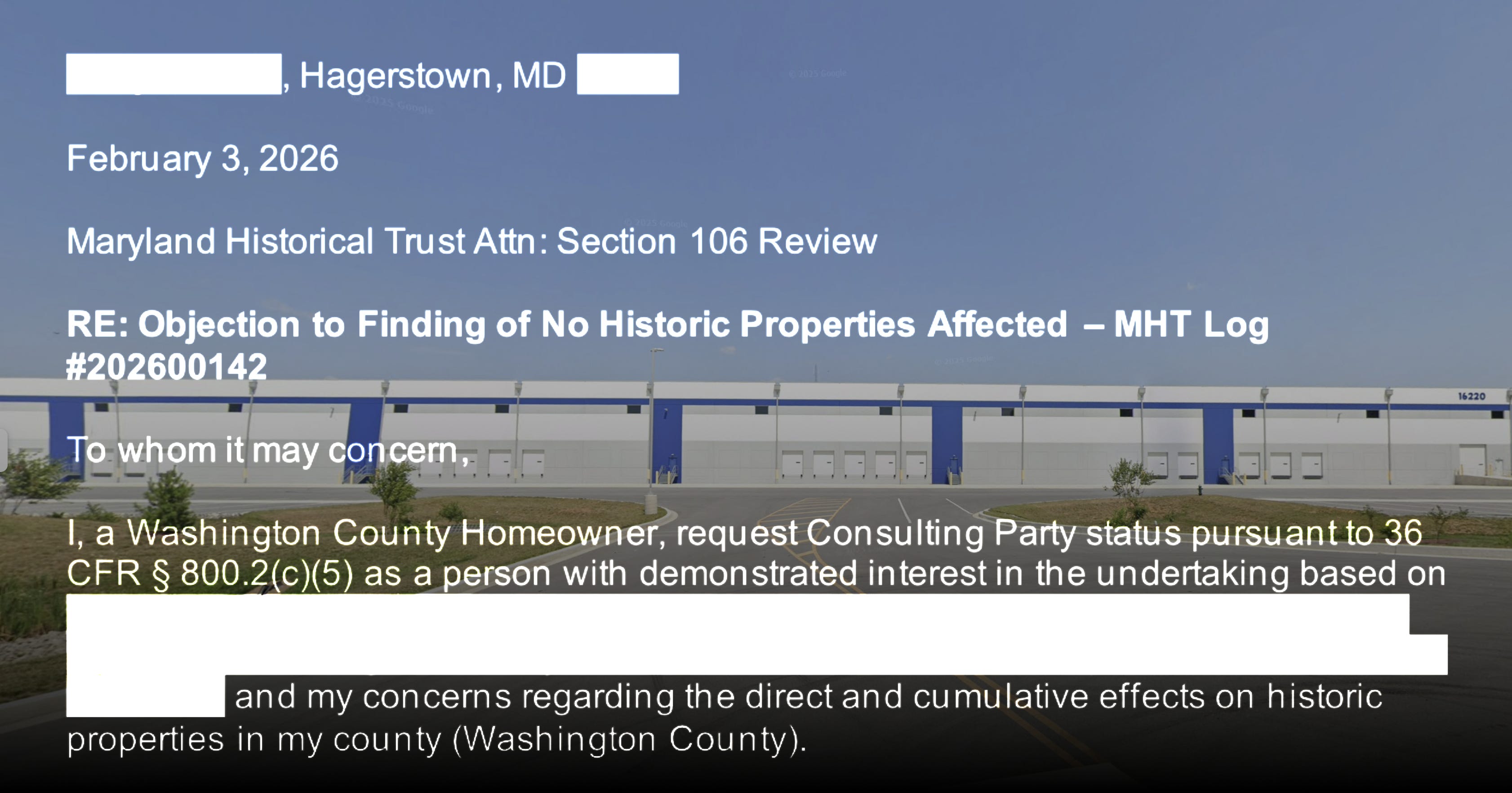
A Hagerstown resident has filed a formal challenge to a planned federal immigration detention facility, alleging the government used the wrong address during its review — a discrepancy the objector says exposed how the facility was established without the public consultation process federal law requires.
The Feb. 3 objection, obtained anonymously by Project Salt Box, was filed with the Maryland Historical Trust by a local resident whose name was redacted. More than disputing a clerical error, the filing highlights what the objector describes as a fundamental breakdown in how federal projects are supposed to engage with affected communities.

What Federal Law Requires
Under Section 106 of the National Historic Preservation Act, federal agencies planning projects that could affect historic properties are required to follow specific steps designed to ensure transparency and community input.
According to the law, agencies must accurately identify the project site and assess potential impacts on historic properties. They must publicly announce their plans with accurate information, giving the community time to review what is being proposed.
The law then requires a consultation phase: agencies must provide time for public comment and formally respond to those comments. Throughout the process, community members have the right to request “consulting party” status — which the law allows to give them a formal role in the review rather than limiting them to passive comment periods.
What the Objector Says Happened
According to the objection, nearly every step of this process appears to have been bypassed or mishandled in Hagerstown.
On Jan. 12, the Department of Homeland Security sent a consultation letter to the Maryland Historical Trust identifying the planned facility as 10900 Hopewell Road. Four days later, the department purchased the property — but the deed listed it as 16220 Wright Road, which the objector says is a different legal parcel with different historic designations and deed restrictions.
The objector alleges that by using the Hopewell Road address, the department issued a finding of “No Historic Properties Affected” and closed the review without public announcement, consultation or opportunity for residents to request consulting party status or raise concerns.
Project Salt Box broke the story that the warehouse had been purchased by DHS on Jan. 27. The facility was not publicly disclosed until Jan. 28 — after the property was purchased and the review was complete. By the time the community learned about the facility, the objector argues, the required consultation process had already been declared finished.
A Timeline of Preparations
The objection also points to infrastructure preparations that began months before the facility was disclosed, raising questions about when planning began and why the community was not informed.
In May 2025, Washington County approved land acquisitions for the Wright Road Relocation, a road project that would serve the warehouse corridor. That same month, the county’s Transit Development Plan identified the warehouse address as a site expected to generate high volumes of vehicle traffic — a designation typically reserved for major industrial operations.
In August 2025, as Project Salt Box previously reported, the warehouse owner refinanced the property and extracted $15.9 million in cash — a common move when sellers anticipate a buyer.
In December 2025, the county awarded a $7.73 million contract for tactical village expansion at the Public Safety Training Center. While the training facility is connected to the warehouse by the Wright Road corridor, the center has been in development since 2019 as part of a separate, long-term county project.
The objection notes that all of this activity occurred before the public knew a federal detention facility was planned — and before the community had any opportunity to participate in the review process that federal law is designed to guarantee.
How Federal Ownership Sidestepped State Law
The timeline matters in part because Maryland has its own protections designed to ensure community input on detention facilities.
Under Maryland’s Dignity Not Detention Act, enacted in 2021, local jurisdictions are prohibited from entering into new contracts with ICE or private companies to house federal detainees. The law also requires 180 days’ notice and public meetings before detention facilities can open.
But the law governs agreements and contracts, not ownership. By purchasing the property outright rather than leasing it or contracting with the county, the department created what amounts to a sovereign enclave, allowing it to claim immunity from local zoning and notice requirements that would apply to private facilities.
County officials have said they were not consulted about the facility’s conversion.
An Opening for Community Voice
If the Maryland Historical Trust determines that the address error invalidated the initial review, federal regulations would allow it to require a new consultation process — one that would mandate public engagement and give local residents, advocacy groups and elected officials an opportunity to raise concerns about the facility’s impact on the community and historic landscape.
While this would not subject the facility to Maryland’s specific 180-day notice requirement — which applies to private detention facilities seeking local permits, not federal property — federal preservation law would require structured community input. Courts have ruled that executive orders cannot waive these requirements — agencies must follow the consultation process Congress established, regardless of project priorities or claims of sovereign immunity.
Under federal regulations, when agencies do not follow required procedures, community members have the right to object and request that the process be conducted properly. The objection letter argues that is exactly what needs to happen in Hagerstown.
The filing also opens the door for other residents to submit similar objections or request consulting party status under federal law, potentially amplifying pressure on the Maryland Historical Trust to conduct a more comprehensive review.
We Want to Hear From You
Do you live in Washington County? Are you a local resident impacted by the purchase of this ICE warehouse? We want to hear from you. Click below to tell us your story.
You guys are missing something critical. The transit Infrastructure for this was approved in MAY 2025. There had to be official hearings on submissions before MAY 2025. COUNTY OFFICIALS were in on the plans in the spring of 2025. Residents of the county need to investigate that. The ownership change is important, but the issue is, collusion of the county board, to bypass Maryland law.
Paragraph from the reporting above:
"In May 2025, Washington County approved land acquisitions for the Wright Road Relocation, a road project that would serve the warehouse corridor. That same month, the county’s Transit Development Plan identified the warehouse address as a site expected to generate high volumes of vehicle traffic — a designation typically reserved for major industrial operations."
I'm very interested in the original company who "owned" the property and how they got around so many historical restrictions in the first place over on that location. When I explained where it was to most of my co-workers who are from here the first words outta their mouths was "Over by Van Lear?!" And that should raise a lot of eyebrows because of just how historical most of that area and a wide swathe of this county is. I'm not originally from here but I've lived here for nearly 20yrs. I know just how persnickity the historical land people are.