

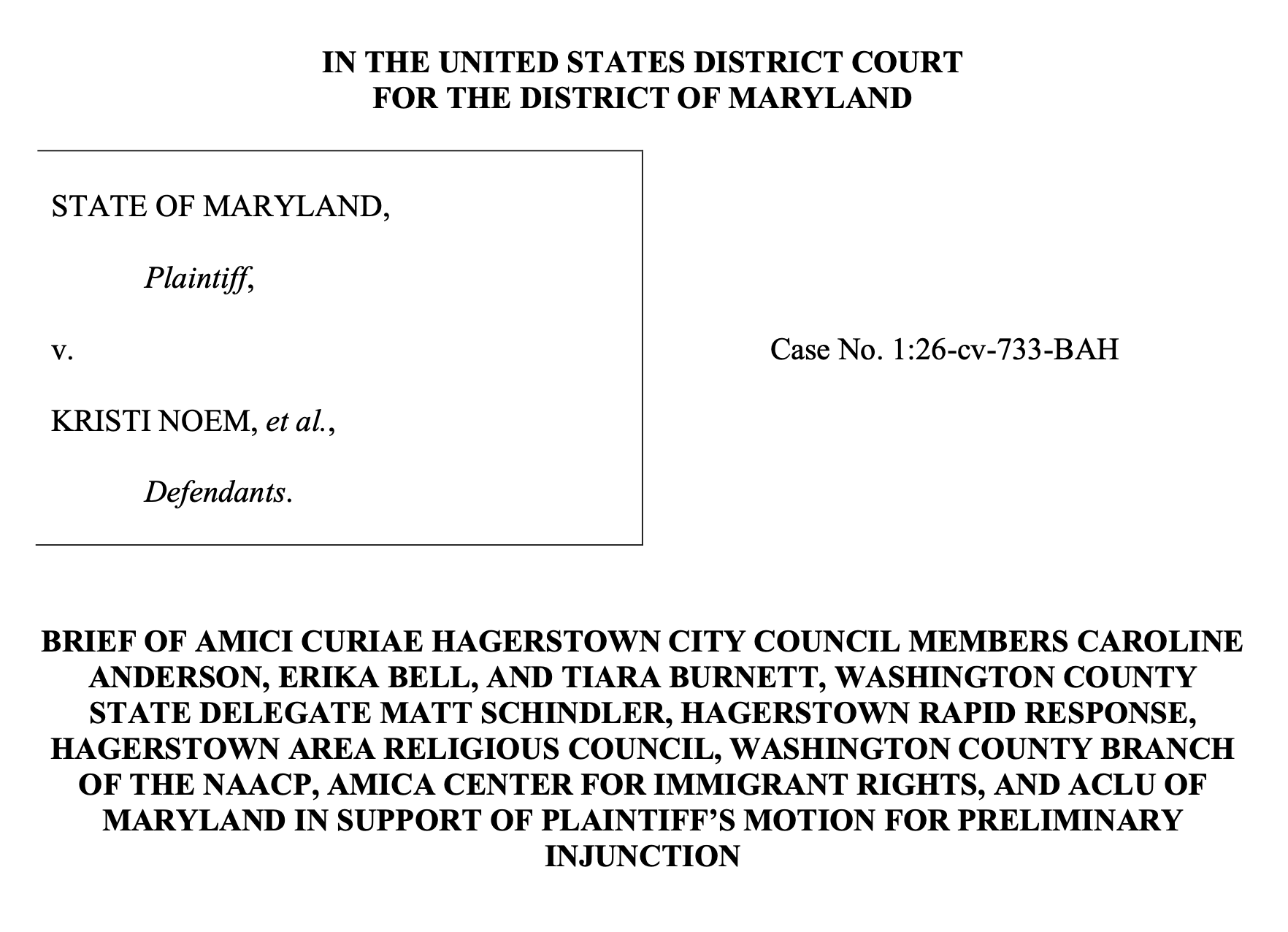
A new amicus brief in Maryland’s lawsuit over the planned ICE detention center in Washington County offers an account of what the Williamsport project means for the people who have to live with it. The filing comes from Hagerstown City Councilmembers Caroline Anderson, Erika Bell, and Tiara Burnett; Washington County Delegate Matt Schindler; Hagerstown Rapid Response; the Hagerstown Area Religious Council (HARC); the Washington County NAACP branch; the Amica Center for Immigrant Rights; and the ACLU of Maryland. The brief also includes an exhibit from more than 50 local doctors and nurses and a declaration from HARC’s executive director on health and community impacts.

DHS bypassed NEPA, leaving locals in the dark
The brief’s first section addresses one of the core issues with the Williamsport site. DHS moved to convert an 825,620‑square‑foot warehouse into a regional ICE processing center without a meaningful National Environmental Policy Act (NEPA) review. Amici tell the court that there are still no public plans for the inside of the facility, no public explanation of how the warehouse will be rebuilt from a low‑occupancy logistics space into a high‑turnover detention center, and no operations plan that answers basic questions about sewage, stormwater, emergency services, or lighting.
In the absence of any substantive plans, local officials and residents have been left to piece together DHS’s intentions using a national Detention Reengineering Initiative document and a bare‑bones floodplain notice, which describe Williamsport as a regional processing center for up to 1,500 people at a time, cycling through in three‑ to seven‑day stays. The brief points out that even that number could be low, citing the Social Circle, Georgia proposal, where similar warehouse square footage is tied to projected populations of 7,500 to 10,000 people. Amici frame this as the kind of opaque, high‑impact decision‑making NEPA is meant to stop: building out detention capacity first and only confronting the consequences for surrounding communities after the fact.
A warehouse‑turned‑detention hub will overwhelm local infrastructure
The second major theme of the brief focuses on the lack of infrastructure in the region to support a large-scale detention center. Amici warn about the strain a detention center would put on local water infrastructure. According to the brief, DHS plans to move an estimated 78,000 to 182,500 people through the site each year, even though Hagerstown’s 1928‑era water plant is already fragile and operating at maximum pressure, with less than a day of backup supply if the plant fails. The warehouse’s current allocation is 800 gallons per day, while city staff estimate the detention center would need 75,000–150,000 gallons daily—at least 100 times more—and DHS has not applied for additional water allocation.
The brief also highlights how the project may impact Williamsport’s effort to brand itself as a small tourism town built around its history and the C&O Canal. The mayor reports that existing and prospective businesses are already asking whether they should stay or come at all, and warns the facility “is going to hurt the town’s efforts for years to come.”
Separately, I‑81 and I‑70 are already overburdened, with widening of I‑81 not scheduled until 2027. Detention traffic, including buses, vans, and staff vehicles, will worsen congestion, air quality, and crash risk and could strain the small regional airport that serves the area.
Health care, EMS, and mental health systems are already at capacity
The brief includes an open letter from Washington County health care providers that walks through patterns already documented at existing ICE facilities. In the letter, the providers cite DHS’s inspector general, who in 2024 found broad noncompliance with medical care and environmental health standards at existing detention centers, including chronic sanitation problems in bathrooms and housing units. They argue that as the detained population has nearly doubled, overcrowding, food quality, temperature control, and access to sinks and toilets have deteriorated further, with some facilities reporting overflowing toilets and floors flooded with feces‑ and urine‑contaminated water. Local clinicians warn that ICE facilities generate heavy EMS and 911 call volumes, which in Washington County would fall on just eight volunteer paramedics and an ER that already struggles with wait times. They emphasize that a 1,500‑bed site will strain an already overextended system and put both detained people and county residents at risk.
Putting the whole story in front of the court
Maryland’s lawsuit has focused on DHS’s use of warehouse conversions and fast‑track contracting to rapidly build out detention space, the agency’s efforts to sidestep NEPA and local land‑use processes, and growing resistance from local communities.
This brief pulls those issues into a single record for the judge, using DHS planning documents and floodplain notices alongside evidence from Williamsport and other detention hubs to show how a seemingly technical “reuse” decision impacts local infrastructure, planning, and civil rights issues. Amici tell the court that unless construction is paused now, the project will move ahead without the environmental review and public input NEPA requires, locking in a detention center with harmful impacts that cannot be undone.
We love your writing, Em!
Thank you for keeping us all informed. Again, this is almost deja vu of what we are experiencing here in Roxbury NJ. We also have the old Morris canal historical preserved land right next to the building.
I will certainly pass this along to our Governor. 💪