

ICE Moves to Bypass New Mexico Law and Keep Detention Centers Open
The federal government is seeking a direct contract with CoreCivic, a private prison company, that would render the state's new ban on immigration detention largely moot.

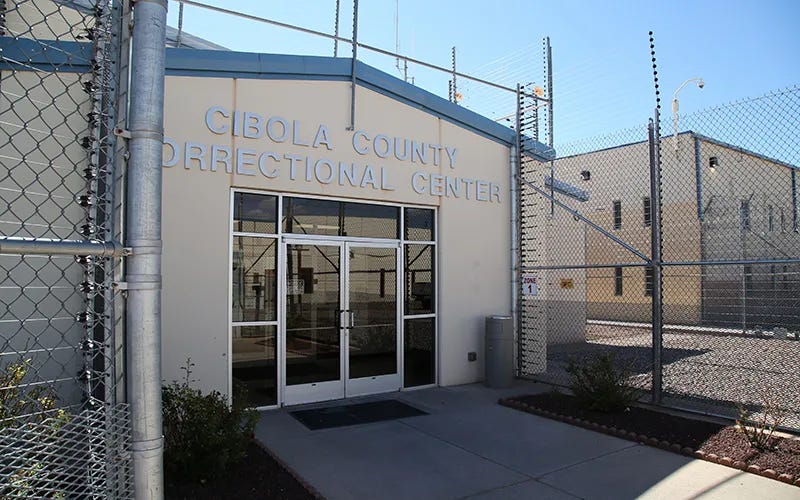
The Trump administration has moved to keep two immigration detention centers in New Mexico operating under federal control, according to a notice posted this week on a government contracting website — a maneuver that would effectively nullify a state law passed last month to shut them down.
The notice, which appeared on SAM.gov, announces the government’s intent to award a two-year contract directly to CoreCivic, the Nashville-based private prison company that already operates both facilities, bypassing the county governments that have served as intermediaries for years. The two centers — the Cibola County Correctional Center in Milan and the Torrance County Detention Facility in Estancia — together hold up to 1,955 detainees.
New Mexico’s Immigrant Safety Act, signed by Gov. Michelle Lujan Grisham on Feb. 5, bars state and local governments from contracting with federal immigration authorities to detain people on civil charges. It takes effect May 20. But the law was written to restrict what local governments may do — not what the federal government may do — and that distinction appears to be exactly what immigration authorities are now moving to fill.
“It allows them to skirt federal procurement processes,” Ian Philabaum, director of legal organizing at the Innovation Law Lab, told The Santa Fe New Mexican in February, describing the intergovernmental arrangements ICE has historically used in New Mexico. Those arrangements — in which ICE pays counties, which then pass the money to CoreCivic — allowed the agency to avoid the competitive bidding and oversight requirements that direct federal contracts carry.
The proposed contract would eliminate the county middlemen entirely.
A System Under Strain
The Torrance County contract expired in October without public explanation, leaving the facility in legal limbo for months. On Dec. 30, the three-member Torrance County Commission held a special meeting — convened between Christmas and New Year’s Day — and voted to extend the contract, backdating it to Nov. 1.
The county had posted notice of the meeting in a local newspaper just one day before it convened, rather than the 72 hours required under state law, and the New Mexico attorney general’s office concluded in a January letter that the session was “likely improper and invalid.” The county re-approved the contract a second time in February — the morning after the State Senate voted to ban such agreements — this time, commissioners said, on the advice of legal counsel.
ICE did not respond to questions about its plans during that period, and has not commented on this week’s notice.
The Federal Workaround
Nothing in New Mexico’s law prevents CoreCivic from contracting with ICE directly. Ryan Schwebach, the Torrance County Commission chair, said in January that he believed a direct federal contract was the most likely outcome even before the law passed. This week’s notice suggests he was right.
A third facility — the Otero County Processing Center, near Chaparral — does not have the same escape route. Because the county owns the land and building, there is no private operator for the federal government to contract with directly; when the ban takes effect, it is expected to close. When similar facilities have shut down in other states, detainees have generally been transferred to other ICE detention centers, sometimes hundreds of miles away.
The conditions at all three New Mexico facilities have been the subject of sustained criticism. The Innovation Law Lab, which has provided legal support to detainees at the centers since 2019, has documented allegations of inadequate medical care, plumbing failures and retaliation against detainees who spoke out. More than 1,500 people are currently held across the three facilities, according to Source New Mexico, many of them asylum seekers.
The deadline for other companies to challenge the sole-source designation — and argue that they, too, could operate the facilities — passed on March 13, three days before the notice gained wider attention. The government is under no obligation to hold a competitive bidding process.
For the more than 1,500 people currently held across the three facilities, the outcome of the contract fight will determine where — and whether — they remain detained.
Governor Lujan Grisham’s office did not respond to a request for comment. CoreCivic did not respond to a request for comment.
I continue to believe that for state-level action, we need to be supplementing the big swings with measures on clear legal grounds that don't go as far but serve as a deterrent, such as the detention camp profits tax: https://susanrogan.substack.com/p/private-prison-companies-are-getting?utm_source=publication-search
I watch SAM.gov every day for the Moshannon Valley Contract . The deadline for other companies to challenge the sole-source designation — and argue that they, too, could operate the facilities — passed on March 13. I would swear this was only posted in the last 48 hours. Something stinks about this more than just the fast track approach.