

ICE Detained a US Citizen in Maryland. They Moved Her to Louisiana Despite Court Orders.
The Maryland-born woman disappeared from the agency's tracking system for two days, then was transferred 1,000 miles after a federal judge ordered she remain in state

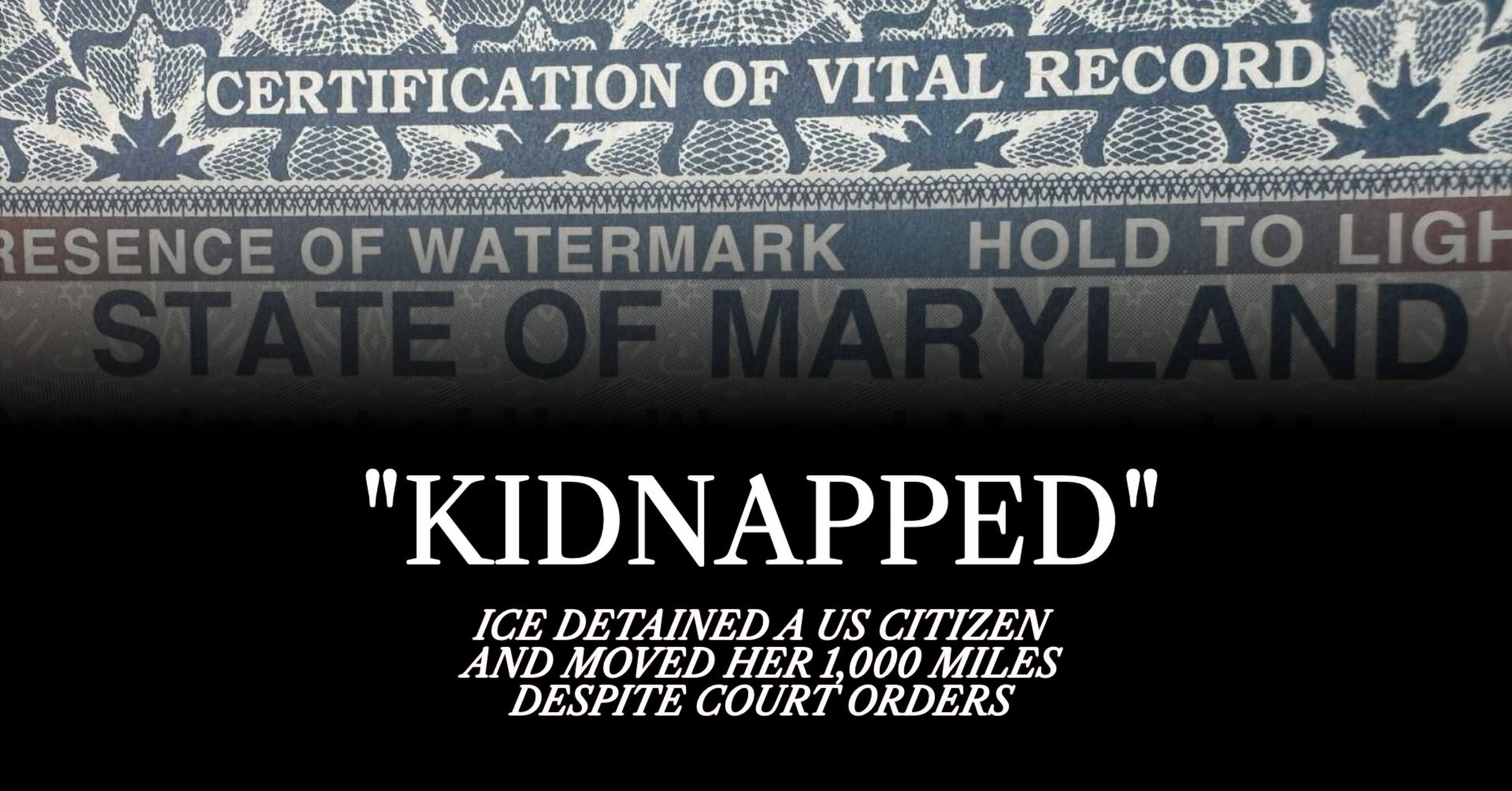
A Maryland-born woman detained by Immigration and Customs Enforcement disappeared from the agency’s tracking system for two days, then was transferred to Louisiana the morning after a federal court ordered she remain in Maryland—despite her attorneys presenting her birth certificate as proof of U.S. citizenship.
ICE told her lawyers the birth certificate wasn’t authentic.
The case parallels a detention days earlier in Minneapolis, where federal agents tackled a 20-year-old U.S. citizen during his lunch break and held him for hours—ignoring his repeated assertions of citizenship and offers to show his passport.
In both cases, ICE detained U.S. citizens first and verified their status later, if at all. The pattern raises questions about how the agency’s massively expanded transportation network—powered by $59 billion in new federal funding—enables it to move people so rapidly that neither courts nor families can track them.
‘First proof of life.’
The woman, whose identity is being withheld for safety reasons while she remains detained, called her parents on December 14 to tell them she had been arrested and was being held at ICE’s Baltimore Field Office at 31 Hopkins Plaza.
Her parents immediately retained Sanabria & Associates, a Silver Spring immigration law firm. When attorneys tried to locate her in ICE’s online detainee locator system, she wasn’t there. For two days, there was no record she existed in federal custody. The family had no proof their daughter was alive.
The woman told her parents she was being moved to “LA.” Her family thought she meant Los Angeles.
On December 16, Sanabria filed a habeas corpus petition with the U.S. District Court for the District of Maryland.
Habeas corpus is a constitutional protection that allows people to challenge unlawful detention and requires the government to justify why someone is being held. The court approved the petition.
An attorney from the firm's Baltimore office then took her Maryland birth certificate and other documentation proving U.S. citizenship directly to the Baltimore Field Office.
According to Zachary Perez, an immigration attorney with Sanabria who spoke with Project Salt Box, an ICE representative told the firm they did not believe the documentation was authentic and that the facts did not match what was in their system.
When the attorneys asked where their client was physically located, the ICE officer made them wait six hours. Finally, the officer confirmed she had been moved at 6 a.m. on December 17—the morning after the court ordered she remain in Maryland, and three days after her initial detention, exceeding Maryland’s legal framework for how long ICE can hold someone.
Not to Los Angeles. To Louisiana.
Their first proof of life came when she finally appeared in ICE’s detainee locator system on the 17th—in Louisiana.
The timeline matters. ICE’s longstanding policy limited hold room detention to 12 hours, but in June, the agency issued a nationwide memo extending all hold rooms to 72 hours, excluding “exceptional circumstances.” She was moved at 6 a.m. on December 17—exactly 72 hours later, right as that expanded window was closing. Rather than release her or formally transfer her to a detention facility as policy requires, ICE moved her out of state.
Perez questions the convenience of that timing.
“Our client was kidnapped,” Perez said. The case exemplifies ICE’s approach of “detaining first, asking questions later,” he warned, adding: “You are legal until the government tells you otherwise.”
Attorney Victoria Slatten first shared the case on TikTok.

 Tiktok failed to load.
Enable 3rd party cookies or use another browser
‘I Feel Like I Was Getting Kidnapped’
In Minneapolis on December 10, federal agents chased Mubashir—a 20-year-old U.S. citizen who asked to be identified only by his first name—tackled him, and placed him in a chokehold.
“The agent never identified himself, didn’t say ‘ICE, stop.’ I feel like I was getting assaulted, I was getting kidnapped,” Mubashir said at a press conference the following day.
Mubashir said he repeatedly told officers he was a U.S. citizen and asked to show his identification, but was ignored. After officers saw his passport hours later and became convinced he was a U.S. citizen, they told him he was free to go.
At least two other Somali residents of Minneapolis were arrested by federal immigration officers the same day and later released because they are also U.S. citizens, according to the Minnesota chapter of the Council on American-Islamic Relations.
The following day, another U.S. citizen—a Somali woman born in Edina, Minnesota—was arrested near Nicollet Mall in downtown Minneapolis, zip-tied, and taken to Sherburne County Jail in Elk River. She was held for over 24 hours before being released after officials verified her citizenship.
The arrests occurred during Operation Metro Surge, an ICE enforcement operation in the Twin Cities that the Department of Homeland Security said targets individuals with final deportation orders and criminal records. Governor Tim Walz sent a letter to Homeland Security Secretary Kristi Noem on December 11 expressing concern about the arrests and urging a review of due process protections.
Following the Money
The ability to move detainees across state lines within hours is the result of deliberate expansion of ICE’s detention and transportation capacity.
A budget bill passed earlier this year provides ICE with $45 billion for new detention centers and $14 billion for deportation operations. The funding adds 10,000 new ICE detention officers, creates 50,000 or more detention beds, and adds fleets of buses and vans to the nation’s detention and removal operations.
The Brennan Center for Justice analyzed the recent legislation and concluded it “funds a giant immigration detention apparatus that would likely be difficult to dismantle under future presidents.”
GEO Group’s transportation subsidiary, GTI, is the largest provider of ground and air transportation for ICE. The company expects increased removal flights to produce an additional $40 million to $50 million in annual revenue. New contracts worth approximately $100 million each have been issued for detainee custody and transportation services in regions including San Diego and San Francisco.
This network allowed ICE to move the Maryland woman rapidly—within 24 hours of a court order requiring she remain in the state.
Nearly 90 percent of people in ICE custody are held in facilities run by for-profit firms. In May, CoreCivic’s CEO told investors the company had never seen such demand for its services in its 42-year history.
Rapid Transfers Create Legal Challenges
The legal implications are stark. Habeas corpus petitions—the constitutional mechanism for challenging unlawful detention—must generally be filed in the district where someone is detained.
When ICE moves detainees between districts, their attorneys face a choice: litigate in multiple jurisdictions simultaneously or withdraw from representation. If the attorney cannot discover where the client has been moved, representation becomes impossible.
In a July ruling, a Fourth Circuit panel found that moving detainees without notice reduces habeas corpus to “a game of jurisdictional hide-and-seek.” The court denied the government’s request to transfer a case after ICE moved a detainee from Virginia to an undisclosed location, finding that such transfers undermine the fundamental purpose of the writ.
By the time an attorney files a motion regarding a violated court order and a court holds a hearing, the detainee may be hundreds or thousands of miles away. The practical remedy for contempt of court becomes moot.
For families, interstate transfers sever the ability to visit, make phone calls more expensive, and compound the trauma of separation with geographic distance.
Birth Certificates Dismissed as Fake
Both the Maryland and Minnesota cases raise questions about how ICE verifies citizenship claims—questions that have become more urgent as the Trump administration seeks to redefine who qualifies as a U.S. citizen.
On his first day in office in January 2025, President Trump signed an executive order attempting to end birthright citizenship for children born to parents who are not U.S. citizens or lawful permanent residents—despite the 14th Amendment’s guarantee that “all persons born or naturalized in the United States” are citizens. Multiple federal courts have blocked the order as unconstitutional. The Supreme Court has not yet announced a specific date for a final ruling on the birthright citizenship executive order.
The Maryland woman’s detention nearly a year after the executive order was signed illustrates how the administration's broader assault on birthright citizenship translates into practice when ICE agents question citizenship documentation. In Maryland, ICE told Sanabria they did not believe the woman's birth certificate was authentic, despite it being an official state document. In Minneapolis, Mubashir repeatedly told officers he was a U.S. citizen and asked to show his passport. They ignored him for hours.
“ICE doesn’t have jurisdiction over United States citizens. So, for them to detain a U.S. citizen for over 24 hours at a detention facility for no reason is truly terrifying,” said Evangeline Dhawan-Maloney, an immigration attorney in Golden Valley, Minnesota.
Almost 58 percent of Somalis in Minnesota were born in the United States, and of the foreign-born Somalis in the state, 87 percent are naturalized U.S. citizens, according to Census data.
Congressional members have called for investigations into reports of U.S. citizens being wrongfully detained and deported.
The Maryland-born woman remains in Louisiana. Her attorneys continue working her case across state lines—navigating a system where proof of citizenship can be dismissed as inauthentic, where detainees vanish from tracking systems, and where a court order to keep someone in Maryland can be rendered meaningless by a 6 a.m. transfer to a facility more than 1,000 miles away.