

Update, Tuesday, Sept. 29
Federal immigration authorities bought four robot dogs that can listen for movement inside buildings and help tactical teams look into hard-to-reach spaces, according to a government document explaining why the purchase was made without competitive bidding.

The document, posted to SAM.gov on Tuesday, shows ICE paid $110,200 for each robot package. The order also covers four robotic arms, four thermal zoom cameras, four radio kits and training for officers. With training and shipping, the total comes to about $326,000 per robot.
According to the document, the robots will support ICE’s Special Response Teams, including in dark settings where officers use night vision equipment. It says the robot’s microphone can pick up movement so the operator can alert the team “to the presence of a subject.” The robot’s arm can reach 5½ feet to see on top of closets, bunk beds and some crawl spaces, the document says.
The package also includes a two-way communication system that the document describes as being for de-escalation.
The document ties the purchase to the Subterranean Border Defense Act, a law on efforts against cross-border smuggling tunnels, and to President Donald Trump’s executive order titled “Protecting the American People Against Invasion.”
It says the robots will carry an oxygen sensor to check whether the air in tunnels is safe to breathe.
The document says the robots are also meant to detect radiation, toxic gas leaks and explosives. However, it describes RADeCO’s Blackstone detection software as optional and does not list it among the items purchased.
ICE posted a notice seeking potential vendors on Aug. 28, and two companies responded. The agency rejected GovTRobotics, which offered a standard Boston Dynamics Spot with an arm. The document says that offer did not meet ICE’s specifications and that GovTRobotics was not an authorized Boston Dynamics reseller.
This story has been updated to clarify that although ICE did not post a public solicitation for the order, it did post a notice on SAM.gov on Aug. 28 seeking potential vendors. Two companies responded, but ICE still awarded the order to RADeCO as a sole-source purchase without competitive bidding.
The document ties the purchase to the Subterranean Border Defense Act, a law on efforts against cross-border smuggling tunnels, and to President Trump’s executive order “Protecting the American People Against Invasion.” It says the robots will carry an oxygen sensor to check whether the air in tunnels is safe to breathe. The document also says the robots are meant to detect radiation, toxic gas leaks and explosives, but it describes RADeCO’s Blackstone detection software as optional and does not list it among the items purchased.
ICE posted a notice seeking potential vendors on Aug. 28, and two companies responded. The agency rejected the other bidder, GovTRobotics, which offered a standard Boston Dynamics Spot with an arm. According to the document, that offer did not meet ICE’s specifications, and the company was not an authorized Boston Dynamics reseller.
Federal immigration authorities have bought $1.3 million worth of robot dogs from a Connecticut company, according to a federal contract record reviewed by Project Salt Box Monday. The purchase comes a month after the agency disclosed plans to buy the machines.
Immigration and Customs Enforcement signed the $1,304,296 purchase order on Friday with RADeCO Inc. of Plainfield, Conn., an authorized distributor and industry partner of Boston Dynamics.
The order, which runs until Nov. 24, covers “Cerberus Spot quadruped robots and accessories” for the agency’s Office of Firearms and Tactical Programs, according to the record.
RADeCO sells the Cerberus as a customized version of the Boston Dynamics Spot robot and describes it as a fully integrated platform for explosive ordnance disposal and for chemical, biological, radiological and nuclear detection, known as CBRN.
The agency did not seek competing bids for the order. According to the contract record, ICE used a rule that allows agencies to buy from a single company when only that company can meet their needs, and RADeCO submitted the only offer. ICE had posted a notice on Aug. 28 seeking potential vendors, and two companies responded before the agency asked only RADeCO for an offer. The record shows that ICE did not post a public solicitation for the order.
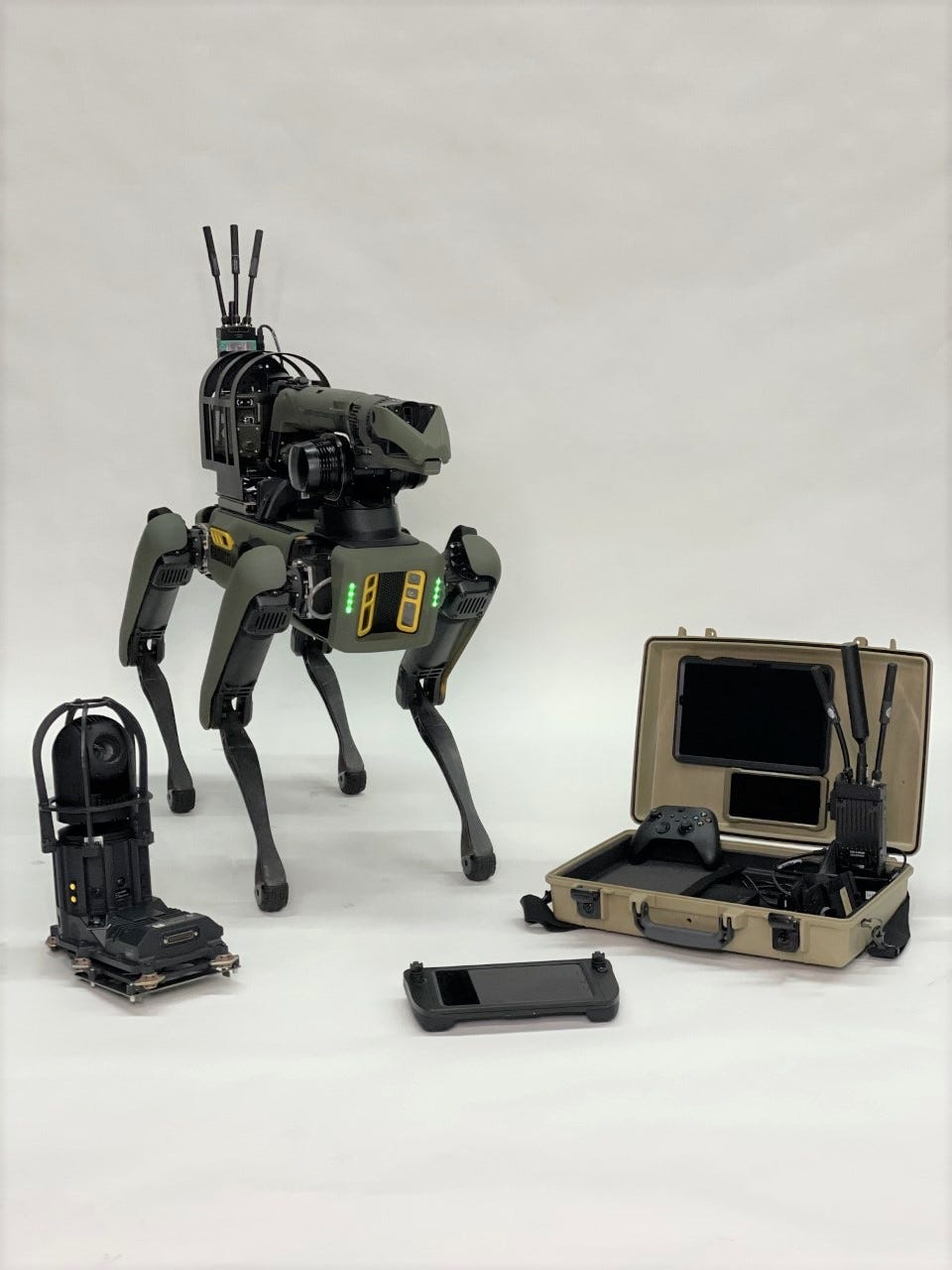
According to a product description on the company’s website, the Cerberus adds updated ground station controls, thermal, infrared and high-definition cameras for remote driving, extended-range communications equipment that RADeCO calls “military grade,” and its own Blackstone detection software.
The Blackstone software sends readings from CBRN sensors on the robot to the Android Team Awareness Kit, a smartphone app that the military and law enforcement agencies use to share maps, locations and other information in the field, according to RADeCO. The company says the software is part of a project funded by a Department of Homeland Security research division that works on countering weapons of mass destruction.
A Homeland Security procurement forecast, first reported by ABC News on Aug. 28, said ICE planned to spend up to $2 million on the robots and could use them to detect hazardous gas, inspect unexploded ordnance, investigate suspicious packages and explore underground or confined spaces. Some of that work overlaps with cases handled by Homeland Security Investigations, ICE’s investigative arm, which pursues cross-border smuggling tunnels and drug cases that can involve labs with toxic chemicals.
Detecting radiological and nuclear material, which the Cerberus package is also built to do, has mainly been the work of Customs and Border Protection and other federal agencies.
Boston Dynamics has said its terms of use bar customers from arming the robots. When news of the planned purchase broke, the company said “any attempted weaponization of Boston Dynamics’ robots is strictly prohibited,” according to Mass Daily News.
It is not clear why the agency’s tactical office needed the full detection package. ICE did not immediately respond to an emailed request for comment from Project Salt Box.
1. For those who asked what is being done - the De-Ice Action Network (DIAN) started a campaign to engage Boston Dynamics. We did this because no one in the Network believes for one minute that ICE will not weaponize these robotic dogs against people. The folks at Boston Dynamics who talked to our leadership are living in a world of surrealism. Rachel Maddox ran a piece on the DIAN action as did the Boston Globe.
2 Hyundai owns 43% of Boston Dynamics. Consideration is being given about starting actions against Hyundai.
DIAN successfully ran a campaign against Citizen Bank financing the deportation camps.
We need to keep identifying and engaging corporate America who is making huge profits off the crazed anti-immigration cartel.
Weird how these companies always name things like "Cerberus" and "Palantir" and we're not supposed to take the implications seriously, that they intended to do evil shit.