

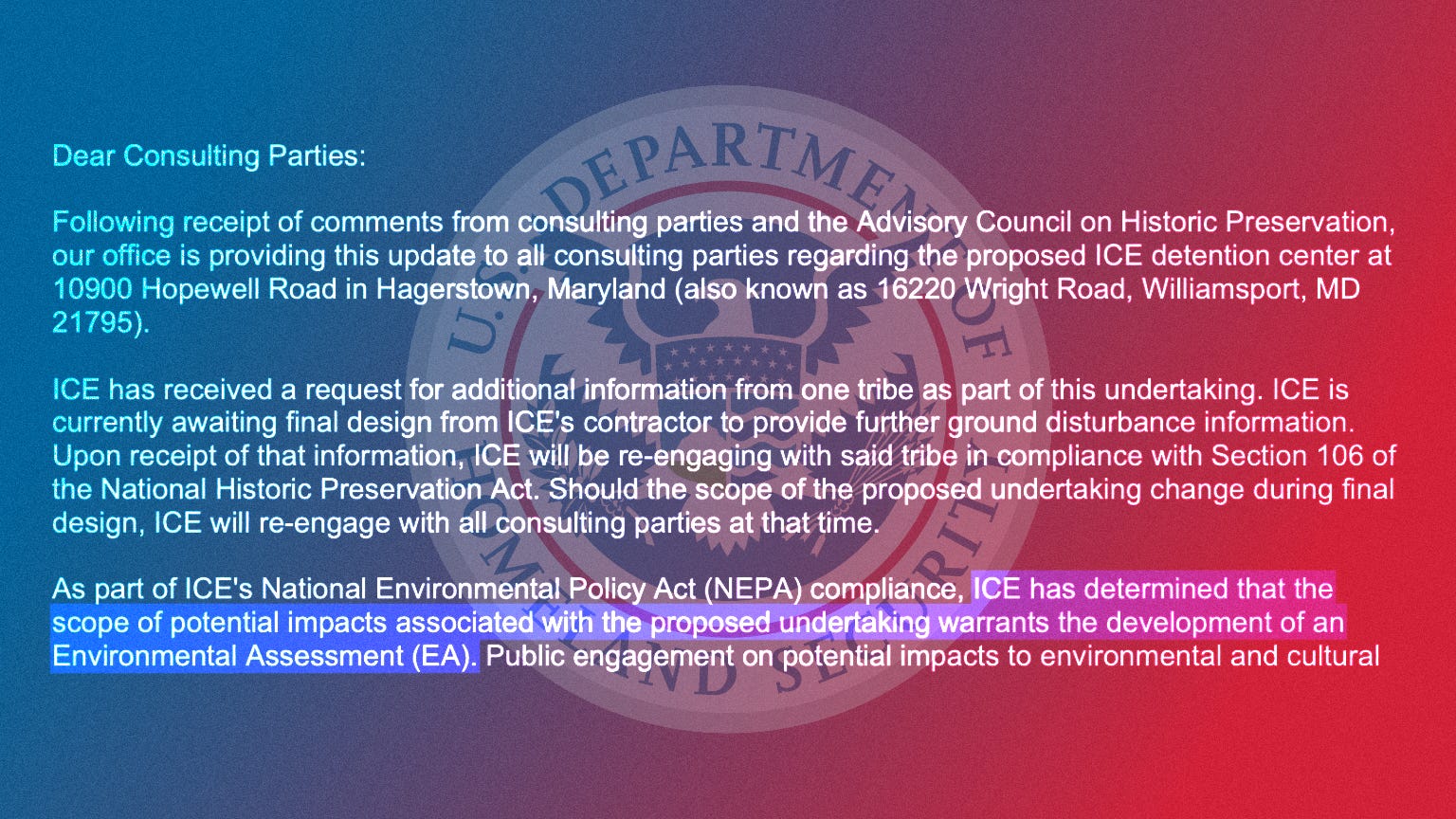
A Department of Homeland Security email released by Washington County under a standing Maryland Public Information Act request shows that the proposed ICE detention facility in Williamsport, Maryland remains far from moving forward, with unresolved tribal consultation and a contractor that has yet to produce basic design documents complicating a project already halted by a federal court.
The May 5 email, sent by Gabrielle Fernandez, a DHS environmental specialist, to consulting parties involved in the federal review process and obtained through the county’s public records portal, offers the clearest window yet into the state of the project.

ICE’s contractor, KVG LLC, has not yet delivered final design plans to the agency — plans that would include basic ground disturbance information, according to the email. That missing information is currently blocking ICE from completing its obligations under Section 106 of the National Historic Preservation Act, which requires the federal government to consult with tribes and other parties about potential impacts to cultural and historic resources before proceeding with a project.
At least one tribe has formally requested additional information about ground disturbance at the site, the email states. ICE said it cannot respond until KVG delivers the outstanding design details, at which point the agency said it will re-engage with the tribe. The Advisory Council on Historic Preservation — an independent federal body named in the email — has standing to weigh in on whether that consultation is being handled adequately.
When the federal government purchased the 825,000-square-foot warehouse on Hopewell Road in January for roughly $102 million, it conducted what is known as a Categorical Exclusion — the lightest available form of environmental review under federal law, typically reserved for projects so routine they require no meaningful analysis. ICE completed that review in a single day, then purchased the property the next.
Maryland sued. In April, U.S. District Judge Adam B. Hurson issued a preliminary injunction halting conversion work, finding the project did not qualify for that shortcut. The May 5 email represents a direct reversal of the agency's legal position — ICE had argued in court that a Categorical Exclusion was sufficient, requiring no further environmental review.
ICE now says the project requires an Environmental Assessment — a more substantive review than the one-day Categorical Exclusion the agency conducted before purchasing the site. Under federal environmental laws, an EA sits in the middle tier of environmental review. Its purpose is not to resolve questions about impact, but to determine whether those impacts are significant enough to require the most intensive form of review: a full Environmental Impact Statement, an often years-long process of environmental consideration.
But an EA is not a guarantee of deeper scrutiny. If ICE conducts the review and concludes that impacts are not significant, it can issue what is known as a Finding of No Significant Impact — and potentially move forward without ever producing a full EIS. Under federal law, agencies conduct and evaluate their own environmental reviews. Courts are the primary external check on whether those conclusions hold, reviewing them under a standard that asks whether the agency’s decision was arbitrary or unsupported by the record. Maryland has already demonstrated it is willing to use them.
Whether ICE’s EA will be sufficient is likely to be contested. The record already contains significant evidence of impact. The Maryland Department of the Environment has found that Washington County’s sewer system cannot support a facility expected to house up to 1,500 detainees — a pumping station serving the property is operating at more than 99 percent of its allocated capacity, according to state regulators. The state has barred any increase in sewage flow tied to the property until the county revises its water and sewer plan.
The timeline for any expanded review also remains uncertain. During proceedings earlier this year, an attorney representing ICE acknowledged that completing a full environmental review could take years.
Tribal consultation remains incomplete, according to the email. And the contractor responsible for the project’s final design has not produced the documents needed to move that consultation forward.
Ms. Fernandez said in the email that public engagement on the Environmental Assessment will be initiated in the future. No timeline was given. The warehouse remains under the terms of Judge Hurson’s injunction, which permits only limited maintenance while the legal and regulatory process continues.
If I sign a falsified federal application I'm liable. What about whoever signed the original false applications?
Tribal? Their trying to steal more land from the Indians?