

How to FOIA ICE
A plain-language guide to requesting public records

Federal and state agencies are required by law to make government records available to the public on request. The federal Freedom of Information Act establishes that right at the national level; every state has enacted a parallel law governing its own agencies. Those laws cover contracts, site surveys, lease agreements, environmental assessments, and internal planning records that rarely appear in press releases. Records obtained through public information requests have established facility capacities, contract values, and emergency planning decisions in the federal detention expansion program.
You do not need to be a journalist, a lawyer, or an advocacy organization to file a request. Any person can request federal records under FOIA. State sunshine laws vary, but most extend broad public access rights — and in some states, residents who live in a jurisdiction have legal standing that out-of-state requesters do not.
Readers who file requests and share what they find are a direct part of how Project Salt Box tracks and documents ICE's expanding detention footprint across the country.
What these laws cover
The Freedom of Information Act, 5 U.S.C. § 552, requires most executive branch agencies — including the Department of Homeland Security, Immigration and Customs Enforcement, and Customs and Border Protection — to release records upon request unless a specific statutory exemption applies. The nine exemptions cover areas including classified national security information, internal personnel rules, trade secrets, and certain law enforcement records. Agencies cite these exemptions often, and most can be appealed.
State public records laws govern state and local agencies: county governments, planning departments, fire marshals’ offices, city councils, and public utilities. For example, Maryland’s Public Information Act, codified at Md. Code, Gen. Prov. § 4-101 et seq., requires agencies to respond within 30 days and mandates that the first two hours of search and preparation time be provided at no charge.
Before you write a request
Check existing FOIA reading rooms and disclosure libraries first. Many agencies are required to post frequently requested records online. DHS maintains a public reading room and ICE posts responsive documents at ice.gov/foia/library. A document already posted is available immediately; submitting a new request for it delays your access and consumes agency processing time. MuckRock, a nonprofit platform that facilitates records requests, maintains a searchable archive of records obtained by other requesters across thousands of agencies — check it before you start.
Then narrow your request before you write it. FOIA and its state equivalents do not require agencies to answer questions or conduct research on your behalf — they require agencies to search for and produce records. A request asking what an agency’s plans are for a particular facility will likely come back as not describing an identifiable record. Before drafting, identify the specific document types you want — contracts, correspondence, permits, inspection reports — and pair each with a named party, a facility address or contract number, and a defined date range. The narrower the request, the faster it tends to move and the less it is likely to cost.
I am writing to request records under the Freedom of Information Act (5 U.S.C. § 552). I would like copies of any contracts or agreements between [agency name] and [company name] related to the property at [address], covering the period from [start date] to the present.
You can submit the same request to multiple components of a large agency if you are not certain which one holds the records. ICE and CBP are separate components of DHS, and records about a facility may exist in one, the other, or both.
Submitting your request
Most federal agencies and many state agencies accept requests through online portals, which confirm receipt and assign a tracking number. The national FOIA portal at foia.gov allows you to submit requests to most federal agencies, track their status, and receive productions electronically. As of early 2026, DHS and ICE no longer accept requests by mail; requests must go through foia.gov or the ICE FOIA portal. CBP uses a separate SecureRelease portal. The Department of Justice maintains a directory of federal agency FOIA contacts with submission links for agencies that operate their own systems.
For state agencies, your state attorney general’s office typically maintains a directory of agency public records contacts. Many county and municipal agencies accept email submissions; some still require written requests by mail. When in doubt, call the agency’s main public affairs line and ask where to send a records request.
Keep a copy of every request you submit, the confirmation of receipt, and all subsequent correspondence. Response deadlines run from the date the agency acknowledges receipt, not from the date you submitted it.
Writing the request
A records request can be written plainly, but it needs to be precise. Every request should include your name and contact information, a description of the specific records you want, a reference to the Freedom of Information Act by name, and a fee waiver request. If you have grounds for expedited processing, include that as well.
When describing the records, be concrete. Name the facility, the contractor or agency, the document type, and the date range. Requests that describe a broad topic rather than specific records — “all documents related to ICE detention in [state]” — will likely be rejected outright. Specific requests move faster and cost less.
I am writing to request records under the Freedom of Information Act (5 U.S.C. § 552). I would like copies of any contracts, lease agreements, or permits related to [facility name or address], from [start date] to the present, including any amendments or modifications to those documents.
Requesting a fee waiver
FOIA authorizes agencies to charge fees for search time, duplication, and review. If you are requesting records for a noncommercial public interest purpose, you can ask the agency to waive those fees — and you do not need to be a journalist or affiliated with a news organization to do so.
The request should explain what you are looking for, why it matters to the public, and that you have no commercial interest in the records. Keep it short. Agencies receive boilerplate fee waiver language constantly; a clear, specific explanation of your purpose carries more weight.
I am also requesting a fee waiver under 5 U.S.C. § 552(a)(4)(A)(iii). I am seeking these records to understand how public funds are being spent in my community and plan to share what I find publicly. I have no commercial interest in these records.
If your fee waiver is denied, you can appeal that denial separately from any appeal of a withheld record.
Requesting expedited processing
Federal FOIA allows requesters to ask for faster processing when delay would harm the public’s ability to get timely information about what the government is doing. To qualify, you generally need to show that you are sharing information with the public and that there is a specific, time-sensitive reason the records are needed now. A general claim that the public should know is not sufficient; a pending construction start, an imminent facility opening, or an active legal proceeding are.
I am requesting expedited processing because [describe the specific time-sensitive circumstance]. I am sharing my findings with the public through [your platform or community] and certify that this statement is true and correct to the best of my knowledge.
Appealing
If an agency withholds records in whole or in part, denies your fee waiver, or fails to respond within the 20 business day statutory deadline, you have the right to appeal. Federal appeals go to the agency’s FOIA Appeals Officer. Your letter should identify the request by its tracking number, describe what was withheld or what deadline was missed, and explain why you believe the response was wrong. You do not need a lawyer to write one.
I am writing to appeal the response to FOIA request [tracking number], dated [date]. The agency withheld [describe the records] citing [exemption cited]. I do not believe those records fall within that exemption because [your reason]. I ask that the agency release the withheld records.
If an administrative appeal is denied, you may file suit in federal district court. The Reporters Committee for Freedom of the Press and the National Freedom of Information Coalition offer free guidance on that process.
At the state level, appeal mechanisms vary. Some states have an open government ombudsman who can intervene; others require suit in state court. Your state attorney general’s office can direct you to the applicable process.
How to submit a request through the SecureRelease portal
ICE and CBP process FOIA requests through the federal SecureRelease portal, accessible through foia.gov. The portal walks you through six steps.
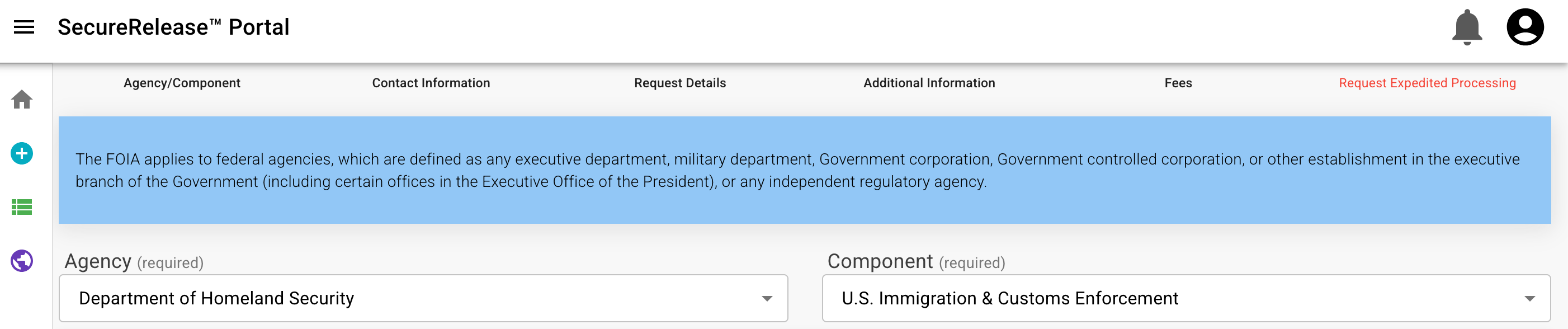
Step 1: Agency and component. Select “Department of Homeland Security” from the agency dropdown, then select “U.S. Immigration & Customs Enforcement” from the component dropdown. The portal will display ICE’s contact information and any active processing notices — check these before proceeding, as they may flag delays. As of February 2026, ICE has noted delays across most FOIA offices.
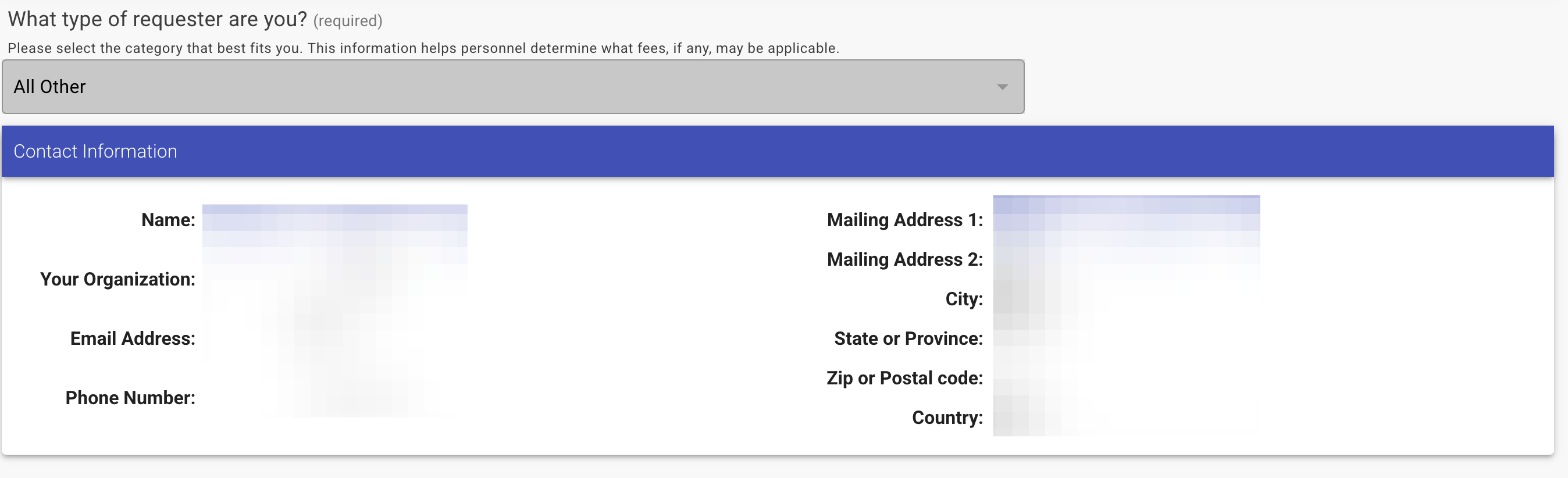
Step 2: Contact information. The portal will ask what type of requester you are. Select “All Other” unless you are filing on behalf of a news organization or educational institution — your requester category affects what fees may apply. Fill in your name, mailing address, email, and phone number. This information is collected separately from your request, so you do not need to include it in the request text itself.
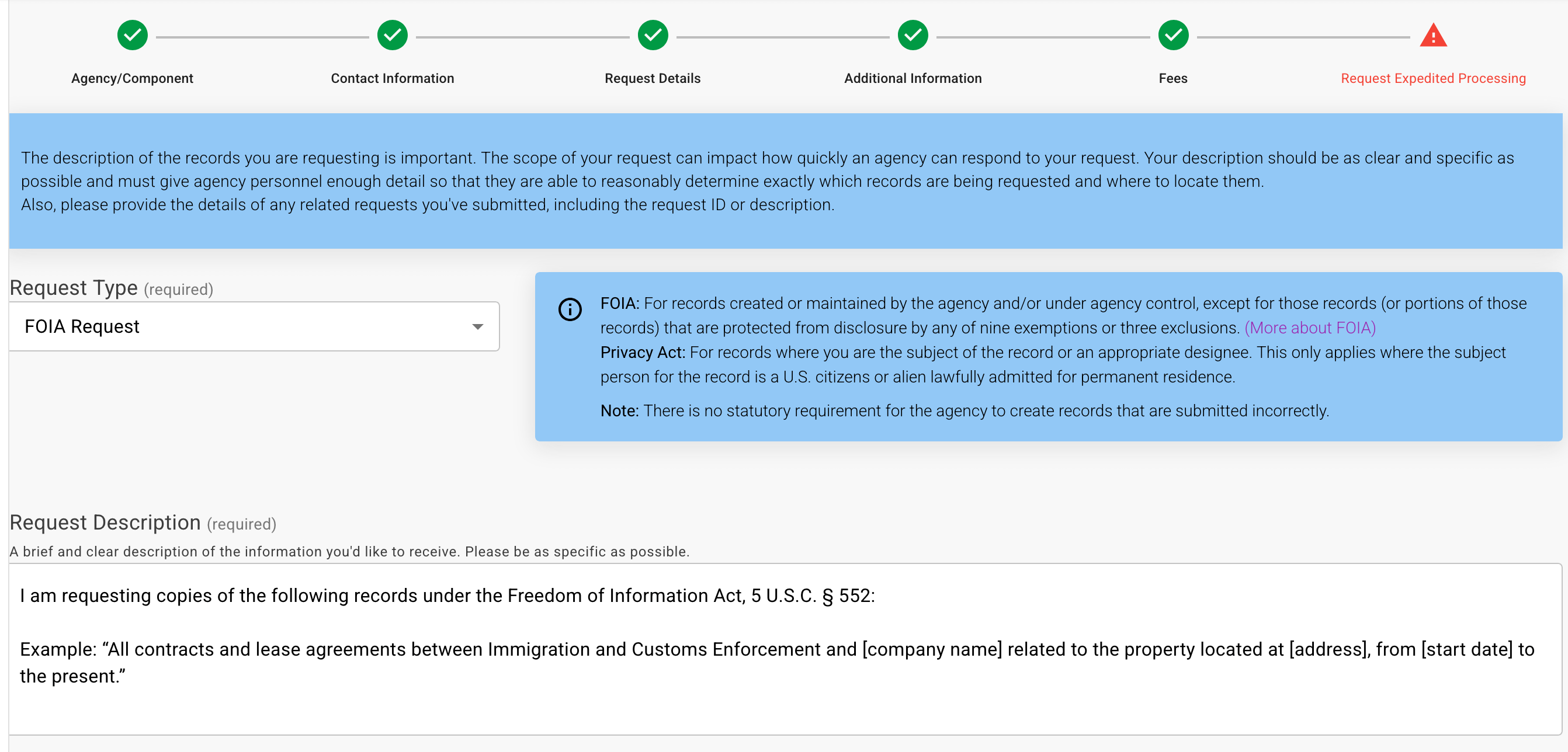
Step 3: Request details. Select “FOIA Request” as the request type. The portal then presents a single open text field labeled “Request Description.” This is where you paste your request language. The portal instructs you to be as specific as possible — name the document types, the parties involved, the location, and the date range. If you have submitted related requests previously, note the prior request ID here as well.
Step 4: Additional information. The portal will ask for a “Request Designation.” Select “Other (I am not requesting records about a person).” The remaining fields on this screen — alien number, date of birth, SEVIS number — are for people requesting records about themselves or a specific individual. Leave them blank.
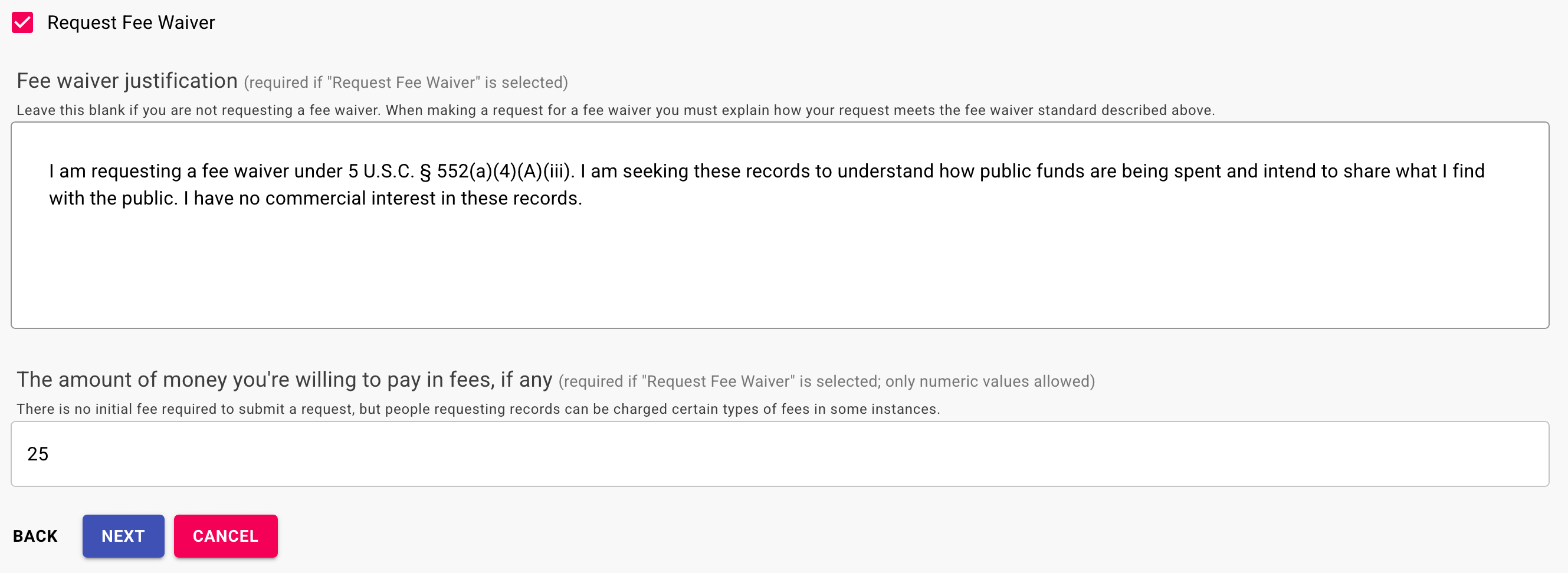
Step 5: Fees. Check the “Request Fee Waiver” box. A text field will appear asking you to justify your fee waiver request — paste your fee waiver language here. The portal also asks for the maximum amount you are willing to pay in fees if the waiver is denied. Entering $25 is a reasonable starting point; you can adjust this based on your situation.
Step 6: Expedited processing. If you are requesting expedited processing, check the box and paste your justification in the text field that appears. If you are not requesting expedited processing, leave this step blank. Complete the reCAPTCHA and click “Submit Request.”
Resident advantages
The case for crowdsourcing records requests is fundamentally geographic. Fire marshal inspection reports, county building permit applications, zoning variance records, local emergency management correspondence, utility connection permits, and tax assessment filings exist only within state and local systems. A federal FOIA request to ICE cannot reach a city’s internal correspondence about a facility, a county assessor’s chain of title, or a local planning department’s site review. Those records require a state or local request, and a local resident is often better positioned to know they exist and to identify the right agency.
In five states — Alabama, Arkansas, Delaware, Tennessee, and Virginia — that advantage is also a legal one. Those states limit public records requests to their own residents by statute, meaning a news organization headquartered elsewhere may have no standing to file at all. Kentucky imposes a similar residency requirement, with narrow exceptions for registered out-of-state business entities and certain news media organizations. New Jersey and New Hampshire have statutory language that could be read the same way, though neither state currently enforces it as a bar to out-of-state requesters. In any of these states, a local resident filing on their own behalf has access that an outside organization cannot replicate.
Cost is another variable worth understanding before you file. For instance, California’s Public Records Act does not include a statutory fee waiver — if an agency declines to reduce costs at its own discretion, you have limited recourse.
The practical workaround is showing up in person: viewing records at a California agency’s office is free, and you may be permitted to photograph or scan pages with your own device at no charge. Agencies may only bill the direct cost of duplication for copies they produce themselves, and cannot charge for staff time spent searching or reviewing records. A local resident who can walk into an office has a meaningful cost advantage over a remote requester ordering copies by mail.
Elected officials and local agency heads answer to constituents, not to outside organizations. A records request from someone who lives in a jurisdiction lands differently than one from a national outlet headquartered elsewhere — particularly in smaller counties and municipalities where officials are directly accessible. A national organization also has limited capacity to file simultaneously across dozens of jurisdictions. Residents who live near a facility, know which local agencies received correspondence, and can appear at a county office are doing something no national organization can replicate at scale.
Share what you find
Project Salt Box is an all-volunteer investigative nonprofit covering federal immigration detention contracting and homeland security spending. We want to hear from readers who have obtained records through public information requests or have knowledge of federal contracting in their communities.
If you obtain records and would like to share them, or have a tip related to ICE detention expansion, you can reach us at projectsaltbox@pm.me.
We do not identify sources without their permission.
A starting-point records request
Most federal and state agencies now accept records requests through online portals, which collect your contact information separately. The following is the text you will need to paste or type into the request field. Replace the bracketed sections with your own information.
I am requesting copies of the following records under the Freedom of Information Act, 5 U.S.C. § 552:
[Describe the records you want. Be as specific as you can: name the document type, the agency or company involved, the location or address if relevant, and the date range.]
Example: “All contracts and lease agreements between Immigration and Customs Enforcement and [company name] related to the property located at [address], from [start date] to the present.”
I am requesting a fee waiver under 5 U.S.C. § 552(a)(4)(A)(iii). I am seeking these records to understand how public funds are being spent and intend to share what I find with the public. I have no commercial interest in these records. If my fee waiver request is denied and fees are expected to exceed $25, please notify me before processing so I can decide how to proceed.
If any portion of this request is denied, please identify the specific exemption claimed and provide information on how to appeal that decision.
A few notes on using this template
The description of the records is the only part that requires real thought. Everything else is standard language that agencies expect to see. If your description is too broad, the agency will either reject the request outright or return an estimate for a search that costs more than you want to pay — which is why narrowing your request before you file matters.
The $25 threshold in the fee notification line is a reasonable ceiling for most requests, but you can raise or lower it based on your situation.
For state and local requests, replace the statutory citation (5 U.S.C. § 552) with the name of your state’s public records law. MuckRock’s state-by-state guides can tell you what it’s called and how to cite it. The structure — describe what you want, ask for a fee waiver, ask for an explanation of anything withheld — works in virtually every state system.
Resources
Finding and submitting requests
FOIA.gov — The federal government’s central records request portal. Submit requests to most federal agencies, track status, and receive productions in one place.
ICE FOIA Portal — ICE’s dedicated submission portal for immigration enforcement records.
CBP SecureRelease Portal — Customs and Border Protection’s separate submission system.
MuckRock — A nonprofit platform for filing, tracking, and sharing public records requests. Includes a searchable archive of records obtained by other requesters and state-by-state guides to local public records laws.
Reading rooms and existing disclosures
DHS FOIA Library — Previously released DHS records available for immediate download.
ICE FOIA Library — ICE’s public reading room, updated regularly with new productions.
State public records laws
Reporters Committee Open Government Guide — State-by-state legal reference on public records laws, written by attorneys in each jurisdiction. The most authoritative resource if you hit a specific legal obstacle.
Right on Transparency — State Residency Requirements — A summary of which states restrict records requests to their own residents, with statutory citations.
Ballotpedia — Who Can Make Public Records Requests by State — A plain-language summary of requester eligibility rules in all 50 states.
Legal help and appeals
Reporters Committee for Freedom of the Press — Free legal resources and attorney referrals for journalists and members of the public facing FOIA disputes.
National Freedom of Information Coalition — A network of state-level press freedom and open government organizations. A good starting point if your dispute involves a state or local agency.
Note: This guide is for informational purposes only and does not constitute legal advice. Public records laws vary by jurisdiction and are subject to change. If you have questions about your rights under a specific state or federal records law, consult an attorney or contact one of the legal resources listed above.
This is incredibly valuable information. Thank you for posting it. Not having to research how to make these requests will save me and many others valuable time when trying to figure out what the government has done or is doing in our area in order to plan resistance activities.
This is valuable information. Thank you for sharing!