

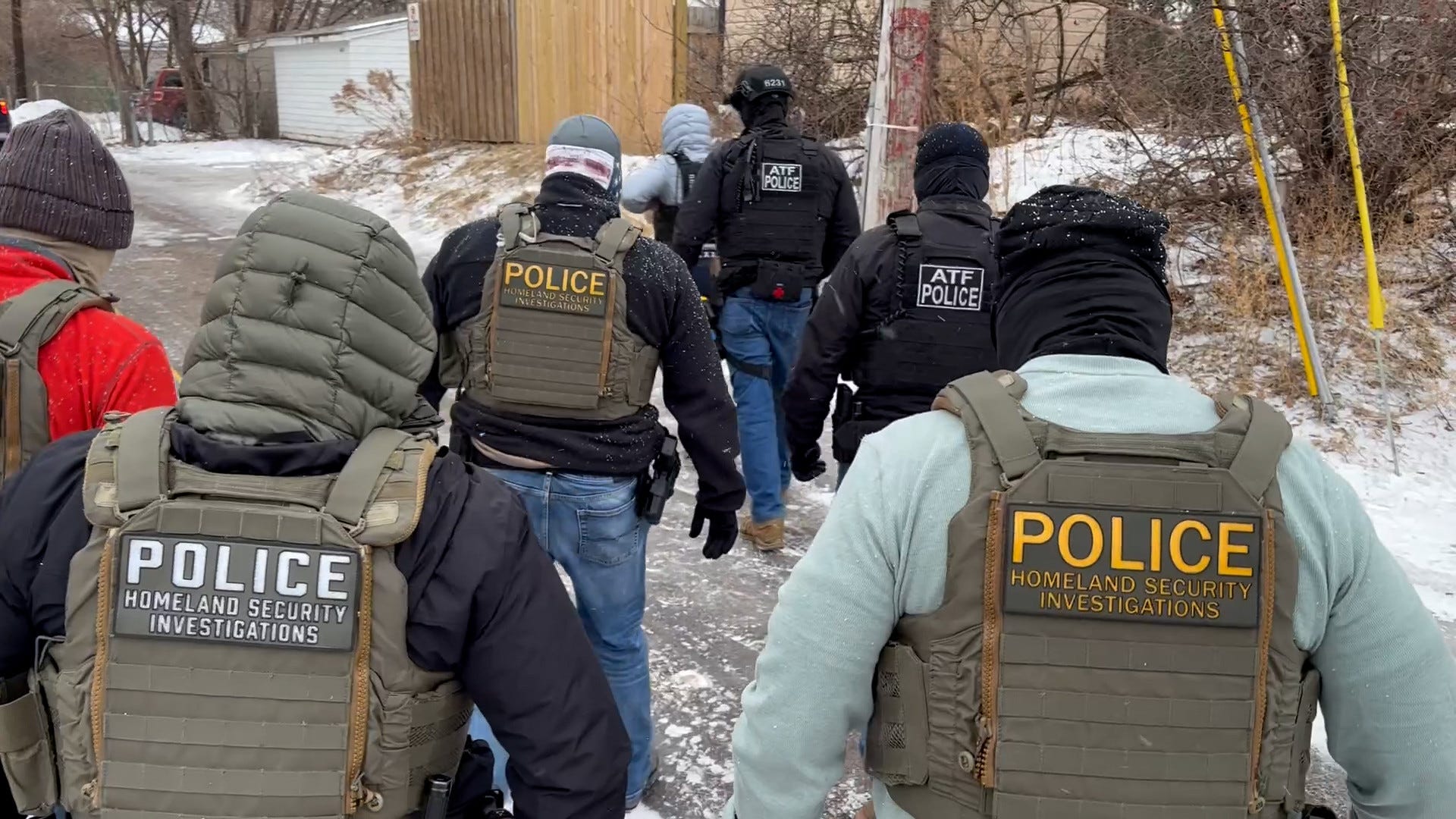
The Department of Homeland Security plans to give a Nebraska company a no-bid contract for software meant to let federal agents search billions of wiretap, phone, and location records, according to a notice posted Wednesday.
Agents using the system could question an artificial intelligence assistant in plain English. A requirements document attached to the notice calls for a single platform that gathers live wiretaps, call records, email, financial records, and social media data for investigators at Immigration and Customs Enforcement’s criminal investigations branch, Homeland Security Investigations.
ICE said in the notice that Pen-Link Ltd. of Lincoln, Nebraska, is the only company “reasonably available” to do the work because of its capabilities and the “proprietary nature of the services.” The contract calls for one year of work with four one-year options, for a possible five years. The notice gives no dollar amount. Other companies have until 10 a.m. Monday, Oct. 26, to send a one-page response showing they could do the job.
Pen-Link already sells ICE a separate tool called Webloc, which tracks phones using location data collected from mobile apps and digital advertising. ICE pays for access to that data instead of getting it through a court order. The notice does not say whether Webloc data will feed the new system. In March, 72 members of Congress called for an investigation of ICE and other agencies over what they called warrantless purchases of Americans’ location data.
The requirements document describes a system for thousands of agents, with at least 500 using it at the same time in offices across the United States and overseas. The system must store at least 10 terabytes of data, which the document says covers billions of communication records.
The requirements call for live wiretaps and live location “pings” from phones, along with records of who called whom and when. They also list “tower dumps,” which are lists of every phone that connected to a cell tower during a set period and can include many people who are not under investigation. The other data listed includes email, web browsing history, financial records, and social media records from companies such as Google, Facebook, Snapchat, and WhatsApp, along with data copied from seized phones.
The tools described include maps of where phones have been, alerts when a phone enters a marked area, and a phone app that displays live data. The system must also link to a national platform run by the Homeland Security Task Force that flags when two agencies are investigating the same phone number or account.
The document describes an assistant that runs on ICE’s own Microsoft Azure accounts. Agents ask it to summarize, map, and chart the data, and it translates and transcribes recordings. The document says ICE data and agents’ questions may not be used to train outside AI models and that every use of the assistant must be logged. A separate entry in DHS’s public inventory of AI tools describes an ICE project to search and summarize translated wiretap recordings with a large language model. The inventory lists that project as not yet deployed.
The requirements also say the AI assistant must “prevent vendor lock-in,” meaning the agency should not become dependent on one company. The notice does not explain how ICE weighed that goal against its finding that only Pen-Link can do the work.
The notice follows an Aug. 10 request for information in which ICE asked companies about a “Telecommunications Analysis System” with the same features, according to Biometric Update. ICE described that request as market research and said it was not committing to buy anything.
The notice comes as ICE is ramping up contracts for surveillance tools and intelligence analysts. A statement of work posted Sept. 18, first reported by Project Salt Box, calls for 142 contract intelligence analysts with top secret clearances at 24 field offices and three national centers under a program called ERO ONE. The government has said it expects to spend more than $100 million on the contract. Jay Stanley, a senior policy analyst at the American Civil Liberties Union, said in an American Prospect article published Wednesday that the program “looks dangerously like the construction of an internal spying agency.” DHS did not respond to the Prospect’s request for comment.
Pen-Link has sold investigative software to police and federal agencies since it was founded in 1987. Its main product, PLX, helps investigators organize and analyze call records, search histories, and other data that phone and technology companies turn over under court orders, according to an April report by the Citizen Lab, a research group at the University of Toronto. In 2022, Forbes reported that Pen-Link held about $20 million a year in contracts with federal agencies including ICE, the FBI, and the Drug Enforcement Administration. Fed360, a website that compiles federal contracting data, lists Pen-Link with $266 million in federal awards since fiscal 2015. Most of that money came from the DEA and the Justice Department, and ICE accounted for about 15%.
ICE already relies on PLX. A DHS purchasing forecast posted in February says the Homeland Security Task Force “requires” PLX for its “telecommunication analysis and intercept” work. The forecast estimated that purchase at $5 million to $10 million and said no competition was planned. In August, U.S. Customs and Border Protection posted its own notice saying it planned to negotiate a PLX contract with Pen-Link.
In 2023, Pen-Link merged with Cobwebs Technologies, an Israeli surveillance company, after both came under the same owner, the investment firm Spire Capital. Pen-Link now also sells two tools that Cobwebs built. Tangles searches social media and other websites. Webloc, the location tool, draws on records from hundreds of millions of phones. A January report by 404 Media described it as designed to monitor a neighborhood or block for phones and follow them from work to home. The Citizen Lab found that the data covers up to 500 million devices with up to three years of history, and that Webloc identifies each phone by its advertising ID, a number assigned to the phone for ad targeting, rather than by its owner’s name.
ICE bought Tangles and Webloc licenses worth up to $2.3 million for September 2025 through September 2026, according to a contract document first reported by 404 Media. The document says the HSI Office of Intelligence uses the tools to support investigations of cross-border crime. A DHS forecast posted in April lists a follow-on purchase of an open-source intelligence tool from Pen-Link for that office, worth up to $20 million over five years.
Pen-Link told the Citizen Lab that it gets its location data from providers that obtain users’ consent through apps and that remove sensitive locations. The company said its customers use its tools to find kidnapped children, fight human and drug trafficking, and identify possible terror threats.
ICE is a law enforcement agency, not an intelligence agency. It is not part of the U.S. intelligence community, so it does not have the national security spying powers that the National Security Agency uses to collect foreign communications.
Most of the data the system is designed to hold comes through criminal law tools that require a judge’s approval. To listen to calls or read messages as they happen, agents must get an order from a federal judge under the Wiretap Act. They must show probable cause that a specific serious crime is taking place. The law lists the crimes that qualify, and smuggling people into the country is one of them. Deportation cases are civil matters, and civil immigration violations do not qualify.
Wiretap content is among the most tightly regulated data in the telecommunications analysis platform ICE is contracting. The requirements section of the notice of intent files them under “Title III,” the common name for the federal wiretap statutes.
Under the law, a phone tap needs sign-off from a senior Justice Department official before prosecutors approach a judge, and the judge must be satisfied that other investigative methods have failed or appear unlikely to work. Orders generally expire after 30 days unless a judge extends them, and the statute directs agents to limit how much unrelated conversation they capture. Recordings go under seal and stay on file for 10 years, and people named in an order typically receive notice within 90 days of its end. Officers may pass the content to other law enforcement officials as their official duties require. The documents leave open how those limits apply to a platform that holds wiretap content alongside tower dumps, email, and financial records, links to partner agencies, and lets an AI assistant summarize translated recordings.
A separate court order lets agents see in real time which phone numbers, email addresses, or internet addresses a person contacts, though not what was said. The government only has to certify to a judge that the information is relevant to a criminal investigation. Agents can get records that phone and technology companies keep through subpoenas, court orders, or warrants, depending on the type of record. In 2018, the Supreme Court ruled in Carpenter v. United States that police generally need a warrant to get a person’s past cellphone location records from a phone company. A 1994 law requires phone and internet companies to build their networks so they can deliver wiretaps and call records when a court orders it, and the requirements document says the new system must accept data in the formats that law requires.
Tower dumps face a legal challenge of their own. On Aug. 5, Judge Carlton Reeves of the U.S. District Court for the Southern District of Mississippi ruled that warrants for tower dumps are unconstitutional in every case. Reeves wrote that a tower dump amounts to a general warrant, the kind the Fourth Amendment was written to prohibit, because it names no suspect and reaches every phone near a tower. The case grew out of a federal gang investigation in Jackson, where investigators sought records from towers near the sites of violent crimes. Reeves wrote that the requests could produce “thousands if not tens of thousands” of records.
The government appealed to the Fifth Circuit on Sept. 3. Neither the Supreme Court nor the Fifth Circuit has ruled on tower dumps, and lower courts are divided on whether they count as searches at all. The Eighth Circuit, in a 2021 case, found a tower dump warrant for 90-minute periods particular enough. The order does not say which federal agency sought the records.
Purchased location data is different. Agencies that buy it have said no warrant is needed because the data is sold commercially. Privacy groups such as the Electronic Privacy Information Center say buying the data lets agencies avoid the warrant required to get the same location history from a phone company.
In 2023, the DHS inspector general found that ICE, CBP, and the Secret Service did not follow federal privacy rules before they bought and used phone location data. The report said the agencies did not complete required privacy reviews first. ICE disagreed with a recommendation to stop using the data until those reviews were approved and said continued use helped HSI carry out its mission. ICE later said it stopped using such data in late 2023. It bought the Webloc licenses described above in 2025.
Neither the notice nor the requirements document says how long ICE may keep the data in the new system. They also leave open whether records on people who are not suspects, such as those in tower dumps, stay searchable for other cases, and whether ICE’s deportation officers, who cannot get wiretaps for civil cases, can search data that HSI collects in criminal cases.
Democrats need to make sure ea h and every no bid contract gets canceled.
One can only hope they will be as incompetent awarding this no bid contract as they were on the reflecting pool.