

While the Department of Homeland Security was telling a federal judge it had not decided whether to turn a warehouse in Roxbury, N.J., into an immigrant detention center, it was seeking bids from companies to do the work, according to contract documents DHS filed Tuesday.
Immigration and Customs Enforcement, the DHS agency that would run the facility, asked for bids in August. One company, SK2 LLC, submitted its offer for the Roxbury job on Sept. 4. Eleven days later, DHS told the judge it had “no timeline” for deciding what to do with the warehouse. ICE signed the contract with SK2 on Nov. 5. According to federal contracting records, at least six other unnamed companies also bid on the contract.
The documents, filed in New Jersey’s lawsuit over the warehouse, also show the contract would let ICE approve construction of offices at the site while an environmental review is underway.
That work is not among the activities a May court order allows before the review is complete.
New Jersey and Roxbury Township sued in March to stop DHS from converting the 470,000-square-foot industrial warehouse into an immigration detention center. The May order, which both sides agreed to and U.S. District Judge Jamel K. Semper signed, bars DHS from “any activities” at the site “for purposes of converting it into a detention center” until it completes an environmental assessment and the state has a chance to challenge the results.
The order lists the work DHS may do in the meantime: temporary fencing that does not disturb the ground, security cameras and lighting, an alarm system, new locks, and routine maintenance of the building’s heating, plumbing, electrical, and fire systems.
It also does not explicitly bar DHS from hiring contractors or designing a facility.
DHS filed 178 pages of contract documents along with a sworn statement from an ICE contracting official. They include the signed order with SK2, the Tennessee-based company that helped the agency buy warehouses for detention earlier this year, and a 158-page performance work statement describing what ICE expects from the company. Project Salt Box first reported the $31.8 million award on Nov. 6.
DHS’s account of its plans has changed several times. In June, government lawyers told the court DHS no longer planned to convert the warehouse and intended to sell it. In July, they said the agency would “consider the retrofitting” of the building, then said it had no timeline for deciding. On Nov. 6, the day after ICE signed the contract, the state’s lawyers asked about Project Salt Box’s report. DHS’s lawyers “could not confirm” whether it was correct, according to a state court filing. They then told the state for the first time that DHS had decided to move ahead. On Monday, DHS told the court that ICE “currently intends to retain the Roxbury facility and renovate it to some level of detention capacity.”
The Roxbury order was also placed under a Navy contract that Homeland Security Secretary Markwayne Mullin told Congress in June the agency had stopped using. At a House Appropriations homeland security subcommittee hearing on June 25, when a lawmaker began asking about ICE’s use of the Navy program, known as WEXMAC, to buy detention services, Mullin said, “We’re not using it anymore, just so you know.”
The contracting official’s sworn statement identifies the WEXMAC contract as the “parent contract” for the Roxbury order. ICE issued the solicitation for the Roxbury job in August.
SK2’s offer came the same day ICE agents brought nine people to the warehouse’s parking lot for processing. Agents brought five more on Sept. 8, ICE later acknowledged in an email to Rep. Analilia Mejia. Neighbors and local officials had reported seeing ICE vehicles at the site. On Sept. 14, the director of ICE’s Newark field office told staff to stop using the lot, according to the email.
On Sept. 15, the day after that order, DHS and the state filed a joint update with the court. In its section, DHS said it “continue[s] to assess whether to proceed” with converting the warehouse and that “there is no timeline for reaching that decision.” DHS did not mention the solicitation, SK2’s bid, or agents’ use of the parking lot.
In their section of the same update, New Jersey and Roxbury told the judge they had learned of reports that the warehouse had been used in immigration enforcement. DHS’s section did not address those reports.
In a Nov. 6 filing, New Jersey and Roxbury said that because of DHS’s “varying representations,” they had asked the agency for a copy of the contract to check whether its description was accurate. They also said ICE’s use of the parking lot raised concerns about DHS’s “willingness to skirt the boundaries” of the May order.
The state and township received the contract documents Tuesday afternoon, “after repeated requests over the past 11 days,” according to Tuesday’s filing. They remain concerned that DHS has violated the order “by pressing ahead with steps to convert the warehouse into a detention center,” the filing says, and may ask the judge to enforce it once they finish reviewing the documents.
Help us report on the Roxbury warehouse. If you work for DHS, ICE, or a contractor and have information about this contract or work at the site, Project Salt Box researchers would like to hear from you. You can reach Michael Wriston confidentially on Signal at mwriston.410 or by email at projectsaltbox@proton.me. For your security, use a personal device and not a work phone or computer.
In a sworn statement, Sarah A. West — the ICE contracting officer who oversees the Roxbury contract — explained what the $31.8 million ICE awarded SK2 on Nov. 5 pays for. Of that, $650,000 pays for the environmental review. The other $31.1 million pays for four months of maintenance and repair at the warehouse and for designing a facility with “some level of detention capacity,” along with space for other uses such as training and offices.
The work West described accounts for about 3% of the contract’s potential value.
The award listing ICE first posted on SAM.gov, the federal contracting website, did not mention Roxbury. It said the order was for the renovation of an “existing, ICE-owned permanent structure in San Antonio, TX,” wording identical to the description of ICE’s award to GardaWorld Federal Services to convert a warehouse in San Antonio into a detention center.
West also approved the GardaWorld award listing in September, according to SAM.gov records.
On Nov. 13, a week after Project Salt Box reported the award and New Jersey asked DHS for a copy of the contract, ICE revised the listing to name Roxbury and to describe the work as maintenance and developing “a design for renovation.”
The signed order provided by the government describes its purpose as “to obtain design and renovation” of the warehouse and the “delivery of comprehensive detention operations and wraparound services” at the Roxbury site.
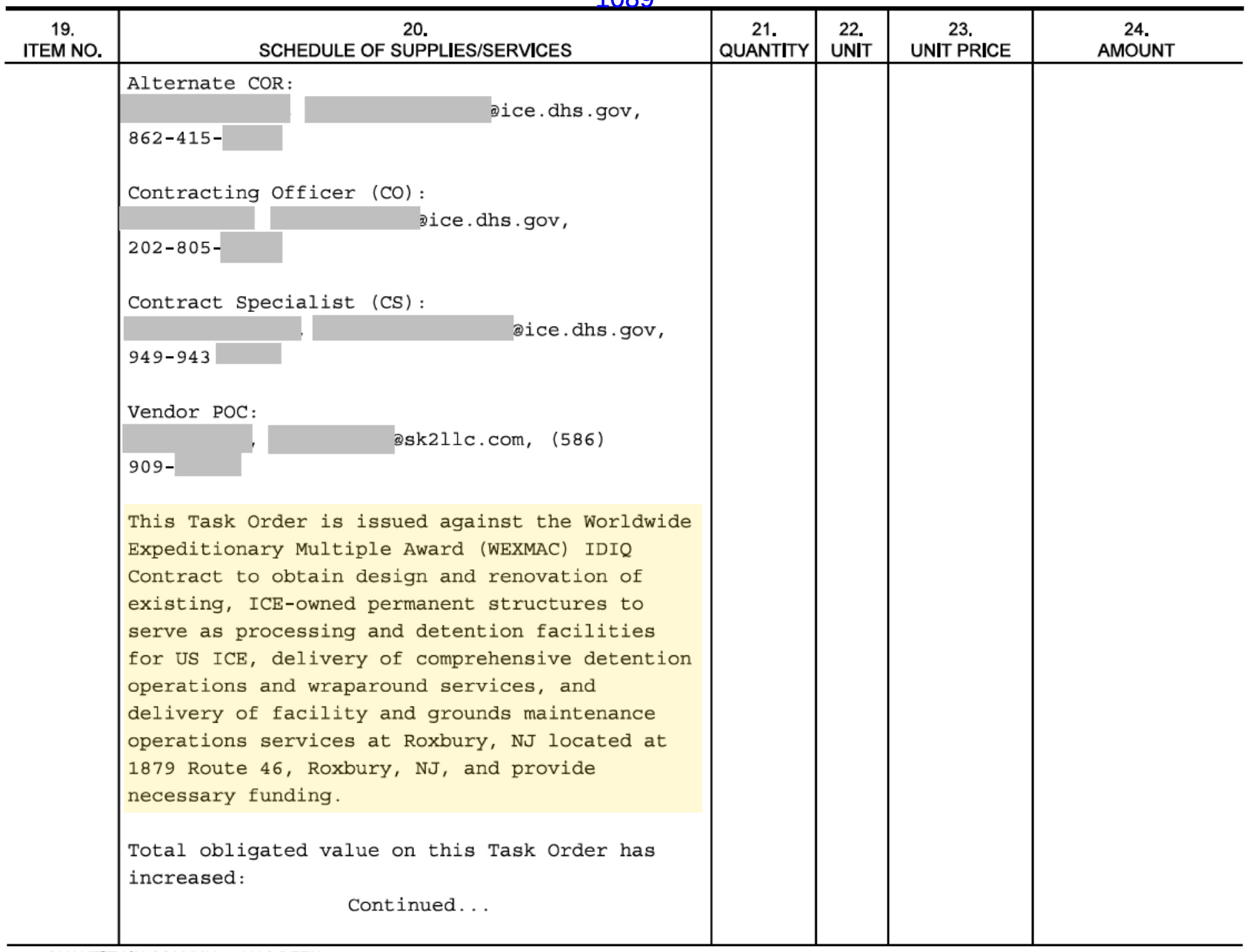
The rest of the contract consists of options — additional work ICE can choose to buy later — according to West. If ICE bought all of them, the contract would be worth $998.3 million over five years. That total includes $206.5 million to fully retrofit the building and the cost of running a detention center there.
West said ICE could not buy any of those options until the environmental review is finished. In the same filing, government lawyers wrote that “the contract prohibits renovating the Roxbury facility into a detention center” until then.
Under the contract’s terms, renovations “for housing aliens may not proceed” until the government issues a final finding that the project would not significantly harm the environment. The same terms allow ICE to approve “interior construction or reconfiguration of administrative and office space while environmental review is ongoing.” West quoted that provision in her statement.
An “initial” environmental review of items including perimeter fencing, office space, security systems, backup power, and heating and cooling systems ended in a categorical exclusion, a finding that no more detailed review was needed, according to the work document.
That passage does not say which site the review covered, and the document applies to ICE’s warehouse program generally.
ICE will give the company “a sample floor plan for each facility,” which the company must use to develop “the final design and renovation plan,” the contract says. Each facility is to include segregation housing, an armory, medical isolation rooms, and a secure perimeter, and will hold single adult men and women, housed separately, “of all classification levels.” Plans for training space include a room for defensive tactics drills and, “where applicable,” a firearms range at least 25 yards long. Immigration court space is also required.
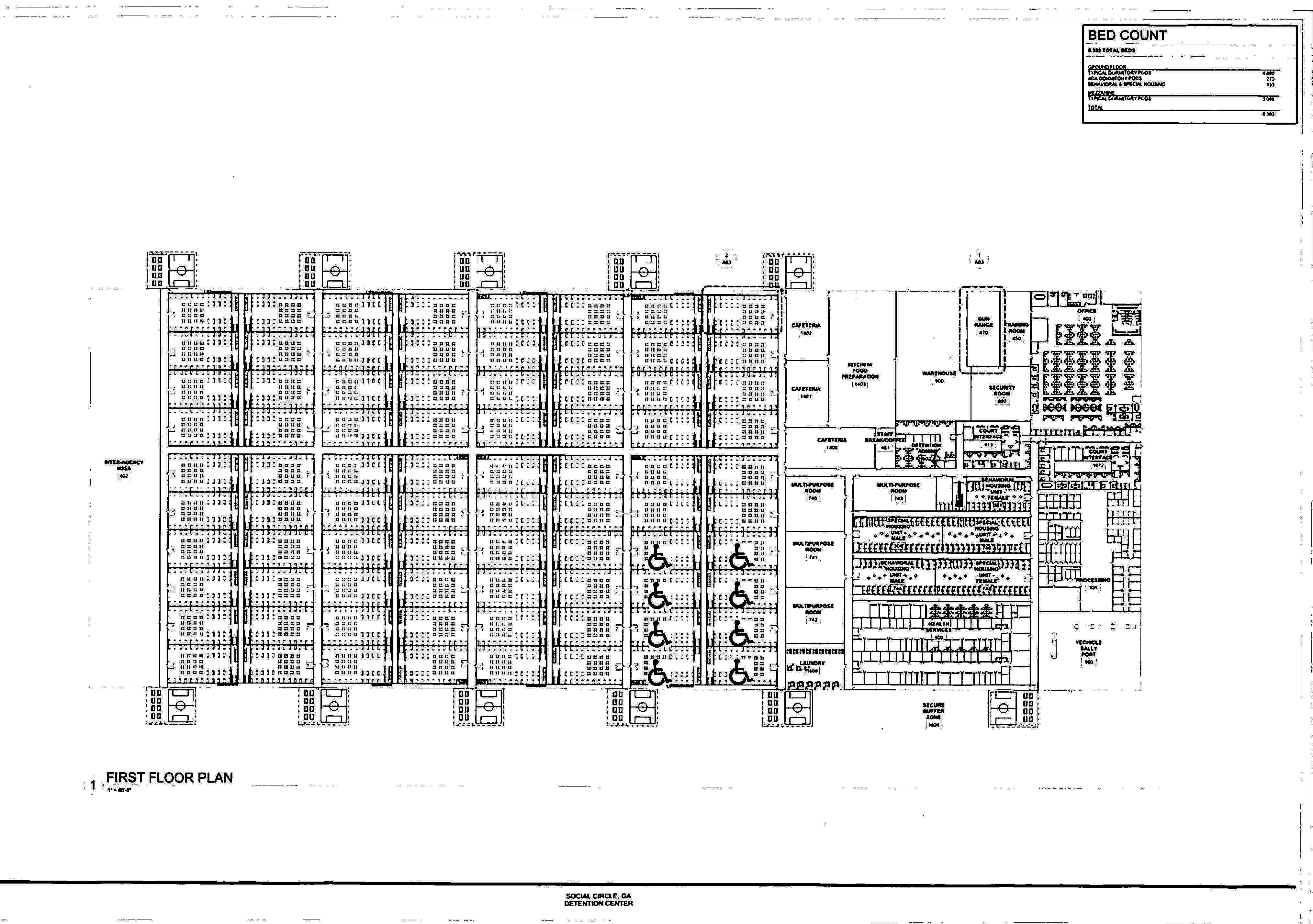
A floor plan DHS shared with officials in Social Circle, Ga., for a warehouse the agency planned to convert there included many of the same features, among them a gun range, a training room, special housing units, and space for immigration court proceedings. DHS dropped the Social Circle project in June.
The contract prices the first four months at about $7.8 million a month. Routine maintenance of the building in later years is priced at about $1.4 million a month.
One passage requires the company to complete “all necessary reviews/assessments and all required renovations within the 120-day delivery timeline” described in the contract’s section on the start of work. The funded first period of the contract is labeled 120 days. The section that passage refers to sets a 120-day deadline for renovations that begins after the environmental review is complete. Under the same schedule, the final environmental review is due 15 days after ICE approves 90% of the facility’s design.
ICE blacked out the number of beds in the documents it filed. But the contract sets aside about $15.4 million in the second year for detainees’ daily costs, at $27.96 per person. That amount would cover about 1,500 people a day, according to a Project Salt Box calculation, the same capacity federal planning documents described for the site earlier this year.
DHS has asked the court to let the parties file their next update on Jan. 15.
New Jersey and Roxbury said they will tell Semper how they plan to proceed once they finish reviewing the contract material. They said a new request to block the project would not be due until DHS completes its initial environmental review.