

Over the past month, DHS has filed a series of procurement notices for equipment that defined counterterrorism operations in Iraq and Afghanistan. The hardware includes surveillance drones, armored tactical vehicles, and platforms designed to withstand IED attacks. The purchases arrive as the administration reframes immigration enforcement as a counterterrorism mission.
CBP filed notice this morning of an extension to its contract with General Atomics for up to 11 additional MQ-9 Reaper drones. The modification increases the contract ceiling and extends the period of performance through September 2027 to accommodate aircraft deliveries and continued operational support for the existing fleet.
The Reaper on the Homefront
The MQ-9 Reaper is a medium altitude, long-endurance unmanned aerial system (UAS) platform that has, throughout its years of service, conducted thousands of strikes in Iraq, Afghanistan, Yemen, Somalia, and Syria during the Global War on Terror. The drone combined long-endurance surveillance with heavy strike capability, and became synonymous with targeted killings and precision strikes against high-value targets. The Air Force retired the older MQ-1 Predator in 2018 and transitioned entirely to the more capable MQ-9 platform.
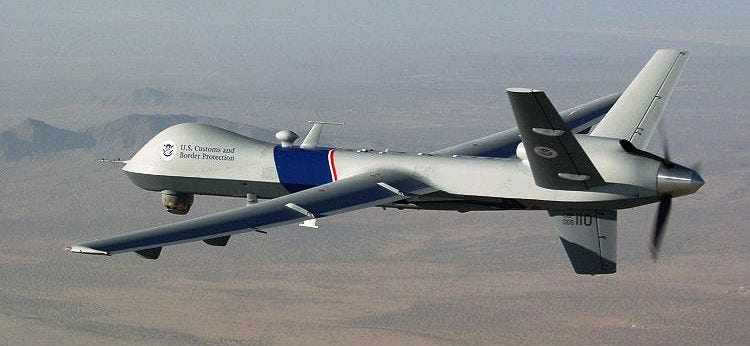
The Air Force describes its primary mission as engaging time-sensitive targets, with intelligence gathering as secondary. The aircraft can carry up to 3,750 pounds of ordnance, including Hellfire missiles and laser-guided bombs. By 2010, Reapers were flying more than 33,000 close air support missions annually in Afghanistan. The platform was reportedly used in the 2020 assassination of Iranian General Qasem Soleimani.
CBP has operated the MQ-9 platform since at least 2012, when it first deployed the aircraft along the Southwest Border. The agency now operates the drones from three National Air Security Operations Centers in Sierra Vista, Arizona, San Angelo, Texas, and Grand Forks, North Dakota. The current contract, worth $274.4 million, covers operations and maintenance.
The platform can fly for up to 30 hours at altitudes reaching 50,000 feet, with a maximum speed of 240 knots. It carries nearly 3,000 pounds of sensors for land and water surveillance. According to a CBP fact sheet, Air and Marine Operations uses the MQ-9 to “increase domain awareness in the land and maritime environments” and “detect, identify, classify, and track potential illicit activities.” The drones carry advanced sensor packages, including electro-optical and infrared cameras, Vehicle and Dismount Exploitation Radar (VADER) for detecting moving targets and performing change detection over wide areas, and SeaVue marine search radar for tracking surface targets in coastal waters.

But the mission has expanded well beyond border surveillance. CBP has flown over 700 hours in support of state and local law enforcement operations. In 2020, the agency deployed a Predator over Minneapolis during protests following George Floyd’s death. This June, CBP flew at least two MQ-9s over downtown Los Angeles in response to ICE raids and subsequent demonstrations.
A recent solicitation for operational and maintenance support describes the system’s capabilities in detail. Contractors will manage a fleet that includes ground control stations, satellite communications terminals, and advanced sensor arrays. The solicitation emphasizes that “any potential contract support must be able to surge to enable focused operations in land or maritime domains as required to meet national security and disaster response requirements.”
The document also notes a significant constraint: due to the proprietary nature of the GA-ASI system, the government only has limited data rights. This means CBP cannot easily transition to alternative contractors without risking “decreased interdictions of transnational criminal activity and increased risk to CBP ground units” due to lack of technical expertise. The agency is effectively locked into General Atomics for the foreseeable future.
Armored for War
ICE has been acquiring armored tactical vehicles originally developed for high-threat military environments. The agency recently increased the ceiling on a blanket purchase agreement for Lenco Bearcats, adding $4.7 million in capacity. Based on historical pricing of approximately $671,000 per vehicle, this suggests ICE has procured between four and seven additional Bearcats for operations in the Midwest and Kansas City area.
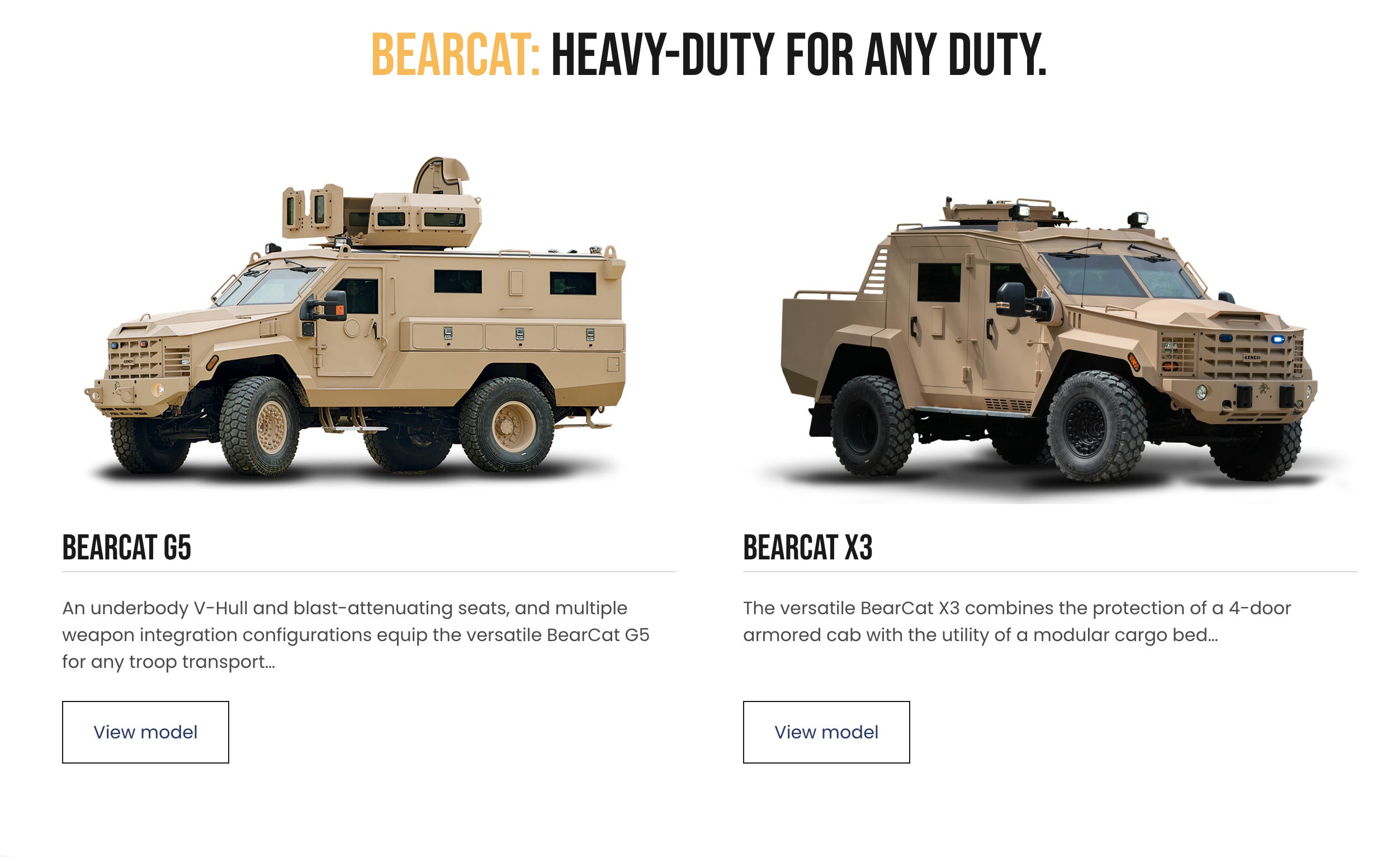
The Bearcat was developed in 2001 with input from the Los Angeles County Sheriff’s Department as the first dedicated police armored vehicle. It features half-inch to inch-and-a-half thick mil-spec steel armor with bulletproof glass rated to stop .50 caliber BMG rounds and blast-resistant flooring designed to withstand IED attacks. More than 5,000 have been produced, seeing extensive deployment in Iraq and Afghanistan before becoming standard equipment for SWAT teams.
ICE also posted a single source notification for 20 Roshel Senator armored tactical vehicles at a total cost of $7.3 million, or roughly $366,560 per vehicle. The Senator entered production in 2018 and provides STANAG 4569 Level II ballistic protection with a V-hull for enhanced protection against mines and IEDs. More than 1,700 units have been delivered to Ukraine since 2022 as military aid. The ICE procurement specifies the STANG 4569 Level 2/B7 configuration, which provides protection against 7.62mm armor-piercing rounds and Level III blast protection.
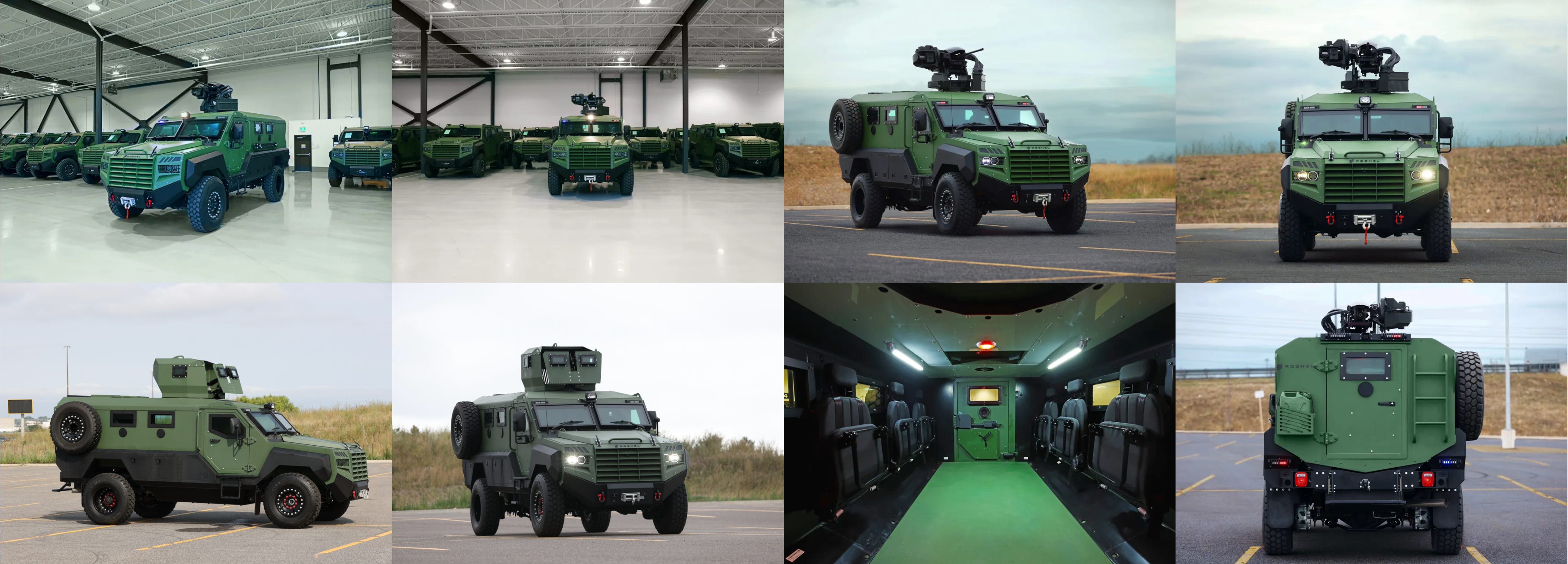
The vehicles are designed to withstand threats that do not exist in routine immigration enforcement. ICE is not facing .50 caliber fire or roadside bombs. Yet it is procuring platforms built specifically for those scenarios.
Redefining the Threat
The procurement pattern aligns with the administration’s redefinition of domestic opposition as terrorism. In September, President Trump issued National Security Presidential Memorandum 7, which directs the FBI’s Joint Terrorism Task Force to investigate “networks, entities, and organizations that foment political violence.”
The directive identifies ideological markers such as anti-Americanism, anti-capitalism, and anti-Christianity as potential indicators of domestic terrorism. The ACLU notes the memo uses “vague, broad labels that, even if true, encompass First Amendment-protected beliefs unconnected to any actual criminal conduct.” Members of Congress warned in a letter that the directives “dangerously conflate constitutionally protected speech and political dissent with terrorism.”
The order tasks the Treasury Department with disrupting financial networks and ensuring organizations that support political violence lose their tax-exempt status. Nonprofits, employees, and donors could face investigation if deemed to aid or abet those engaged in activities the administration characterizes as domestic terrorism.
Meanwhile, the hardware DHS is acquiring was purpose-built for asymmetric warfare and counterinsurgency operations. Reapers were designed to find and eliminate targets in conflict zones. Bearcats and Senators were built to withstand IED attacks and provide armored transport in hostile territory under combat conditions. All three platforms are now being deployed for domestic immigration enforcement.
The administration has provided the ideological framework. The procurement documents describe the operational capacity.
What remains to be seen is the application.