

U.S. Customs and Border Protection wants to collect immigration debt from people its sister agency, ICE, has deported. Before bidding on the overseas collection contract closed on Friday, companies asked the agency how it would work. CBP's answers show it could not say how the people it is chasing are supposed to pay, or who would be allowed to handle their personal information.
The answers came in a question-and-answer document CBP posted to SAM.gov on Thursday, the day before bids were due.

According to the original request for quotes, any outstanding immigration fines must be paid through a federal website, Pay.gov, that only accepts money from a U.S. bank account. Most people who have been deported do not have one and cannot open one.
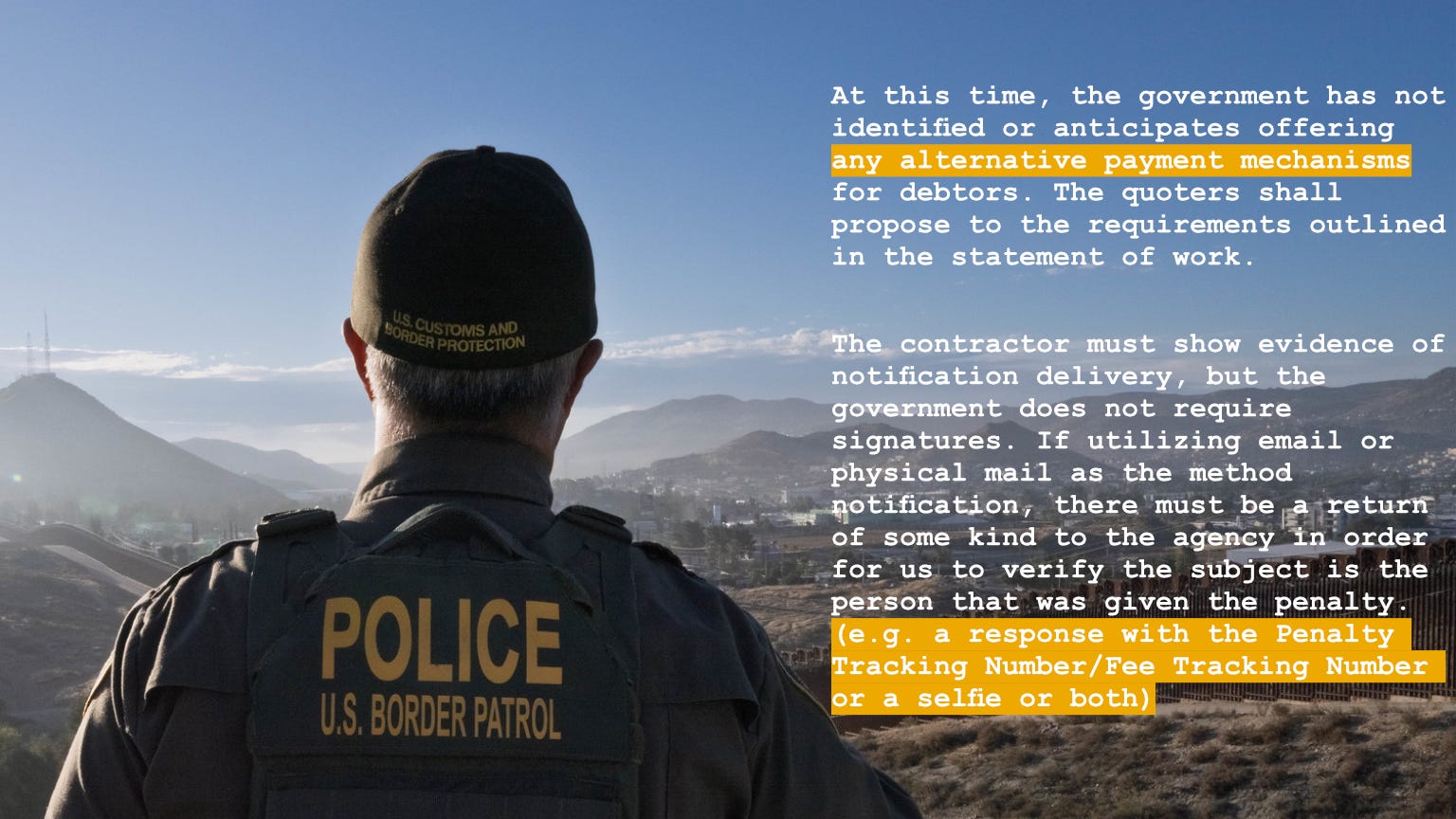
A bidder asked what those people are supposed to do. CBP said it “has not identified or anticipates offering any alternative payment mechanisms,” and that whoever wins the contract will have to propose a fix.
The second question CBP left open was who gets to see a deported person’s private information. To find someone in Mexico, Honduras or Guatemala, a company would hand its workers there that person’s name and last known address. Those workers could be foreign nationals hired abroad.
The three countries are a starting point. CBP said it could add more later by amending the contract, with new pricing negotiated then.
A bidder asked whether foreign workers abroad can be given that information, and how they would be vetted, since U.S. background checks often cannot reach people living in other countries. CBP said it would answer “at its earliest opportunity.” It posted that response the day before bids were due and did not answer the question.
CBP also refused a bidder’s request for more than three business days to submit a bid.
The people being pursued are the same ones the government said it would let off the hook. DHS has promised to forgive these fines for immigrants who self-deport using its CBP Home app. This contract is CBP reversing course in part, targeting people who have already left the U.S.
“Going after folks who are abroad is going to undermine their purported promise to forgive these fines once someone has left the country,” Charles Moore, a senior attorney at Public Justice, told WIRED, which reviewed the contract documents separately.
The contract calls the work “physical observation.” In practice, CBP confirmed, it means going to a deported person's home in another country and confirming they live there. The agency said it will not pay for any of that travel.
The contract is capped at $9 million over two years, which CBP said it will not raise. A company is paid only for the people it reaches, not the ones it cannot find.
To prove it delivered the notice to the right person, a contractor does not need that person's signature. A photo will do — a selfie from the person, sent back with the number that identifies the debt.
In practice, that means someone the contractor hires would need to reach a specific deported person, in Mexico, Honduras or Guatemala, and get them to photograph their own face and return it, along with the paperwork tracking what they owe. The person whose selfie proves the delivery is the same person being pursued for the debt.
Bidding closed Friday. As of Tuesday, CBP has posted no contract award.
Thank you for this update. These people are f'in nut jobs.
Pshhh this is just a way to funnel $$$$$ to favored "contractors." They will just get paid for doing what they can't do. Seems obvious, no? (#corruption)